Showing posts with label science marches on. Show all posts

Saturday, June 9, 2018

Keeping Tabs on Things

Many unposted items

1. Remember Çatalhöyük?

Who could forget that remarkable discovery that gave Anatolia pride of place for the world's first big city? It turns out that one of its investigators may have fudged a bit. A bit of a Piltdown situation, eh what? Though a bit more clever. Now, like the DNA lab that faked some of its results or the detective that planted some of his evidences, all of the data now needs to be revisited. What a bummer.

2. The Outlook for Russia and China

Is not so rosy, according to the Manhattan Contrarian, especially now that they can have a president for life.
Yes, it's the old Roman Empire model for governance.  It seemed like such a good idea when Octavian/Augustus took over in 27 B.C. and ruled gloriously for 41 years of unprecedented power and stability.  But within another couple of decades you had Caligula, followed shortly by Nero, and on downhill from there.  Soon enough, emperors were being assassinated every couple of years by a new guy trying to take over.  Or maybe we should call it the Venezuela model for governance; or the Zimbabwe model; or the Cuba model.  Each of those places had powerful leaders who swept in to great excitement and seemed to many to be by far the best guy to lead the country.  But as dictators the leaders clung to power for life, ran their countries into the ground in their later years, and left no means other than a power struggle to choose a successor.  And, at some point these guys can't quit, because their personal safety is in huge jeopardy as soon as they lose control of the state security mechanism.
 In Russia, the population is stagnating, the economy is stagnating, investment is stagnating. Who's going to invest money in a country where it could get stolen by the kleptocrat the moment you fall out with him? The US, with a population about double that of Russia, attracts ten to twenty times the foreign investment. 

China's economy is up to two-thirds the size of the US, but it has four times the population, so its GDP per capita is smaller than Mexico's or Brazil's and less than one third the size of Taiwan's. On a per capita basis, China is doing worse than Russia at attracting foreign capital. (This is because of their habit of first requiring a Chinese partner for the investor then then appropriating the foreigner's share.)

3. Hail Caesar! Now Buzz Off.

The good news, at least regarding Roman Emperors is that they never had the kind of power that the rulers of our modern scientific states wield. One reads of imperial edicts all the time and they sound very wise or very cruel depending on whether the imperator's wind blows our way or not, but these edicts are really just proclamations of what the emperor said, and whether anyone else in the curia or imperial administration goes along with the gag depends on how persuasive ol' Caesar is -- and how much of a hassle compliance is.
Despite the increasing attempts by later emperors to control affairs across their domains more closely, the Roman Empire was still rather ramshackle in its administration of laws compared to later states. Laws of this kind usually began as a suggestio: a report or statement of a situation needing attention. Officials in the Imperial consistory would then meet and frame a response and, if this response was acceptable to various counsellors and advisers, it would be submitted to the emperor for approval. It would then be distributed to the praetorian prefects, who often added amendments and additions, and then distributed by them to regional governors, who in turn could add to it or amend it to fit local conditions. Finally, it was up to these local officials to see the edict implemented and to enforce it as much as they could. This all meant that what began as a statement of the emperor’s desire could get watered down as it passed down the administrative chain and could also be largely unenforced if the local prefect or diocesan governor was not enthusiastic about the decree. And even if he was, many of these broad statements were very difficult to enforce with any uniformity. As a result, what various laws and decrees said and what actually happened on the ground were often two very different things. The fact that some laws of this kind had to be repeated several or even many times shows that subsequent emperors recognised that previous decrees had gone essentially unenforced and there was often little they could do about this.
Tim O'Neill, Review – Catherine Nixey “The Darkening Age”, History for Atheists (29 Nov 2017)
For example, the edict of persecution against Christians issued by Diocletian and Gratian was mostly ignored by vice-Emperor ("Caesar") Constantius, the father of Constantine. This is a very different milieu than the modern State, whose enforcement tentacles are ubiquitous and rationalized and winked at only at hazard by either subjects or bureaucrats.

 Speaking of ancient emperors and modern tyrants.

4. Sociopaths Rule!

H. sociopatheticus
The estimable Joseph Moore points out the key role of sociopaths in today's society, one of whom he tags as Mr. Zuckerberg, founder of the Book of Faces. Really, sports fans, can anyone suppose that this device was ever intended as anything other than a vehicle for delivering personal information to various advertisers, commercial and political? How do we suppose they made their billions? Remember, the product is that for which someone pays cash money; and where Facebook is concerned, advertisers pay cash money for the eyeballs of the users. You, mi amigo, are the product.

Some advertising guru once noted way back in the days of Mad Men, in between sleeping with their secretaries and each others wives, that only about half of all advertising was effective. The problem was that no one knew which half. And so the public was spattered with twice as many ads as necessary in the hopes that half of them would stick. In the Fifties, it was believed that the sight of a man in a white lab coat using approval-words like "scientific" would entice people to purchase the desired shampoo or toothpaste; but this has changed to images of alluring models clinging to the product and using the approval-word "sexy," thus signalling a new mode of processing sales pitches.

The Lost Generation discovers
sex right in their back yard
A hundred years ago, advertising contained thick blocks of text with complete product specifications. Ho ho. How naive our great grandfathers were! Or else they were more hard-headed and no-nonsense and preferred their sexy babes live and in person rather than in magazines. (There were no televisions.)

The genius of the Book of Faces was to replace broadcast with narrowcast. People hated getting flyers and brochures for crap they didn't care about. So by carefully sorting through people's interests as expressed by themselves, advertisers could ensure sending adverts pretty much to people who had some interest in the material to begin with. So far, so good. No need for Big Brother to spy on us when we could spy on ourselves for free.

Well, you can't expect politicians to pass that up. After all, they are also in the advertising business, and this would enable them to spend their campaign money sending flyers, info, robocalls, and all the rest of that welcome and heartwarming outreach to people who might actually be inclined to listen. (TOF pauses to clean up the hot-beverage-snarfed-out-the-nose from your keyboards.)

So the Great Scandal of Cambridge Analytica was not that they scraped Facebook Data, but that they did so for the purpose of helping the Devil Incarnate, i.e., Donald Trumphiltler and/or Brexit. Had they done so to benefit Hilary Clintonstalin, we would never have heard squeak about it, for then it would have been in aid of Heaven's Purpose, i.e., the Worker's Paradise, or Venezuela. (We know this because no one had a cow about the Obama campaign scraping customer data back in the 2008 election, indeed they were lauded for being "tech-savvy.")

The one thing we have not heard is whether anyone paid the slightest attention to any of the ads that were intended to move them to get out for Trump. Indeed, the fact that people's eyeballs cruise over nasty (or nice) ads seems to have very little influence at all, despite either the boasts of providers of these services or the apocalyptic warnings of the fear-mongers. We are only told that folks were "exposed" to them, as if people were particles devoid of will, moved by mechanical forces. But since the whole purpose of the exercise was to identify those who were inclined to Trump in the first place, it's hard to see the horror of it all. Unless there is Something we're not being told beyond the "boo words" of our information being "weaponized."

Of course, the real danger of the giant rumor mill/echo chamber known as "social" media is that it is simply a set of bubbles and not very social at all. It's a way of sealing ourselves off under the illusion of being "connected." At least, in the old "broadcasting" paradigm you ran the occasional risk of a chance encounter with something that you were not already interested in. A point of view that was not already your own. A product or book or movie that was not already on your radar screen -- and you might, might, decide to give it a shot and find that it wasn't half bad. Or that what the Other Side said about itself was not the same as what Your Side told you that They had said. And your bubble might expand, even if just the tiniest bit.

Or not.

5. Speaking of Russia

Which we were, sorta.

What exactly was the "meddling" which the Russians were supposed to have done? It's not very clear, only that it was surely nefarious, it involved the infamous Internet. and it was engineered by people who do not use articles or the present tense of the verb "to be." Despite all the news stories about how bad the meddling was, it has never been made entirely clear to TOF of what the meddling exactly consisted. Was it like, say the meddling in the Iranian election of 1953 when the CIA helped overthrow the elected government; or the interference in the Chilean election in 1973 with the overthrow [and killing] of Allende.  Or Italy in 1948, or the Clinton-assisted election of Yeltsin in Russia?

No one has ever accused the Russians of being more deft than the US, but it seems that the Russian interference has created barely a ripple on the surface of a still pond, while sundry US interferences have created choppy waters indeed. Surely, the CIA is more adept at this sort of thing. Or is this more like pranking than serious "interference"? To TOF, the term "interference" implies a perturbation in the outcome of the election, or at least in the process. As far as we can tell, the only ones trying to alter the election outcomes are Tammany Hall and its allies in media, academe, and the Deep State.

The Nation, a somewhat left-of-center journal, notes:
A $100,000 Facebook ad buy seems unlikely to have had much impact in a $6.8 billion election. According to Facebook, “the vast majority of ads…didn’t specifically reference the US presidential election, voting or a particular candidate” but rather focused “on amplifying divisive social and political messages across the ideological spectrum—touching on topics from LGBT matters to race issues to immigration to gun rights.” Facebook also says the majority of ads, 56 percent, were seen “after the election.” [emph. added]
-- Aaron Maté, "Russiagate Is More Fiction Than Fact" The Nation (October 6, 2017)
As nearly as TOF can tell, the Russians -- TOF fondly remembers when they were "the Reds" and the Republicans railed agin' them and the Dems favored detente -- supposedly hacked the emails of the Democratic Party and gave them to Wikileaks and furthermore -- and this is the connection with the previous item -- placed Fake News™ on Fakebook in order throw Shade on the Election.

If this last were the Russians' objective, then we must ask ourselves who has been running about casting doubts on the legitimacy of the recent Election, because they are the ones furthering the Russian agenda. But no one seems to be asking that, so we are cast back on wondering anew at the incredible subtlety of the Russians.

Feel the Bern
No one, least of all when they were embarrassing George W. Bush by leaking all that stuff about the Iraq war, suspected that Wikileaks was a secret tool of Russian intelligence. Wikileaks itself claims that the emails came from a disgruntled Democratic insider. (From the appearances, it would seem to have been a Bernie supporter who was disgusted at the way the Party had, against its own rules, taken sides in the primaries against the Bern and for the Hill.) Consequently, enough Democratic Socialists sat on their hands during the elections that the Blue Wall cracked and Mr Trump, after completing his assigned task of wrecking the Republican Party, found himself in unexpected possession of the oval office and to all appearances unsure what to do with it. Mrs Clinton, deceived into expecting a petal-strewn coronation by a worshipful media, found herself gobsmacked by flyover country and unable coherently to account for it.
The "Blue Wall" -- the "reliably Democratic states" -- cracked red in 2016:
A few hundred kilovotes shifted WI, MI, PA. Even MN stayed blue by a mere 44,765 votes.
Darned clever, those Russians, I say. Or was it Comey?
The Russians also apparently planted false or slanted stories in Fakebook -- quelle surprise! -- although TOF has not seen any illustrative examples cited. Since more than half of these ads appeared after the election had already taken place, we are doomed. The Russians have already violated causality. They have found a way to meddle largely after the fact!

However, planting false or misleading stories is a fine old tradition in US politics. Remember when the Democrats (the president of Yale University, no less) spread stories that John Adams was a "hideous hermaphroditical character"? Or the Federalists told us that Jefferson would create a nation where “murder, robbery, rape, adultery and incest will openly be taught and practiced” by Jefferson's Democrats? [OK, so the Federalists came close...] TOF suspects any fables of specific Russian origin would have been lost in the chum of those planted by Democrats, Republicans, news reporters, bloggers, and other free-lance operatives. Any spurious stories about Mrs Clinton, we suspect, would be swallowed only by those already inclined to swallow spurious stories about Mrs Clinton. IOW, not likely to shift any votes. (BTW, the converse is true of spurious stories about Mr Trump. But this is harder to perceive because you already believe those stories and don't realize they are spurious. You are probably still hiding your wimmin from the notorious Mr. Jefferson.)

But no one has provided evidence that anyone previously inclined to vote for Mrs. Clinton voted for Mr. Trump instead as a result of any of these ads, let alone as a result of a specifically Russian ad. Or vice versa. IOW that, as a practical matter, there was any effective meddling by anyone except the DNC, who apparently very effectively torpedoed the campaign of Mr. Sanders.

6. Numbers, We Got Numbers.

Or not.

You have to remember that biology is sorely deficient in numbers when compared to physics or chemistry, and is therefore a sort of Junior Varsity member of Team Science -- at least from the 18th century Scientific Revolution perspective. You may recall that one of the pillars of the Revolution was the privileging of Mathematics as the language of discourse in Science. And so we have equations for Newton's Theory, Maxwell's Theory, Boyle's Theory, Einstein's Theory, and sundry others. But we have, alas, no equations expressing Darwin's Theory.

Well, fair is fair. Math does show up in places in biology, usually in biophysics and biochemistry; but also in genetics and in biostatistics. Although statistics is not the same thing as mathematics. A topic for another day, except that the softer the science, the worse its praxis in statistics. And when the science is social it gets downright mushy.

Case in point, as Rod Serling used to say: correlation. Ever since David Hume (or perhaps since al-Ghazali), correlation has held pride of place over causation because of the inability of inductive reasoning ever to establish causation with any certainty. Correlation establishes only a co-relation between two variables measured on the same unit. This requires:
  • measurements
  • on the same units
An example recently promoted by "The Gift that Keeps on Giving," a.k.a. Jerry Coyne, is that "the happiest countries are the least religious." It is a happy¹ illustration of Thucydides' dictum that people will swallow anything if it accords with their prior beliefs.²

We first note that the Coynester has committed the scientific crime of reifying an abstraction. Countries cannot be "happy" (or "religious"), only a human being can be either.

Second issue: how do you measure "happiness" even on an individual? With a hap-o-meter? (Preferably one calibrated to a standard certified by NIST). This is perhaps more evident a problem to a physicist than to a biologist or a social scientist. The latter in particular is conditioned to accept a questionnaire as an "instrument."

More particularly, did respondents mean the same thing by "happiness" in Bhutan as they did in Tanzania? Was a person who scored a happiness of 6.4 on the "happiness scale" twice as happy as one who scored a 3.2? That is, is the happiness scale a ratio scale? If not, the whole procedure of averaging and correlating is illegitimate to begin with.³ Did happiness ratings within a country form a single statistical population? If not, there may be no average for that country. (What is the average number of testicles possessed by a human being?)

All of the same questions apply to the religiosity scale. What exactly is "importance of religion"? What us meant by a religion? Is shamanism even the same kind of thing as Buddhism?⁴ In those countries possessing established churches, citizens are enrolled in the approved churches for tax purposes, whether they attend that church or not. Does this count? Does pro forma attendance? Does the devoutness of attendees? Who measures such subjective attitudes? How do they do so? With what precision? Does "religiosity" mean the same thing in China as it does in Bolivia?⁴


Notes:
1. happy. Lucky, fortunate. See also may-hap, happen, happenstance, hapless.
2. Thucydudes, History of the Peloponnesian War, IV, 108
3. ratio scale. See Deming, The Statistical Adjustment of Data.
4. Buddhism. Yeah, we know which religion they really mean; but let's go with the flow.


A vital issue: Were the happiness and the religiosity "measured" on the same units (people) or only within the same geographical region (country)?

Imagine trying to determine the relationship between nitrogen content and tensile strength of steel if the two properties were measured on different heats. Even a biologist might hesitate to rely on such results even if he did not notice the metallurgist rolling on the floor laughing his guts out. As a thought experiment, imagine Coyne's reaction to a correlation across US metropolitan areas of the cancer rates in census districts versus the usage of lawn services in those same districts, with no attempt to discover whether the households experiencing the cancers were the same households employing the lawn services!
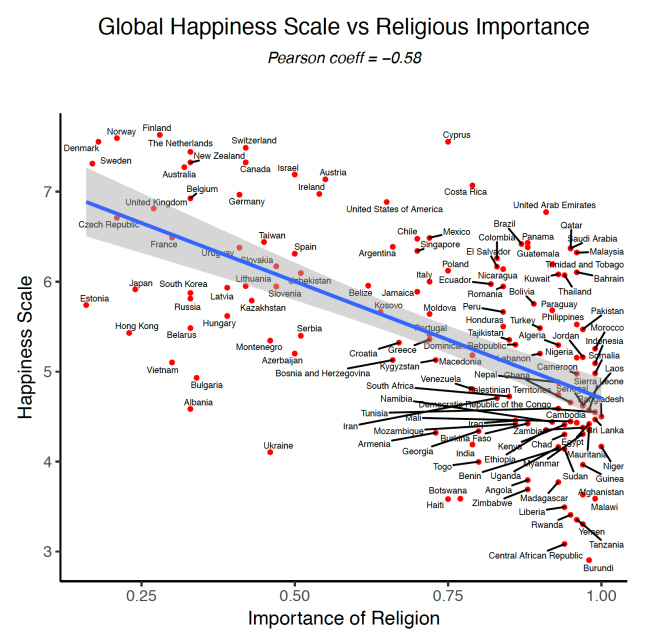
Another issue to be considered is whether one should treat all countries as equal units when they vary widely in size: Singapore is small and compact; Brazil is not.

The reported correlation coefficient is r= ‒0.58. No self-respecting engineer would entertain such a value or r for a New York minute, although TOF has been told that soft "scientists" put much stock in any r greater than zero, provided they have wee p-values. This can be ascribed to their training in "cookbook statistics". But let it be said that you can have a very high "confidence" around a completely wrong value. An r= ‒0.58 means an r²= 0.34. This means that only about one-third of the
variation-in happiness among-countries is "explained" by its association with religiosity of those countries. (Whatever that means.)

But is that even the correlation? A good correlation will often form a 'hot dog' pattern on a scatterplot; a poor one, a 'hamburger.' It is not clear that the scatterplot here is a hot dog or a hamburger with a tail. That is, the weak appearance of a correlation may be due to multiple clusters of points. See below, right. The vast majority of points form an amorphous ball on the right. A second cluster in the northwest consists of Western Europe and a third cluster in the southwest consists of Eastern Europe and East Asia. This is a common pattern on scatterplots: several hamburger clusters so arranged that they line up as a hot dog.

Apparent correlations between X and Y can indeed come about when:
  1. X is a cause of Y
  2. Y is a cause of X
  3. Z is a lurking cause⁵ of both X and Y
  4. coincidence

A hot dog [l.] is actually tow hamburgers [r.].
The correlation in the left hand plot apparently shows that errors decrease with increasing workload on the clerks. The managers were delighted. To reduce errors we will give the clerks more work! But wait. There were two clerks: Adam and Betsy. Betsy was more experienced. She got more work done and made fewer errors than Adam. There was a causal relationship, but it was not between X and Y! It was between Z and X and between Z and Y. (In the actual case, there were four clerks. The case has been simplified for presentation purposes.)

These are all technical issues associated with the use of the statistics; but there are also substantive issues associated with the hypothesis supposedly being tested.

A flawed hypothesis

 Everyone gives lip service to the fact that correlation is not causation, but then turns around and acts as if it were. The Coynester is no exception to this rule and chortles over the "fact" that religion does not result in happiness for its practitioners. (Notice the leap in logic here. That is not even what the data is supposed to show. These are countries, not people.)  But why should anyone suppose that "religiosity" however defined should be expected to entail "happiness" however defined? It may be the opposite case: unhappiness may entail religiosity, at least of certain types. Recall that the Church is sdaid to be a hospital for sinners, not a country club for saints. One would no more expect religious people to be happy than hospital patients to be well.

Furthermore, the original UN survey on happiness concluded that happiness was correlated with other vatiables like social support, GNP, and other factors.People sampled from Western countries were happier because they were wealthier and had more Stuff. not because they were less religious.

Although he is only a biologist, Coyne acknowledges much of this scientific lore, and even admits that religious people may be unhappier because their unhappiness leads them to seek the consolations of religion rather than vice versa; and then suggests that, once their creature comforts are ensured, they can let go of religion.

Perceptive TOFians will realize that since religiosity questions and happiness questions were not asked of the same people, he can' even say that much.

Notes.
4. (a)cross-country comparisons should be made with great care because different countries often use different operational definitions of the variables. Infant mortality is a well-known example. Even within a country, definitions sometimes change. See the Historical Abstracts of the United States for examples
5. lurking cause. A nice article on the subject is Brian Joiner. "Lurking Variables: Some Examples." The American Statistician 35(4): 227-233 (Nov 1981)


7. Instantaneous Propagation of Causation Without Violating Relativity

This is regarded as impossible by non-Aristotelians, but is trivial to Aristotelians. The example is derived from Matt Briggs, based on Heisenberg's interpretation of quantum mechanics.

Suppose you and your buddy Nathan Detroit have agreed to meet tomorrow evening at a social club run by Sky Masterson at six PM for beer and skittles. The probability that you will do so is now P=1.

However, unbeknownst to both you and Nathan, the IRS has raided the joint this very afternoon for running a numbers game -- i.e., something very like the state lottery, but not authorized by the State, and therefore unfair to the betting public -- and has closed and padlocked the establishment. The probability that you and Nathan will meet there tomorrow for beer and skittles has now become intantaneously P=0. There is no speed of light limitation on the propagation of this cause. It became effective immediately [no time lag] everywhere [even widely distant places] once it was served. (Of course, you will not know about it right away, but that is epistemic, not ontic.)

Spooky action at a distance? Who'd'a thunk it?

8.Foam armor

One of the cute features of the Spiral Arm series was a vault warded by a door of marshmalllow. Cf. The January Dancer and the excerpted short story, "Sand and Iron" [Analog, Jan 2008]. Now we have this announcent. Even SF set thousands of years in the future is not safe!
foam aluminum [Wikipedia]
Researchers have discovered that composite metal foam offers greater protection than traditional armor steel plate at a third of the weight. The discovery has broad implications for armored vehicles, and could result in stronger, lighter vehicles better able to protect occupants from the impact of kinetic weapons, explosive shockwaves, and fires.
Scientists at North Carolina State University and the US Army’s Aviation Applied Technology Directorate have invented what they call Composite Metal Foam (CMF). “Metal foam” is exactly what you think it is—metal with sponge-like holes in it.







Friday, March 17, 2017

The March of the Tabs

March comes in like a lion, the proverb says, and this is surely true of the march of the tabs, which have accumulated unpruned on TOF's tab-bar over the unruly winter months, frozen on the branches like cherry blossoms in global warming. Hereunder, with appropriately short shrift:

1. "Everything Old is New Again" Remember the torrential rains in California this past winter? The following article appeared in Scientific American back in 2013:
THE INTENSE RAINSTORMS SWEEPING IN FROM the Pacific Ocean began to pound central California on Christmas Eve in 1861 and continued virtually unabated for 43 days. The deluges quickly transformed rivers running down from the Sierra Nevada mountains along the state’s eastern border into raging torrents that swept away entire communities and mining settlements. The rivers and rains poured into the state’s vast Central Valley, turning it into an inland sea 300 miles long and 20 miles wide. Thousands of people died, and one quarter of the state’s estimated 800,000 cattle drowned. Downtown Sacramento was submerged under 10 feet of brown water filled with debris from countless mudslides on the region’s steep slopes. California’s legislature, unable to function, moved to San Francisco until Sacramento dried out—six months later. By then, the state was bankrupt. 
It gives the usual nod to "but this time the rains will be worse because global warming blah-blah-blah," but it's hard to overlook the pre-emptive catatastrophes that look so much like those of today.  

However, when the "rivers in the sky" were reported during the California deluge this winter, none of this background was reported. This was not likely because they wished to conceal the context, but because the needed more air-time for commercials. These days, you may notice they sometimes don't have enough time to complete a sentence. 

2. La Grande Scazzottata Copernica is up. If you read Italian, enjoy it.

Friday, February 24, 2017

Friends Don't Let Friends Do Stats

A recent story by NBC News [sic]

Female Doctors Outperform Male Doctors, According to Study

Patients treated by women are less likely to die of what ails them and less likely to have to come back to the hospital for more treatment, researchers reported Monday.
If all doctors performed as well as the female physicians in the study, it would save 32,000 lives every year, the team at the Harvard School of Public Health estimated.
Thus does NBC summarize the paper "Comparison of Hospital Mortality and Readmission Rates for Medicare Patients Treated by Male vs Female Physicians" by Yusuke Tsugawa, MD, MPH, PhD; Anupam B. Jena, MD, PhD; Jose F. Figueroa, MD, MPH; et al.

(I wish I knew who Et Al. was. Gets his name on a lot of papers, it seems.)

NBC "News" tells us
“The data out there says that women physicians tend to be a little bit better at sticking to the evidence and doing the things that we know work better.”
Apparently male doctors practice medicine regardless of what the evidence dictates. Worse, they are paid more for their foolish and dangerous behavior.

Alas, Tsugawa and his co-authors did not actually measure how doctors practiced. So even if the 30-day mortality and readmission rates differed between male and female doctors, the researchers had no way of knowing why they differed; and ipso facto neither would NBC. Someone was blowing smoke because the newsmog cannot abide a story that doesn't give a paradigm-conforming reason. Sticking to the evidence? Forsooth..
Design, Setting, and Participants  We analyzed a 20% random sample of Medicare fee-for-service beneficiaries 65 years or older hospitalized with a medical condition and treated by general internists from January 1, 2011, to December 31, 2014. We examined the association between physician sex and 30-day mortality and readmission rates, adjusted for patient and physician characteristics and hospital fixed effects (effectively comparing female and male physicians within the same hospital). As a sensitivity analysis, we examined only physicians focusing on hospital care (hospitalists), among whom patients are plausibly quasi-randomized to physicians based on the physician’s specific work schedules. We also investigated whether differences in patient outcomes varied by specific condition or by underlying severity of illness.
That just sounds scientificalistic as all hell, dunnit? And hospitalists? Who knew? TOF always thought they were "doctors."
Conclusion: Patients treated by female physicians had lower 30-day mortality (adjusted mortality, 11.07% vs 11.49% …) and lower 30-day readmissions (adjusted readmissions, 15.02% vs 15.57% …) than patients cared for by male physicians, after accounting for potential confounders.
It is important to realize that the researchers were not as bold as the newsreaders. They wrote under Key Points:
Differences in practice patterns between male and female physicians, as suggested in previous studies, may have important clinical implications for patient outcomes.
TOF notes a few cautions:

Caution #1. The mortality difference was 11.1% vs. 11.5%. We caution you not to clutch your pearls too tightly over this chasm-like gap.

Caution #2. These were "adjusted percentages." That means the actual percentages were something else and the researchers tweaked the numbers to make them "all else being equal." That is, the reported %'s are the result of a model. The uncertainty of the model was not mentioned. One suspects it may have been more than 0.4%-points.

Caution #3. There were about 1,000 "all elses" that were equalized. These are called co-variates in stat-lingo. That's a heckuva lot of co-variates, leading to the possibility of multi-collinearity. This is when two or more covariates are themselved correlated with each other. If this happens, the model is over-determined and the estimates may be flawed. One is more likely to obtain an uninterpretable swamp. Did they check the Variance Inflation Factors and eliminate superfluous covariates? Inquiring minds want to know.


Caution #4. NBC simply said "patients," but the mean age of these patients was about 80 years old and the first rule of sampling is that the results cannot be generalized to populations that were not subjected to the sampling.

Caution #5. Female doctors were about 5 years younger on average, and female docs also treated many fewer patients on average than men. This implies women docs had more time per patient.

Caution #6.  The report says, “female physicians treated slightly higher proportions of female patients than male physicians did.” Since females tend to live longer than males, especially at advanced age, this would present as a higher survival rate for the patients of female doctors, not because of the doctors' skills but because of the patients' longevity. Is that the reason? TOF does not know, and neither do you or NBC.
One species of "Fake News" is when the reporter doesn't know what he's writing about, which is often the case, especially in technical subjects. The problem is that most scientific papers are wrong.
Most published scientific research papers are wrong, according to a new analysis. Assuming that the new paper is itself correct, problems with experimental and statistical methods mean that there is less than a 50% chance that the results of any randomly chosen scientific paper are true. -- New Scientist
Most clinical researchers, while experts in their fields, are not experts in statistics and tend to find significant results that aren't there, especially if they want to find them. What is almost as bad, if not worse, is when they took Intro to Stats back in college and learned a cook-book approach to "number crunching." The on-going obsession with p-values and tests of significance often overlooks two things:
  1. Statistical significance is not causal significance.
  2. Statistical significance applies to the parameters of the model, not to the actual data.
Therefore, findings from such models tend to be overconfident.


Wednesday, July 6, 2016

Lighting up the Brain


Hey, ya ever see those brain image scans where they pretend they took snapshots of actual brain activity (rather than say model outputs of oxygen consumption is various regions)? Turns out there may be a slight problem:

Friday, May 13, 2016

The Demise of Free Guessing

It must be something in the water. Two more psychology "scientists" have been deceived into thinking that they have run an experiment on free will. But by the terms of their own analysis, they are mistaken. If we observe ourselves (unconsciously) perform some action, like picking out a box of cereal in the grocery store, and only afterwards come to infer that we did this intentionally, then Bear and Bloom must have observed themselves (unconsciously) perform an action like running an  experiment in the psych "lab,"and only afterwards came to infer that they did this intentionally. IOW, if we first pick up the box of Wheaties, then decide to choose it -- hmm. I perceive a box of Wheaties in my hand, so I believe I must have chosen it -- then how does this not apply to the decisions the experimenters think they made?

Tuesday, November 10, 2015

Missing Inaction

Where did they go? You must remember them! A few years ago, they were everywhere. Celebrities spoke of them in the hushed and rapturous tones usually reserved for pyramid power or acupuncture. There was hardly a thought-manager who neglected to tell us of the wonders they would bring. We can "resist the onslaught of time’s vulture." They would provide "answers that have so long been beyond our grasp." They constituted "one of the most promising areas of research."

Troglodytes and religious fundamentalists raised barriers that would result in patients "suffer[ing] needlessly" and "put many critical future advances in medicine beyond the reach of patients in the United States."

Yes, it's good ol' Human Embryonic Stem Cells, that were gonna cure Parkinson's, Alzheimers, and all the rest. That's if anyone could get past that bodily rejection thingie.Those who were opposed to grinding up embryos to make their bread were ridiculed as "anti-science" and the opposition of the Church was called, as was her earlier opposition to eugenics, another episode in the "war of religion on science."

I wonder if they would have also called those opposed to Nazi experimentation on Jews "anti-science"? Yes, I know. Godwin's Law and all that. But the point is that not every instance in which people put on white lab coats is quite the same.

Now, the only thing being opposed was killing human embryos in order to obtain stem cells to experiment with. No one was objecting to the use of non-human embryonic stem cells or of human adult stem cells (like bone marrow). And the usual course of research had been to work on animal models before going on to humans, so a few folks were bemused by the rush at that early stage to jump directly to the human subject. It's not as if benign therapies were going to burst fully formed from the brow of Zeus.

Well, science, as it often does, surprised the activists and in 2007 a Japanese researcher Shinya Yamanaka discovered how to "regress" ordinary cells to stem cell status ("induced pluripotent stem cells"). He was awarded the Nobel Prize in Medicine for this in 2012. There is an obvious benefit in that tissues can be developed in this way from a patient's own cells, thus bypassing the rejection problem. And you didn't have to kill anyone to get them.

For a while, activists pooh-poohed regressed cells and claimed they were somehow not as good as embryonic stem cells. It was almost as if the goal was not scientific discovery but simply to use embryonic cells, period. When necessary, they touted results achieved with "induced pluripotent stem cells" as simply "stem cells" so they could chide those who had opposed the use of embryonic stem cells. See? THEY would have prevented this beneficial result! Meanwhile, cases like this one raised caution flags over the use of embryonic stem cells. Such stem cells are programmed to proliferate, and the risk that they will result in runaway tumors is quite real.

Now, in a paper in Nature Biotechnology, Choi (et the usual al.) finds that induced and embryonic stem cells "are molecularly and functionally equivalent and cannot be distinguished by a consistent gene expression signature."

As time passed and induced stem cells became the preferred research material, noise about stem cell research has quietly faded from the news-smog. It's almost as if the point had always been to find a reason to use embryos.

Thursday, September 10, 2015

Marilyn Monroe, melting glaciers, and aliens

We're Having a Heatwave


TOF thought it might amuse his Faithful Reader to post here an excerpt from The Shipwrecks of Time, a novel in progress, in which characters mention things that were au courant back in 1966. There is a thunderstorm in Milwaukee and.... 

Friday, May 8, 2015

Odds and Ends


In the End, They Always Eat Their Young

This is just as funny as Richard Carrier outing himself as a polyamorous-American. (Hinting why atheist conventions are no-fly zones for women.) An organization calling itself Atheist Ireland dissociates themselves from one PZ Meyers because the latter is too intemperate. Meyers for his part attacks Dawkins, Hitchens, and others. There is blood in the water, amigos. Recall Kissinger's remark when Saddam Hussein and the ayatollahs went after each other. But to those of us who remember the 60s the faction-forming, fissioning, and infighting is all very familiar. "Atheism +" for those out of the loop who did not receive the memo, is "atheism plus feminism, environmentalism, [secular] social justice, etc." A fine illustration of the totalizing tendencies in that region of the spectrum. Diversity will not be tolerated. Orthodoxy will be enforced, even in so heterodox a place as "free" thinking.

300 Years of Philosophical Squid Ink

Philosopher John Searle (he of Chinese Room fame) slaps early modern philosophy across the chops with a dead fish. He's not quite there yet, but he does see the problem. Way too many people will post comments like "Hume proved that causation is not demonstrable" or "Kant proved that we only experience our sensations, not the outside world" -- or even that they "refuted" the Cosmnological arguments -- without any inquiry as to how they might have done these things. Fortunately, natural scientists gave only lip service to Hume and continued to be closet Aristotelians in most things.

Useful Road Signs

Caution: Science Ahead
h/t Dr Boli

The Nanotech Chronicles

In The Washer at the Ford and then again in one of the Firestar books, TOF featured in passing nanomachines that would disassemble harmful molecules or otherwise render them harmless. Now science is catching up with fiction. "Two years ago, [Professor Thalappil Pradeep and] his team developed ... a combination filter that kills microbes with silver and breaks down chemical toxins with other nanoparticles. It’s portable, works at room temperature, and doesn’t require electricity." This is a tremendous accomplishment in providing potable water in ill-watered regions. It is also why drinking vessels in ancient times were so often made of or lined with silver [or gold]. It was not so much a flaunting of wealth as a health measure!

Wasn't One Enough?

In an article breathlessly titled "The Man Who May One Up Darwin" we are told of Prof. Jeremy England who is explaining how life may emerge from non-life, despite-or-because he is a devout Orthodox Jew who prays three times a day.
"Under the right conditions, a random group of atoms will self-organize, unbidden, to more effectively use energy. Over time and with just the right amount of, say, sunlight, a cluster of atoms could come remarkably close to what we call life. In fact, here’s a thought: Some things we consider inanimate actually may already be 'alive.'" 
It's all models and equations right now, but who knows. The problem with any of these inevitable-outcome-of-natural-processes ideas is that by implication life ought to be starting up all the time, here, there, and in milady's chambers. Well, "under the right conditions," whatever they are. Yet it seems to have originated only once in the course of Earth's history. Howcum? Or maybe, as suggested by the dazzling novella "Where the Winds Are All Asleep," it has happened more than once!

VE Day

David Warren has a tribute to the Canadian troops who liberated Holland. Mark Shea salutes his father for winning the war single-handedly.

Super-Heroes Who Did Not Make the Cut

Dr. Boli provides a list, of which my two  favorites are:
  • The Plant. Has awesome vegetative power that can crack sidewalks and split rocks. Moves very, very slowly, so evildoers never notice him until it’s too late.
  • The Accountant. His preternatural ability to detect financial irregularities has stopped many a supervillain’s evil plan.

Wednesday, December 31, 2014

Science Marches On

TOF first ran across the notion of humans in America prior to the American Indians in a fiction! It was "Beringia," a 1990 story by Poul Anderson in his Time Patrol book The Shield of Time. It follows Wanda Tamberly, a time patrolman who has been studying this pre-Indian people (and has grown attached to them) when a band of Indians finds its way across the Bering Land Bridge. They bully the indigenous people (because they can. They are technologically more advanced.) But even when they don't, they over-awe the natives. But they also fear the native's powers of magic. After all, they are in their country and feeling very insecure, having fled their own land. Everything hits the fan, there are causal loops, and the time patrolman has to salvage her own reputation, too.

Wednesday, December 17, 2014

Duhem on Physical Theory and Experiment

Let's see if this works. It should come out as a slide show.
Duhem on Physical Theory and Experiment


which outlines Pierre Duhem's takedown of falsification and positivism. 

Tuesday, September 16, 2014

Clearing the Tabs

Deja Vu All Over Again
Check out the four video clips here. Plus ça change and all that. Clinton is especially interesting, though no one later accused him of lying.

How to Spot Bad Science

Friday, June 13, 2014

This is Science!

Careful what you say!
On Gwyneth Paltrow's blog, appropriately named goop, one finds the following insights into natural science:
I [Gwyneth Paltrow] am fascinated by the growing science behind the energy of consciousness and its effects on matter. I have long had Dr. [Masaru] Emoto's coffee table book on how negativity changes the structure of water, how the molecules behave differently depending on the words or music being expressed around it. Below, Dr. [Habib] Sadeghi explores further.
Said Dr. Sadeghi explains:
Japanese scientist, Masaru Emoto performed some of the most fascinating experiments on the effect that words have on energy in the 1990’s. When frozen, water that’s free from all impurities will form beautiful ice crystals that look exactly like snowflakes under a microscope. Water that’s polluted, or has additives like fluoride, will freeze without forming crystals. In his experiments, Emoto poured pure water into vials labeled with negative phrases like "I hate you" or "fear." After 24 hours, the water was frozen, and no longer crystallized under the microscope: It yielded gray, misshapen clumps instead of beautiful lace-like crystals. In contrast, Emoto placed labels that said things like "I Love You," or "Peace" on vials of polluted water, and after 24 hours, they produced gleaming, perfectly hexagonal crystals. Emoto’s experiments proved that energy generated by positive or negative words can actually change the physical structure of an object.
Getting all Emoto-nal
It's difficult to argue with such hard science experiments as that; so be careful what you say around the office water cooler. Molecules can not only be selfish (as is the case with genes) but can also grow depressed or elated depending on what they overhear or (in Emoto's case) read. Well, science marches on and all that.


Meanwhile, much anxiety is expressed over creationists, a group of people anxious that their beliefs should be accepted as Really Truly Science!™  None of the Taste-Makers in Late Modern Society would be caught dead associating with their ilk and will mock them as "science-deniers" (rather than more truthfully as "science wanna-bes"). They are about as dangerous as anyone outside the Iron Gates.

Folks like Paltrow, however, are already within the gates, and her occult beliefs are accepted at all the best salons and cocktail parties and will circulate through the minds of all the bien pensants along with the vague notion that it has all been "proven" by pukka "scientists."

But surely even liberal as well as conservative devotees of reason can join hands on this tripe. The Real World™, TOF regrets to inform, isn't actually like that.

Saturday, May 31, 2014

More Odds and Ends

Today, TOF presents for your delight a Quote of the Day, a Science! Marches On!, and a Statistical Puzzle for you to solve, among the usual sundry miscellany.

Quote of the Day

"An enemy is just a friend who wants to kill you." – Doug TenNapel
 

Elephant in the Room

"Boko Haram has been carrying out atrocities for years. The group has murdered thousands and caused thousands more to flee. It has burned churches with people inside them; it has massacred people in the streets. But until now, the Western media has paid little attention. Why the change?

Here’s a possible explanation: the majority of Boko Haram’s targets and victims have been Christians—according to one estimate, something like 60%. In fact, 60% may understate things. Boko Haram considers schools and places of entertainment  “Christian” institutions, so one should see attacks on those places as part of an anti-Christian campaign as well. In fact, although it hasn’t been widely reported, Chibok is a predominantly Christian city, and most of the kidnapped schoolgirls are Christians. That was the point."
-- Mark Movsesian, "Choose Your Victims Well"
The term "boko" is derived from the English word "book."  "Haram" means "unclean."

Revenge of the Scotsman


A: “All fish breathe through gills rather than lungs.”
B: “But whales are fish, and they breathe through their lungs.”
A: “Whales may look and seem like fish, but they aren’t truly fish because they breathe through their lungs.”
-- Amod Lele, "The No True Fish Fallacy"

Think about this one the next time someone tries to pull the "No True Scotsman Fallacy" fallacy. There are formal fallacies and material fallacies, and the latter are only fallacies depending on the matter of the proposition, not the form.

We Were Expecting an Auto Race

"Cycling Event Kicks Off Bike Month in Toronto"--headline, CityNews.ca, May 26

Despite

"Despite Enrollment Success, Healthcare Law Still Unpopular"--headline, Gallup.com, May 29

What if They Gave a Winter Olympics and Nobody Came Because They Had No Place to Go

"No Countries Want to Host the 2022 Olympics"--headline, ABCNews.com, May 28

Science!™ Makes Astonishing Breakthrough

"Tired All the Time? Maybe You Need More Sleep"--headline, Philly.com, May 29


A New Concept of Bipartisanship

h/t Mark Shea
At a recent commencement speech at West Point, President Obama called for closing Gitmo and blasted the U.S. for spying on innocent civilians.  We need to find out who's been president all that time.

No Sh*t?


"U.N. Vows to Eliminate Open Defecation by 2025"--headline, Inter Press Service, May 28
They're going to... "eliminate" it...

Science Marches On!


"Does Porn Affect the Brain? Scientists Urge More Study"--headline, Agence France-Presse, May 29

Computers Are Taking Over!


"New 'Electric Brain' Records Store Sales, Gives Receipts"
--headline, Reading (Pa.) Eagle, Jan. 24, 1938

Solve the Statistics Puzzle! It's Fun, Boys and Girls!

"More than half of the world's 671 million obese people live in the U.S., China, India, Russia, Brazil, Mexico, Egypt, Germany, Pakistan and Indonesia."

Saturday, May 10, 2014

Somebody Paid Money for This UPDATED!

A Devoted TOFling yclept Guy Stewart writes:
"While reading io9 (which I enjoy a lot), I came across this article: “Are Religious Beliefs Going To Screw Up First Contact?”

Based on: “...[clinical neuropsychologist Gabriel G. de la Torre]…sent a questionnaire to 116 American, Italian, and Spanish university students.”

Reached this conclusion: “…he found that many of the students — and by virtue the rest of society — lack awareness on many astronomical aspects. He also learned that the majority of people assess these subjects according to their religious beliefs.”

As a statistician, what do you make of the significance of the conclusion of this survey?

To which TOF responds: "Not Much."

Monday, March 3, 2014

What's Wrong With the Cosmos?

Cosmos: A Spacetime Odyssey - Standing Up in the Milky Way
Season 1 Episode 1
Giordano Bruno's spiritual epiphany about the universe; a compressed version of the cosmic calendar.

'Nuff said.

Monday, January 27, 2014

Science Marches On!

Spanish researchers discover the first black hole orbiting a “spinning” star
-- headline, Astronomy Magazine (January 16, 2014)

Stephen Hawking: 'There are no black holes'
-- headline, Nature (24 January 2014)
+++
 And speaking of black holes...

Tuesday, November 26, 2013

Ye Olde Psychopath

In an amusing article in Smithsonian Magazine, a brain scan researcher discovers that he is a psychopath:


Quote:
[James] Fallon seeks to reconcile how he—a happily married family man—could demonstrate the same anatomical patterns that marked the minds of serial killers.

“I’ve never killed anybody, or raped anyone,” he says. “So the first thing I thought was that maybe my hypothesis was wrong, and that these brain areas are not reflective of psychopathy or murderous behavior.”
But no, a scientific theory is never discarded because of contrary evidence. 
[W]hen he underwent a series of genetic tests, he got more bad news. “I had all these high-risk alleles for aggression, violence and low empathy,” he says, such as a variant of the MAO-A gene that has been linked with aggressive behavior. Eventually, based on further neurological and behavioral research into psychopathy, he decided he was indeed a psychopath—just a relatively good kind
Doncha love it?  The theory can't be wrong.  The correlations can't be merely correlative.  He has to be a good psychopath.  This would be like discovering:
  • a study of ballet dancers reveal genetic markers for strong ankles
  • Joe has genetic markers for strong ankles
  • Therefore, Joe (who does not dance) is a new kind of ballet dancer: the non-dancing ballet dancer!
Is there nothing the New Phrenology can't discover?

Tuesday, November 12, 2013

Summa origines scientiarum: Articulus 2

Article 2. Whether the Scientific Revolution was uniquely Western. 

Objection 1.  It would seem otherwise, because Western science grew out off the natural philosophy of ancient Greece, especially from Aristotle, Euclid, Galen, and Ptolemy.  Also, Demokritos proposed a theory of atoms and Aristarchos proposed a heliocentrism, so in many ways Greek science was far ahead of medieval and early modern Europe.  Therefore, the Scientific Revolution started in ancient Greece.

Objection 2.  Furthermore, Western science was backward compared to Islamic science, and the West learned of Greek natural philosophy through Arab intermediaries.  Therefore, the Scientific Revolution began in the House of Submission and not in the House of War.

Objection 3.  Also, China anticipated many of the advances and discoveries of Western natural philosophy.  For example, the 11th century accomplishments of Shen Kua  included: the first discussion of magnetic declination, the application of permutations in traditional Chinese mathematics, a proposal to maintain daily records of lunar and planetary positions, the first suggestion in East Asia of a purely solar calendar, and an explanation of the process of land formation by both deposition of silt and erosion.  Thus, China also had a Scientific Revolution.

On the contrary, physicist Stanley Jaki has written that “the Scientific Revolution was stillborn in every other civilization.”

Prometheus Awards: Read & Watch

 Hello Friends & Fans of Michael Flynn,       The Libertarian Futurist Society has made available the text of the acceptance speech Dad...