Showing posts with label jihad. Show all posts

Friday, March 17, 2017

The March of the Tabs

March comes in like a lion, the proverb says, and this is surely true of the march of the tabs, which have accumulated unpruned on TOF's tab-bar over the unruly winter months, frozen on the branches like cherry blossoms in global warming. Hereunder, with appropriately short shrift:

1. "Everything Old is New Again" Remember the torrential rains in California this past winter? The following article appeared in Scientific American back in 2013:
THE INTENSE RAINSTORMS SWEEPING IN FROM the Pacific Ocean began to pound central California on Christmas Eve in 1861 and continued virtually unabated for 43 days. The deluges quickly transformed rivers running down from the Sierra Nevada mountains along the state’s eastern border into raging torrents that swept away entire communities and mining settlements. The rivers and rains poured into the state’s vast Central Valley, turning it into an inland sea 300 miles long and 20 miles wide. Thousands of people died, and one quarter of the state’s estimated 800,000 cattle drowned. Downtown Sacramento was submerged under 10 feet of brown water filled with debris from countless mudslides on the region’s steep slopes. California’s legislature, unable to function, moved to San Francisco until Sacramento dried out—six months later. By then, the state was bankrupt. 
It gives the usual nod to "but this time the rains will be worse because global warming blah-blah-blah," but it's hard to overlook the pre-emptive catatastrophes that look so much like those of today.  

However, when the "rivers in the sky" were reported during the California deluge this winter, none of this background was reported. This was not likely because they wished to conceal the context, but because the needed more air-time for commercials. These days, you may notice they sometimes don't have enough time to complete a sentence. 

2. La Grande Scazzottata Copernica is up. If you read Italian, enjoy it.

Thursday, August 11, 2016

Deus vult! Part III: I have come in order to die

Back in March and April, TOF began a series on the Crusades, but shortly after a wasp broke his humerus. This has distracted him since from any but trifles. It is now time to resume the narrative.

Hmm. His list of pending blog posts includes also America's Next Top Model and In Psearch of Psyche, both of which have fallen into a black hole. In fact, there may be other series of which I have entirely forgotten. Time to shrug into motion, sez I.

In Deus Vult! Part I, we reviewed in the form of a chronology four hundred years of muslim aggression against Christendom, a region known to the muslims by the subtly suggestive name "House of War." Technically, India, China, and sub-Saharan Africa also live in this house, but at this point in history, most of the action is in the West. India is pending on their to-do list, and China has been kicked out of Afghanistan.¹ Africa will have to wait because there is nothing there that the muslims want, except slaves.

In Deus Vult! Part II, we encountered the Standard Model of the Crusades as an unprovoked  incursion by boorish oafs (as well as oafish boors) into the suave and sophisticated House of Submission. This model was constructed by Marxist historians and their camp followers, who were writing in the twilight of the Age of Imperialism, and consequently, in that marvelous way we have of seeing ourselves wherever we look, saw the Crusades as an earlier version of the Age of Imperialism. No one thought to ask how all those muslims got all over everywhere in the first place.² Could be the Crusades were an anti-imperialist movement! What is the statute of limitations on conquest?
Notes:
1. Afghanistan. One of the reasons the Islamists keep blowing up antiquities from Buddha statues to Palmyra to Cyrene is that they don't like reminders that Others had been there before them and built great works. The Wahhabis have scoured the Peninsula of any trace of the Turkish occupation, or indeed of early Islam itself.    
2. in the first place. For example, TOF recently watched a series on the Old West that involved in part the obnoxious taking by the whites of the Black Hills from the Lakota. Was there any mention that the Lakota had previously taken them from the Cheyenne? Or the Cheyenne from the Arapaho? Even to ask the question is to answer it.

On Your Mark

IN THE STANDARD MODEL, the crusaders were imagined as second sons with no inheritance, as robber barons, as highwaymen, or as others with nothing to lose out to get rich on the fabled wealth of the Orient. More recently, historians have started to look at the surviving data (such a marvelous thought!) and have found that this was not the case.

The pilgrimage to the East was self-funded, for one thing. No one was paying the knight's plane tickets. In fact, there were no planes!³ So everyone had to get there on his or her⁴ own.
Notes
3. no planes. On a positive note, this meant no one could hijack them or fly them into the Hagia Sophia. Well, not until 1204, anyway.  
4. her. You heard me. Of the 150,000 people who took the pledge, the majority were women, the poor, and the elderly. These were asked to stay at home and pray for success. They would get in the way of the more muscular pilgrims. Spaniards were also asked to stay home. They had their own crusade to attend to. But by the somewhat libertarian nature of medieval society, no one other than a sworn lord could outright forbid anyone from engaging in pilgrimage and many went anyhow. Some of the lords brought their wives and families.
Whoa! Out of my way, pilgrim!
Crusading was expensive, up to five times one's annual incomes. (Louis IX’s Seventh Crusade⁵ in the mid-thirteenth century will cost more than six times the annual revenue of the Crown.) To cover the nut, knights and lords sold freeholds, settled property disputes at a disadvantage, liquidated estates, borrowed from relatives, submitted grant proposals, and maxed out their credit cards. This was so extensive that preparations for the First Crusade introduced considerable inflation into Western Europe⁶ and instigated a net flow of wealth from West to East. (So much for getting rich on the wealth of the East.) One of the reasons why the Fourth Crusade will get hijacked to Constantinople was that it will run out of money before it even gets rolling.

They sold off their wealth with no expectation of an ROI. (In fact, except for maybe a few stray Lombards, they may not have known what an ROI was! There was not a single MBA in all Europe. Which may explain their prosperity.)

Yes, prosperity. They had to raise that money from somewhere. Global warming was in full swing, lengthening the growing season, expanding the arable land, increasing the harvests. Had Europe been poor, she could not have afforded these expeditions. 

Only about 40,000 of this total actually marched east. They did not all go together, and many did not complete the journey but turned back when their funding dried up. It was not an organized expeditionary force. It was 40,000 knightly or lordly dudes and their dependents all going in the same general direction for more or less the same purpose at approximately the same time.

That purpose was to make pilgrimage to the Sepulcher in Jerusalem, and the time was 15 Aug 1096. That's right, sports fans! This is the 920th anniversary of the kick-off to the First Crusade. Woo-hoo!
Notes
5.
Louis IX’s Seventh Crusade. I wish we could have had Louis VII's Ninth Crusade, too, but the math doesn't work out.
6. considerable inflation. Later crusaders will take this into account and begin saving up for the journey years ahead of time, a sort of medieval layaway plan.
Don't call me Shirley!
PILGRIMAGE? The Marxist historians of yore could not credit such a thing. Since neither they themselves nor their camp followers believed in religion, they could not believe that others actually did. It must be social cover, it must be hypocrisy. Surely, they could not have been serious! Perhaps they did not believe that rough and tumble warriors could also be pilgrims.⁷

But they were. That the expedition was a cynical exercise in Realpolitik is a Modern illusion suffered by those who see their own beliefs fortuitously reflected in the past. Oh, surely among 40,000 warriors and their dependents there were some cynics and hypocrites, there were some looking to get rich, just as there are in today's NGOs. But remember, no one ordered them to go, they were not sent, they did not belong to an army. They each took a pledge individually to make the journey. The pledge was to God, not a king or baron. They were not even volunteers in the sense of the "All-Volunteer Force," because they were not joining an organization. They were all free agents, not team players.

In fact, they saw themselves as bound on an errand of mercy. The crusade was to be an exercise in charity (Riley-Smith, 1980). The muslims had taken the lands of Christ: his birthplace, his tomb, Antioch (where his followers were first called Christians), the homeland of the Cappadocian fathers, the patriarchate of Alexandria (second only to Rome in honor), the sites of three of the first four Councils. And it was the duty of every sworn vassal to recover the lands of his lord from the enemy. In this case, they had sworn fealty to Jesus. The lord was the Lord, and they were off to reclaim His lands.
Notes
7. warriors/pilgrims. When this was bruited recently in a comm box elsewhere, a correspondent took umbrage and claimed that calling them pilgrims made them seem harmless. Another example of modern picture-book understanding replacing actual historical context. Presumably, she was envisioning the Wife of Bath and others wending their jolly way to Canterbury in a well-groomed England rather than in a war-torn and chaotic Middle East.
IF PARTICIPATION WAS VOLUNTARY, knights had to be persuaded to go. This was done mainly through the crusade sermon, so we might expect these sermons to be full of enticing promises, rose-colored visions, and all the rest of the Late Modern panoply of PR and advertising.

They were not.

For the most part, crusade sermons were full of warnings that crusading brought deprivation, suffering, and often death. Many, if not most crusaders left expecting not to return.⁸ The casualty rate for the First Crusade has been estimated at 75%. This reality was well known anyway, and the potential recruiting pool would not have believed a more rosy picture. Jonathan Riley-Smith noted that crusade preachers “had to persuade their listeners to commit themselves to enterprises that would disrupt their lives, possibly impoverish and even kill or maim them, and inconvenience their families, the support of which they would . . . need if they were to fulfill their promises.”
When the grandfather of TOF was in the cadet corps at Catholic University in 1918, he was discouraged from majoring in philosophy and letters, which he desired above all else, and talked into enrolling in mechanical engineering. The enticement was "you'll get to see action sooner!" That action was the meatgrinder of the trenches of the Western Front. For that matter, there was the French Foreign Legion: "You are in the Legion to die and we will send you where you can die."
This enticing appeal -- You will probably die! -- worked precisely because the crusade was seen as a penitential act.  Undertaking known and significant hardships with the right motives was understood as an acceptable penance for sin. "Far from being a materialistic enterprise, crusading was impractical in worldly terms, but valuable for one’s soul. There is no space here to explore the doctrine of penance as it developed in the late antique and medieval worlds, but suffice it to say that the willing acceptance of difficulty and suffering was viewed as a useful way to purify one’s soul (and still is, in Catholic doctrine today). Crusading was the near-supreme example of such difficult suffering, and so was an ideal and very thorough-going penance." (Crawford, 2011)
For Christians . . . sacred violence, cannot be proposed on any grounds save that of love, ... [and] in an age dominated by the theology of merit this explains why participation in crusades was believed to be meritorious, why the expeditions were seen as penitential acts that could gain indulgences, and why death in battle was regarded as martyrdom. ...  As manifestations of Christian love, the crusades were as much the products of the renewed spirituality of the central Middle Ages, with its concern for living the vita apostolica and expressing Christian ideals in active works of charity, as were the new hospitals, the pastoral work of the Augustinians and Premonstratensians and the service of the friars. The charity of St. Francis may now appeal to us more than that of the crusaders, but both sprang from the same roots.
"Crusading as an Act of Love," Jonathan Riley-Smith,   History 65  (1980):177–92
Notes:
8. expecting not to return. Robert of Crésèques, a 13th-century crusader announced that he had “come from across the sea in order to die for God in the Holy Land” -- and promptly did so, in battle against overwhelming odds

Get Set


Around AD 968, the Byzantine Empire went over on the offensive, recovered Crete (961) and Cyprus (965), and advancing into northern Syria recovered Antioch (969) and the nearer parts of Armenia from the Caliphate.

In that same year, the Shi'ite Fatimids had moved from their original base in the Maghreb and seized control of Egypt,⁹ building Cairo to celebrate and by the way sucking all the oxygen out of the room for Alexandria, whose long era of prosperity now drew to a close. The Fatimids declared themselves Caliphs as the Sunni Umayyads in Spain had already done.

Just in time, too. It was a buyers market in caliphs. The Buyid princes from northwest Iran had been gradually making themselves masters of the plateau and had extended their control into 'Iraq, where they stripped the 'Abbasid caliph of his temporal authority. They still recognized his spiritual authority. Beyond Buyid reach, the western parts of the old Caliphate either fell into Fatimid hands or become independent Arab or Kurdish emirates.

As a result, the Holy Land fell into chaos with three-way fighting between Egypt, Mosul, and Aleppo as well as the occasional Bedouin raiders from the desert. Pilgrims found themselves molested as they had not been by the 'Abbasid caliphs.

Meanwhile, the Buyids began glancing nervously over their shoulders as the Turks, scandalized by Shi'ite control over Sunni populations, moved west. For uncounted centuries, they had been herders of cattle. Now they would become herders of men. 
Note:
9. Moved from their original base. Outside of Europe there were no nation states. Egypt had a certain self-consciousness and so did Persia, but for the most part, ruling dynasties could move around and establish themselves elsewhere. Imagine if the Windsors of England could pull up stakes and make themselves kings and queens of Poland. Instead of talking of the Kingdom of England, we'd talked about the Windsor Kingdom.
The middle of the 11th century was one of upheaval in the Middle East. The Nine Tribes of Turkestan (the Toghuz Oghuz, or "Ghuzz") poured west. One stream, the Cumans, flowed north of the Caspian into the Ukraine, where they drove the earlier Patzinaks into Romania. But the southern stream, who became the Saljūq Turks took control of Khorasan (1037) and smashed their former employers the Ghaznavids (1040). This attracted other Ghuzzers to their banner and they conquered the Buyids bit by bit until they took Baghdad (1055), after which they picked up Mosul, Aleppo, the Kurds, and the Caucasus. Their plan at this point was to advance against the heretics ruling Egypt -- the irony is that the people of Egypt were still largely Christian, at least 50% by some estimates -- but their Sultan, Alp Arslan started to tidy up his borders first. By the late 1050s, the Turks were raiding deep into Armenia, by 1060 into Cilicia.
Side note: Population pressure had squeezed two tribes out of Arabia: the Beni Hilal and the Beni Sulaym. The Fatimids had convinced them to abide in Upper Egypt and then, when their Zirid governors back in North Africa rejected the Shi'a, sent them into Cyrenaica and Tripolitania, where they kicked Zirid butt and converted the two regions -- now called "Libya" -- from Berber to Arab. However, whenever Libya is stressed, it tends to fracture into these two parts: Hilal in the west and Sulaym in the east.
The other big move was by the Sanhaja Berbers, ancestors of the Tuaregs, who came out of the desert, conquered Morocco (to which they gave its name) and began to intervene in the Spanish cockpit.

Alp Arslan humiliating the
Byzantine emperor
Romanus IV Diogenes could let the Normans have Sicily, but Armenia was the key to Anatolia and had to be defended. He gathered the main Byzantine army and began pushing east into Armenia. Alp Arslan, who had already turned toward Egypt, became alarmed about his lines of communication and did a 180. The two armies met at Manzikert on the shores of Lake Van, where Turkish horse-bow tactics ran the Byzantines ragged until the army disintegrated and the emperor was captured.

Short-sighted Greek generals competing for power hire Turkish mercenaries -- who turn on them and open the frontier for Turkoman herders to drive their flocks and herds into Anatolia.A palace coup overthrows Romanus and installs the Doukas family, who make a mess of things. Finally, Alexios I Komnenos takes control and steadies things up. He sends out peasant armies who take control of the coastlands of Anatolia


1095. Emperor Alexios I Komnenos writes to the pope for help.
 
The Arabs (wide cross-hatches) are out of the picture, although Second Wave Arabs have colonized Libya and interior Algeria flipping it from Berber to Arsb. The Berbers (tight mesh) rule in Spain and Morocco, the Algerian-Tunisian coast, and have set up a rival Caliph in Egypt. The Turks (border of open circles) have taken over Persia, Anatolia and are trading Syria/Palestine back and forth with the Fatimids.

Go!

When  already  that  time  drew  nigh,  to  which  the  Lord  Jesus  draws  the  attention  of  his  people  every  day,  especially  in  the  Gospel  in  which  he  says, “If any man will come after me, let him deny himself and take up his cross and   follow me”,   there   was   a   great   stirring   throughout the whole region of Gaul, so that if anyone, with a pure heart and  mind,  seriously  wanted  to  follow  God and  faithfully  wished  to  bear  the cross after him, he could make no delay in speedily taking the road to the Holy Sepulchre.
-- Gesta Francorum

Coming Soon: Power to the People!

References

  1. Crawford, Paul F. "Four Myths About the Crusades," Intercollegiate Review (Spring, 2011)
  2. Madden, Thomas F. The New Concise History of the Crusades (Rowman-Littlefield, 2006)
  3. McEvedy, Colin. The New Penguin Atlas of Medieval History (Penguin, 1992)
  4. Riley-Smith, Jonathon. The Crusades: A History, 2nd ed. (Yale University Press, 2005)
  5. Riley-Smith, Jonathon. "Crusading as an Act of Love," History 65 (1980): 177-92.
  6. Warren, David. "Of bombs and bulldozers," Essays in Idleness (3 Aug 2016)

Saturday, July 2, 2016

Responsorials

In response to the recent jihadi attack in Istanbul, one presidential candidate responded with bluster and promises to flail around at random and the other responded with bromides and boilerplate. What a wondrous age we live in.

The Turks responded by rounding up dozens of suspected terrorists and bombing the crap out of ISIS camps in Syria. They reopened the airport the very next day and as far as US news reporting went, held no group hugs or candlelight vigils.
++++++

I once heard the following story about the Turks from a US soldier assigned to NATO. Turkish border guards on the border with Russia back in Soviet/NATO days used to draw straws. The winner would strip to his shorts, pull out a Sykes knife, and walk to the border. There, he would urinate onto Russian soil and, brandishing the knife, dare the Russian border guards to do something about it.

There were a similar stories told of Turks in the Korean war. Along with the Ethiopians, the Turks were the UN contingent the Chinese and North Koreans most feared falling into their hands.

Tuesday, March 22, 2016

Deus vult! Part I: The Preludes

"But before we become too certain of our rectitude and complacent about how far our society has advanced, we should remember that secular ideological violence -- "ethical" in the sense that it is employed on behalf of a religious or cultural or even pseudoscientific ideal that is considered by its adherents to be of universal importance -- has manifested itself recently in wars waged in the names of imperialism, nationalism, Marxism, fascism, anticolonialism, humanitarianism, and even liberal democracy."
-- Jonathan Riley-Smith, The Crusades, Christianity, and Islam

The Stage Setting

Map from The New Penguin Atlas of Medieval History: Trade Routes and Towns
The World of Late Antiquity was in serious decline. Global warming, with its longer growing seasons and more expansive agriculture, had ended and global cooling had set in. The bubonic plague had, well, plagued the Empire. Population had dropped 20% and cultivated land had contracted, esp. in North Africa, Rome's breadbasket after the wheat of Egypt had been diverted to Constantinople by the New World Order. Town life in Western Europe had virtually ceased even before the Germans crossed the frozen Rhine on the last day of AD 406.

The Empire itself was being called Romania by folks sensing that they were now all in the same lifeboat together. The Gauls had finally given up Gallic for Latin, and the Iberians likewise, though both spoke it with funny accents. Case endings were no longer being pronounced, though they were still being meticulously spelled. (Though odd spelling mistakes are creeping in as the new semi-literate elites have begun spelling things they way they sound.) The Latin demonstrative ille has been clipped to become il or le or even el in different dialects and the definite article has appeared as if by magic.

The Empire is a large agribusiness with luxury goods coming in from the east and bulk commodities circulating on the Mediterranean, the backbone and center of the classical world. Anyone much more than a day's cart ride from the sea coast is S.O.L. bulk shipment-wise, save for what can be raised locally. The grain grown in Egypt and Africa is destined for the welfare lines in the great cities. The peasants in the provinces live in poverty and oppression, and many have been placing themselves under the protection of local counts or (in the West) barbarian barons. (Outside the Empire, in Ireland, it is different: the farms are smaller, the peasants are independent, and they are well-armed.)

North of the Alps, the city lamps have gone out, but there are still four sizable metropolises around the Mediterranean, though only Constantinople is still growing. None of them exceed 125,000 people. Rome itself is only a shadow of its old imperial glory. Anybody who is anybody is headed for Constantinople to kiss imperial butt.

At the time of the map, all the territory shown in the map is Christian of one sort or another except for the North, where the Scandinavians, Saxons, Lombards, Slavs, etc. remain pagan, and the East, where the Persians practice Zoroastrianism. The Arabian peninsula is a mixture of pagans, Jews, and Christians; and there are additional Christians off the map in Ethiopia (Axum), India (Malabar Coast), and in Central Asia.

There are also Jews ruling Yemen, in the city-state of Yathrib (now Medina), and in the empire of the nomadic Khazars north of the Caucasus. Also, as agriculture contracts with the cooling climate, the pagan Berbers of the Sahara have begun raiding the Christian Berbers of the coast.

The Patriarchs

As the Church had grown, so had the need for some sort of organization.  Each of the four metropolises has become the seat of a Patriarch of the Church and under each is a set of local bishops. The idea is to keep the beliefs reasonably uniform. This network parallels roughly the organization of the Empire in which the Church found herself.Or did until trans-alpine Europe began to deflate.

1. First in dignity is Rome, the See of St. Peter, which has administrative authority over all the West, including North Africa as far as Tripolitania (Tunisia) and northern Europe as far as anyone dares go a-calling. About a hundred years before the map, Patrick chased snakes out of Ireland, and about a hundred years after it, Boniface will cut down the Donar Oak in Hesse. The bishop of Rome, who started calling himself "Pope" about a hundred and fifty years before the map, has a collegial doctrinal authority over the whole church. That is, when the others cannot agree on a troublesome matter, they would appeal to Rome.
Alexandria
2. Second in dignity is Alexandria, the See of St. Mark, whose Patriarch is also called "Pope", and who has administrative authority over All Africa east of the Libyan desert and south into Nubia and Ethiopia. It is a raucous and rowdy city, given since ancient times to frequent rioting over even the election of a patriarch.

Antioch
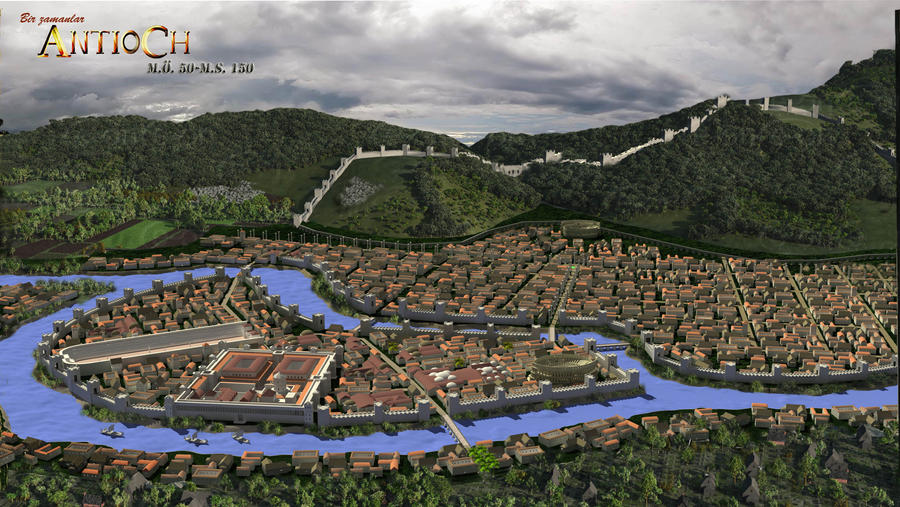
3. Third, but disputing precedence with Alexandria from the get-go, is Antioch, the city where folks were first called "Christians." This See, too, was founded by Peter. It has authority over "all the East," including lands under Persian rule, on the Malabar coast of India, and even in China. Antioch is at the end of the Silk Road and the Spice Route and is known even to the Chinese (who call it Tai Ch'in (Daqin)). [The term actually refers to the whole Roman Empire, but the Chinese only knew it as the terminus of the Silk Road.]
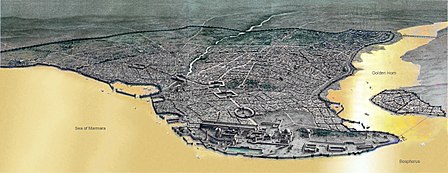
Constantinople, with the Land Walls in the background
4. Finally, the bishop of Constantinople, the See of St. Andrew, has recently been raised by the Council of Chalcedon to the status of Patriarch over the objections of Antioch and Alexandria. But it's hard to say no when one of your parishioners is the Emperor of the Whole Freaking World. Well, of what is still being called the Roman Empire. This gives the Ecumenical Patriarch considerable throw-weight of metal, especially when that metal is carried by Gen. Belisarius and Gen. Narses who, shortly after the time of the map will bring all the cities shown (except the Persian ones) back into the "Roman" embrace. They will even bring in some of the uncitied regions: the remainder of North Africa, the southern third of Spain.

5. A fifth Patriarch, Jerusalem, the See of St. James, administers three provinces in Palestine; but this position is mostly honorary as being the Mother Church. Jerusalem at the time is nowheresville and was given the honor at the council of Chalcedon. Jews had been forbidden to live in Jerusalem by the pagan Romans after the failed revolt of Bar Kockba. This really frosted them and they are eager to return from Arabia and Persia.

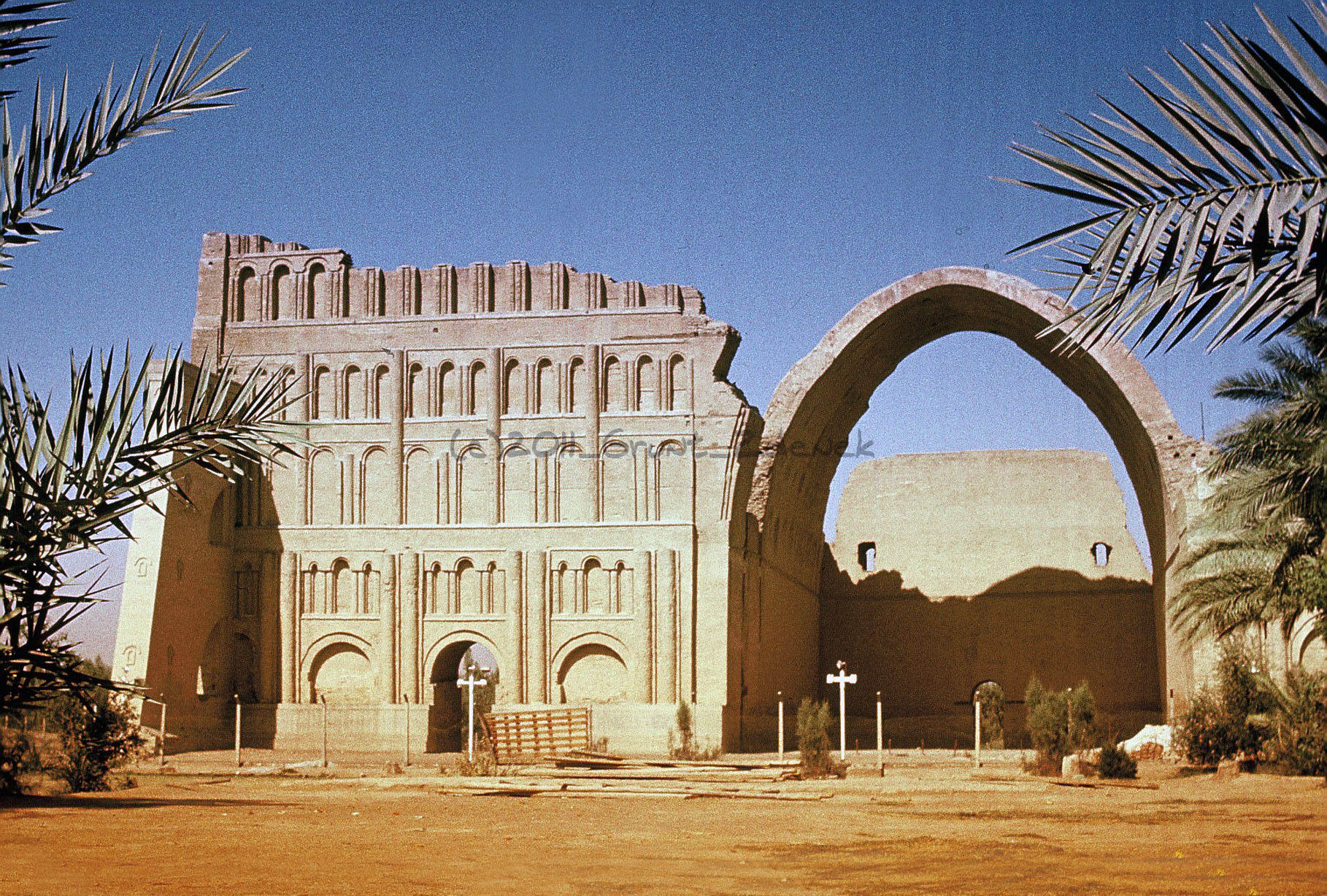
Ctesiphon, what's left of it
6. Outside the system, a sixth patriarch is the Patriarch of Ctesiphon, in Iraq, near what is now Baghdad, and was then part of the Persian Empire. This is the center of the Ancient Church of the East and is not in communion with any of the other Patriarchal Sees. It achieved its status by being outside Roman control. The Nestorians expelled by the Empire after the Council of Ephesus had gone there. Their descendants are the Assyrian Christians currently being massacred and expelled by ISIS.


But all is not beer and skittles. (Except maybe in German lands, where there is at least beer. Come to think of it, they may also have played an early form of skittles. Who knows?)

Vandals behaving badly. Why are football teams named Vikings
and Pirates, but not Vandals and Visigoths?
Rome, away off in the mostly-rural West has her own problems. The Eternal City has proven not so eternal. She had been sacked (almost reverently) by Alaric's Visigoths (410) demanding their back pay as foederati, then by the Vandals (455) (who thereby gave us "vandalism"), and will shortly be besieged and wasted in the upcoming 10 Years War between Byzantium and the Ostrogothic kingdom shortly after the time of the above map. The Ostrogoths are trying to keep up appearances for the sake of the kids, but otherwise the Western Patriarchate consists of a gaggle of Germanic warlords, and their spiritual shepherd is more like a border collie. The situation around map-time is roughly this:

Clovis united the Franks into a single nation, and converted to Catholicism a generation or two before the map. But the Frankish custom of dividing the inheritance among all surviving male heirs means a) unified kingdoms split up in the next generation and b) the next generation starts killing one another. The Visigoths in Spain are about to switch from Arian to Catholic ca. 589, but the Ostrogoths in Italy will remain stubbornly Arian until the Byzantines arrive, kick their butts, and snuff out the lights in Rome.

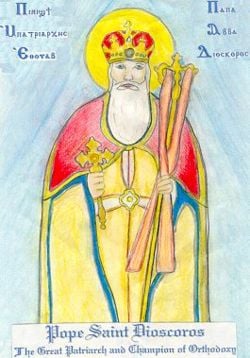
Pope Dioscorus of Alexandria
is a saint in the Coptic Church
But the truly fatal flaws are in  the East, where religious tumult brews over Christological matters that seem rather obscure to Moderns. A succession of heresies -- Arianism, Nestorianism, Monophysitism, and others in between -- have inflamed passions. Somehow.

In overreaction to Nestorianism, there had been a swing to the opposite extreme of Monophysitism. So a Council had been called at Chalcedon in 451 to settle things. This Council declared that Monophysites had cooties and deposed Patriarch Dioscorus from the See of Alexandria, installing Proterius in his place.

Pope Proterius of Alexandria is a
saint in the Eastern Orthodox Church
The non-Chalcedonians in Alexandria took offense at the deposition of Dioscorus and thought the pro-Chalcedonians looked too much like neo-Nestorians. In time-honored Alexandrian fashion, they settled the debate by mob violence. A mob attacked Proterius in the cathedral baptistery during Holy Week, dragged him through the streets behind a chariot, dismembered him, and burned his body, thus showing their displeasure in that very special Alexandrian way (cf. Arian Bishop George (361), philosopher Hypatia (415), and Prefect Callistus (422)). Thus began the line of Coptic Popes of Alexandria. Most of the Egyptians went with the non-Chalcedonians so this represents the majority, but an official (Chalcedonian/Orthodox) Patriarch continued to administer the church in the name of the emperor, and persecute the Copts, who began to look around for someone, anyone to liberate them from Greek oppression. The irony is that the non-Chalcedonians were not really Monophysites. The real problem was that the Greeks were in freaking charge and did not want anyone to forget it.

The situation in Antioch was similar, but instead of killing the Orthodox patriarch, the Syrians simply continued to recognize the deposed heretical one and after AD 518 Antioch wound up permanently with two Patriarchs. Again, much of this was rooted in Syrian resentment against heavy-handed Greek rule. Ironically, both the Egyptians and the Syrians also regarded genuine Monophysites as heretics and preferred to call themselves Miaphysites.
From our distant perspective, much of the problem seems to have stemmed from the difficulty of translating Greek philosophical terms into Syriac and Coptic. These were not only different languages, but were from different language families! Concepts that were distinct in Greek overlapped in Syriac. Discussions in 1984 between St. John Paul II and Mar Ignatius Zakka I Iwas, the Patriarch of the Syriac Church, concluded the whole thing was a matter of "differences in terminology and culture and in the various formulae adopted by different theological schools to express the same matter."

In 525, shortly before the above map and off its southeast border, Dhu Nuwas, a pagan Yemeni convert to Judaism rebelled against the Ethiopian garrison and attempted to forcibly convert the Christian Arabs of Najran, throwing those who refused into a burning ditch. Survivors who escaped to Ethiopia secured a punitive expedition from Axum, which crossed into the Yemen and kicked Yemeni butt. The story of the Martyrs of Najran spread all over the Middle East.
The Relevant World in AD 600, on the Eve of the Byzanto-Sassanid Was
Last but not least, a new round (602-628) of the neverending war between the occupier of the Iranian Plateau and the occupier of the Anatolian Plateau -- a war that goes back to Achaemenid Persia vs. Lydia -- was being played out between the Sassanids and the Byzantines. The Persian Sassanids take advantage of a Roman Civil war, which we won't Phocas on, and invade Anatolia, Syria, and even Egypt. Woo-hoo. It's Cyrus the Great reborn! The Persians bring a force of Jews along with them and restore them to Jerusalem. Even more shades of Cyrus! The Jews then proceed to slaughter all the Christians in town. Bad tactical move.

The Persians think this is going a little too far and begin to suppress the Jews, who respond WTF? Fun and games in the early 7th century. Heraclius, the governor of Africa, overthrows Phocas and after a penalty flag for offsides, throws long and goes straight for the Persian heartland. The shah pulls all his troops out of the Empire to block him and gets himself assassinated by his brother, who sues for peace. He's like, Dude, what were you thinking?

Jerusalem is now back under Christian rule. The Jews are like uh-oh.

Shah and Emperor look around and realize that nearly thirty years of continuous war has seriously depleted their military resources. Oh well. We'll just take some time to patch things up and rebuild.

But they would not have time, because....

It's Jihad Time!

Thursday, December 10, 2015

San Bernadino as Cultural Artifact

One of the benefits of anti-social media is that it encourages the Usual Suspects to opinionate in a sort of spasm, thereby revealing their hearts. Shortly after the San Bernadino shootings, several "tweets" (as TOF believes they are called) made announcements akin to the following:
Alan Colmes @AlanColmes
Planned Parenthood Clinic Across Street From San Bernardino Shooting
http://colm.es/1Tw8tpd 
This and other tweets were found here.
It actually wasn't across the street. It was over a mile away. But there are many folks who play by Deming's Funnel Rule #4. That is, they center on the most recent result. Some fruitcake had shot up a Planned Parenthood Clinic shortly before and killed three people; so this must be another. In the same spirit, generals in 1914 expected a replay of the Franco-Prussian War, and in 1939, a replay of the Great War. Activists today often seem to think they are reliving the Sixties™. But Funnel Rule #4 always results in flying way off target.

The one thing anti-social media doe not encourage is waiting for the information before whistling for your dog. Other "tweets" pushed other popular thought-cliches:

Saturday, March 7, 2015

News from the Fronts

Nigeria

  • Chadian troops crossed the border into Nigeria and ejected Boko Haram from the town of Gamboru, which the group has held for several months. The Nigerian military claimed the country’s sovereignty remains intact. 
  • Nigerian and Chadian warplanes have bombed the jihadist group “out of a slew of northeastern Nigerian towns.” 
  • Boko Haram’s pressure on Maiduguri has “put a stranglehold on one of Nigeria’s key cities.” 
  • The UN condemned the jihadist group’s recent attacks.
  • A suicide bomber killed at least 13 people and injured more than 30 at a bus station in Potiskum in northeastern Nigeria. 
  • The Nigerian military claimed to have retaken the town of Baga from Boko Haram on Feb. 21
  • On Feb. 22, a young girl estimated to be 8-10 years old detonated a bomb at a market in Potiskum, killing five people and wounding dozens. 
  • A Christian missionary from Seattle, Washington was abducted in Emiworo in Kogi state on Feb. 23. 
  • The Nigerian military has increased airstrikes on Gwoza and Bama in Borno state prior to a ground offensive to retake the area.
    Boko Haram killed scores of civilians when it invaded the village of Njaba and drove through 13 villages along the border with Cameroon as it retreated from a Nigerian Army offensive. 
  • Nigerian troops drove the jihadist group from Mafa town in Borno state, Bara in Yobe state and Gulak in Adamawa state during recent operations.

Mali

  • French forces killed about a dozen jihadists “in the region of the Adrar des Ifoghas mountains” in northern Mali. 
  • The UN’s peacekeeping mission is struggling with persistent insecurity and tensions with the civilian populace.

Niger

  • Nigerien forces repelled attacks by Boko Haram on the border towns of Bosso and Diffa; 109 jihadists and four soldiers were killed, and 17 soldiers were wounded. 
  • Shortly afterward, a young boy blew himself up in Diffa’s market, killing five.

Chad

  • Boko Haram conducted its first attack on Chadian territory, killing one soldier and wounding four others before being driven back from the village of Ngouboua. The jihadist group has pushed into Chad, Niger and Cameroon recently in its bid to expand its “caliphate.”

Algeria

  • Algeria announced the founding of a “national monitoring board” to combat religious extremism. 
  • Algeria reportedly declined to join the US-led coalition against the Islamic State after requests from the US and France.

Tunisia

  • Tunisian security forces arrested roughly 100 suspected jihadists in the past three days, some of whom were planning attacks, according to officials. The government also presented video evidence linking some suspects to the Islamic State.

Libya

  • Libya's Western-backed elected parliament has withdrawn from UN-sponsored peace talks. 
  • Amnesty International claimed that seven civilians were killed by Egyptian airstrikes in Derna on Feb. 16. 
  • Libya has resumed oil production from Sarir field and oil exportation from the port of Zueitina. 
  • Nearly 15,000 Egyptians have fled Libya after the murder of 21 Egyptian Coptic Christians by the Islamic State.

Egypt

  • An IED prematurely detonated, killing two men who were attempting to place the bomb in Samalut, Minya governorate. 
  • Egypt has banned Islamic State videos from the internet. 
  • Qatar recalled its ambassador to Egypt after the latter's airstrikes in Libya. 
  • Pro-army nationalism has increased in the wake of Egypt's airstrikes in Libya. 
  • Egypt called on the UN to lift the arms embargo on Libya to pave the way for security intervention in the war-torn country. 
  • The West has declined to support Egypt's intervention in Libya.
    Four bombs exploded in Cairo, killing one person and wounding at least seven. 
  • The Egyptian military killed dozens of suspected jihadists during operations in the Sinai. 
  • Egyptian President Sisi and visiting King Abdullah II of Jordan urged international cooperation in counterterrorism efforts.

Somalia

  • The US is sending 20 Mine-Resistant Ambush Protected (MRAP) armored vehicles to African Union forces combating terrorism in Somalia. 
  • Turkish special forces arrived in Mogadishu prior to a visit by President Raccip Tayyip Erdogan.
  • Three mortar rounds landed inside the presidential palace compound in Mogadishu; Shabaab claimed responsibility for the attack. 
  • Fifteen people were killed when government forces clashed with the "moderate Islamist group" Ahlusunah Wal Jamaa in Guricel Town in central Somalia.

Yemen

  • An Iranian diplomat who has been held hostage since July 2013 has been freed and has returned to Iran. Iranian officials claimed he was freed in a military operation, but Yemeni officials claimed he was released as part of a prisoner swap. 
  • Houthis seized control of the National Dialogue headquarters in Sana'a and demanded former president Hadi leave the country.

Saudi Arabia

  • King Salman awarded Indian cleric Zakir Naik, who runs "Peace TV," with the King Faisal International Prize and gave him $200,000. Naik has called 9/11 an "inside job" and called the US the "biggest terrorist."

Syria

  • French lawmakers made an unauthorized trip to Syria to hold talks with President Bashar al Assad. 
  • The Assyrian Human Rights Network claims that the Islamic State now holds 262 Christians hostage after an offensive that took over nearly a dozen Assyrian villages. 
  • The Islamic State's masked British executioner of Westerners has been identified as Mohammed Emwazi from west London. 
  • Syrian Kurdish forces cut off one of the Islamic State's supply lines from Iraq in northeastern Syria. 
  • The US-led coalition conducted nine airstrikes in Syria on Feb. 24-25; three destroyed an islamic State vehicle near Al Hasakah and six destroyed "three ISIL tactical units, an ISIL fighting position and destroyed six ISIL fighting positions" near Kobani.

Iraq

  • The military claimed that it killed 80 Islamic State fighters as it advances on Tikrit. 
  • The military has also launched an operation to retake Karma. 
  • The US launched 12 airstrikes against the Islamic State near Al Qaim, Fallujah, Haditha, Mosul, Samarra, Taji, and Tal Afar. 
  • The Islamic State torched oil wells in Ajil, and destroyed religious sites in Mosul and Nimrod.
    Massive columns of Shiite militas, including some groups that are listed by the US as Foreign Terrorist Organizations, have been leading the fight in Tikrit. 
  • Several photos have been released by the semi-official Iranian news agency Fars showing [Iranian general] Qassem Soleimani on the battlefield near Tikrit. Other photos circulating on social media show the leader of the Qods Force with various Shiite militias taking part in the current offensive in central Iraq.

Afghanistan

  • The Taliban killed nine policemen in separate attacks in Uruzgan and Helmand. 
  • A Taliban suicide bomber killed seven people in Helmand. 
  • "Gunmen" killed the executive director for Sayyedabad district in Wardak province.
http://www.longwarjournal.org/

Tuesday, April 23, 2013

The Arithmetic of the Struggle

"However, to bring down America we do not need to strike big. In such an environment of security phobia that is sweeping America, it is more feasible to stage smaller attacks that involve fewer players and less time to launch and thus we may circumvent the security barriers America has worked so hard to erect. This strategy of attacking the enemy with smaller, but more frequent operations is what some may refer to the strategy of a thousand cuts. The aim is to bleed the enemy to death."
-- the late* Samir Khan, explaining "Operation Hemorrhage," (Inspire, Nov. 2010)
In Adam Gadahn's May 2010 message entitled "A Call to Arms," Gadahn counsels lone wolf jihadists to follow a three-pronged target selection process. They should choose a target with which they are well acquainted, a target that is feasible to hit and a target that, when struck, will have a major impact. The Tsarnaev brothers did all three in Boston.

(*) late.  US missile strike in the Yemen.

Read more: Why the Boston Bombers Succeeded | Stratfor
Two thousand pounds of education
  Drops to a ten-rupee jezail 
-- Rudyard Kipling, "Arithmetic on the Frontier" 

Saturday, September 11, 2010

How Long Do Some People Remember Historical Dates?


Jan Sobieski.  

On September 10, 1683, the papal legate sang a great outdoor mass on the Kahlenberg, west of Vienna, for King Jan III Sobieski and his 16,000 troops. The king of the Polish-Lithuanian Commonwealth had been named commander of the field army of some 85,000 troops, including not only the Polish–Lithuanian contingent, but also troops of the Habsburg Monarchy, Bavaria, Saxony, Franconia, Swabia, the Grand Duchy of Tuscany, and the Zaporozhian Cossacks -- collectively: the Holy League.

Prometheus Awards: Read & Watch

 Hello Friends & Fans of Michael Flynn,       The Libertarian Futurist Society has made available the text of the acceptance speech Dad...