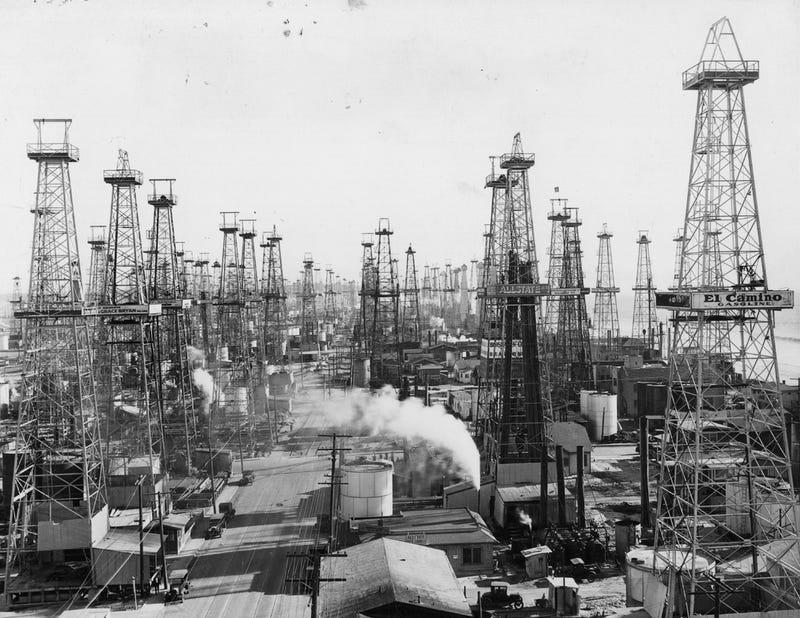
|
| Los Angeles oil fields, 1935 |
Courtesy of Paleofuture, a roster of Peak Oil predictions:
"Petroleum has been used for less than 50 years, and it is estimated that the supply will last about 25 or 30 years longer. If production is curtailed and waste stopped it may last till the end of the century. The most important effects of its disappearance will be in the lack of illuminants. Animal and vegetable oils will not begin to supply its place. This being the case, the reckless exploitation of oil fields and the consumption of oil for fuel should be checked."
— July 19, 1909 Titusville Herald (Titusville, PA)
1919: until 1921-1924
"In meeting the world's needs, however, the oil from the United States will continue to occupy a less and less dominant position, because within the next two to five years the oil fields of this country will reach their maximum production and from that on we will face an ever increasing decline."
— October 23, 1919 Oil and Gas News
1937: Gone in 15 years (1952)
Capt. H. A. Stuart, director of the naval petroleum reserves, told the Senate Naval Affairs Committee today the oil supply of this country will last only about 15 years.
"We have been making estimates for the last 15 years,' Stuart said. 'We always underestimate because of the possibility of discovering new oil fields. The best information is that the present supply will last only 15 years. That is a conservative estimate.'"
— March 9, 1937 Brooklyn Daily Eagle
1943: Peak oil has been reached
"There is a growing opinion that the United States has reached its peak oil production, the Oil and Gas Journal pointed out in its current issue. Since 1938, discoveries of new oil have not equaled withdrawals, in any single year, although there is a very good chance that 1943 will see enough new Ellenburger oil in West Texas to provide an excess."
— June 7, 1943 Bradford Evening Star (Bradford, PA)
1945: Just thirteen years left (1958)
"Faced with the threat that our nation's petroleum reserves may last only thirteen years, geologists are striving to tap the almost limitless supply of oil located beneath the seas off our coastline. The first attempt to get oil from the depths of the Atlantic Ocean was begun this month near Cape Hatteras, North Carolina, and Secretary of the Interior Harold L. Ickes revealed that the scientists are making progress in their efforts to reach the underwater oil."
— December 10, 1945 Times Recorder (Zanesville, Ohio)
1956: Ten to fifteen years until peak oil (1966-1971)
"M. King Hubbert of the Shell Development Co. predicted [one year ago] that peak oil production would be reached in the next 10 to 15 years and after that would gradually decline."
— March 9, 1957 Corpus Christi Times (Corpus Christi, TX)
1966: Gone in ten years (1976)
"A geologist stuck a figurative dipstick into the United States' oil supplies Tuesday and estimated that the country may be dry in 10 years."
— August 3, 1966 Brandon Sun (Brandon, Manitoba)
1972: U.S. oil depleted in twenty years (1992)
"At any rate, U.S. oil supplies will last only 20 years. Foreign supplies will last 40 or 50 years, but are increasingly dependent upon world politics."
— May 1972 Bulletin of the Atomic Scientists
1977: Oil will peak by the early 90s
"As a nation, Americans have been reluctant to accept the prospect of physical shortages. We must recognize that world oil production will likely peak in the early 1990's, and from that point on will be on a declining curve. By the early part of the 21st century, we must face the prospect of running out of oil and natural gas."
— 1977 US Department of Energy Organization Act
1980: In the year 2000
"Stressing the need for conservation, [physicist Dr. Hans] Bethe said the world will reach its peak oil production before the year 2000. Production of oil worldwide will then drop to zero over about 20 years, he said. Rigorous conservation could stretch the world's oil supply to the year 2050, he said.
— October 17, 1980 Syracuse Post Standard (Syracuse, NY)
1996: Peak oil likely by 2020
"Unfortunately, oil production will likely peak by 2020 and start declining. Without a change, developing countries will ultimately be left in the dark, and developed countries will struggle to keep the lights on. Conflict is inevitable. My guess is that this won't become a big issue unless there is a thalidomide event. We will have to see in the rear-view mirror that we are past the peak in worldwide oil production."
— Richard Smalley, Nobel Laureate in Chemistry, 1996
2002: Global peak by the year 2010
"Global supplies of crude oil will peak as early as 2010 and then start to decline, ushering in an era of soaring energy prices and economic upheaval — or so said an international group of petroleum specialists meeting Friday."
— May 25, 2002 Index Journal (Greenwood, SC)
2007: Sometime between now and 2040
Most studies estimate that oil production will peak sometime between now and 2040. This range of estimates is wide because the timing of the peak depends on multiple, uncertain factors that will help determine how quickly the oil remaining in the ground is used, including the amount of oil still in the ground; how much of that oil can ultimately be produced given technological, cost, and environmental challenges as well as potentially unfavorable political and investment conditions in some countries where oil is located; and future global demand for oil.
— February 2007 GAO Report
So buckle up sports fans. The oil is gonna run out Real Soon Now. Unless it already did and we're living in the Matrix.
Yet each time one of these predictions comes along, we still take it seriously.