Showing posts with label crusades. Show all posts

Friday, December 23, 2016

Deus Vult! Part IV: Off to the Races

Continuing TOF's intermittent series on the Crusades. Hooray. I think.
Dudes, let's all go to the Holy Land and kick the Turks
out of Byzantium! Wear the pilgrim's cross when you go!

In Deus Vult! Part I, we reviewed four hundred years of muslim aggression against Christendom, a region known to the muslims by the subtly suggestive name "House of War."

In Deus Vult! Part II, we encountered the Standard Model of the Crusades as an unprovoked  incursion by boorish oafs (as well as oafish boors) into the suave and sophisticated House of Submission. No one thought to ask how all those muslims got all over everywhere in the first place.

 In Deus Vult! Part III, we noted that crusading was a crowd-sourced enterprise with voluntary participation. Participants were enticed by promises of suffering, impoverishment, and probable death. Who can resist inveiglement like that? But crusading was conceptualized as an act of charity and in the mental universe of the day, the greater the sacrifice, the greater the merit. Like any vassal, they were pledged to recover their lord's lost territories. The Lord in this case was Jesus H. Christ himself, and his lands were all the Middle East. This was not then an unrealistic goal: even Egypt was still about 50% Christian, and the lands more recently lost to the Turks were eminently recoverable. In fact, the Byzantines had briefly recovered some of them, only to lose them once more in the disaster following Manzikert. The crusade was less an organized military expedition than it was a joint pilgrimage undertaken by several thousand well-armed knights  initially with the purpose of restoring their Greek brothers' lost territories; then as it built up steam, of making a pilgrimage to Jerusalem as a sort of protest movement.

Problem was, there' s a whole bunch of muslims sitting on it.

Right Makes Might

Set a later time, this map shows the division within Islam
between the"highlands" (green) and the "lowlands" (yellow),
which in 1098 were exemplified by the Saljūqs and Fatimids, resp.
The House of Submission was divided into two broad zones. The Highlands -- the mountainous plateaus that run from Anatolia eastward to the Hindu Kush -- was occupied by Saljūq Turks, nominally comprising a great Sultanate but actually a potpourri of subordinate emirs of varying degrees of independence and mutual hostility. The Lowlands were the desert borders more or less reigned on lightly by the Fatimid caliphs. The Abbasid Caliphate owned a spurious independence and pretended not to notice the Saljūq hand up their skirts working the arms and voice. The Turks had a Sunni disposition while the Fatimids were in deep Shi'ite. This added piquancy to the usual rivalry between the uplands and the lowlands.¹ Syria-Palestine, which lay in between the two, suffered the usual soccer ball fate of lands-that-lie-in-between, which is why the Christian pilgrims going there found an on-going state of turmoil going on. Neither the Saljūqs nor the Fatimids were in complete control of their vassals and disorder was the order of the day. 
Notes:
1. Uplands vs. Lowlands. This goes back to the Hittites vs. the Egytians.

Thursday, August 11, 2016

Deus vult! Part III: I have come in order to die

Back in March and April, TOF began a series on the Crusades, but shortly after a wasp broke his humerus. This has distracted him since from any but trifles. It is now time to resume the narrative.

Hmm. His list of pending blog posts includes also America's Next Top Model and In Psearch of Psyche, both of which have fallen into a black hole. In fact, there may be other series of which I have entirely forgotten. Time to shrug into motion, sez I.

In Deus Vult! Part I, we reviewed in the form of a chronology four hundred years of muslim aggression against Christendom, a region known to the muslims by the subtly suggestive name "House of War." Technically, India, China, and sub-Saharan Africa also live in this house, but at this point in history, most of the action is in the West. India is pending on their to-do list, and China has been kicked out of Afghanistan.¹ Africa will have to wait because there is nothing there that the muslims want, except slaves.

In Deus Vult! Part II, we encountered the Standard Model of the Crusades as an unprovoked  incursion by boorish oafs (as well as oafish boors) into the suave and sophisticated House of Submission. This model was constructed by Marxist historians and their camp followers, who were writing in the twilight of the Age of Imperialism, and consequently, in that marvelous way we have of seeing ourselves wherever we look, saw the Crusades as an earlier version of the Age of Imperialism. No one thought to ask how all those muslims got all over everywhere in the first place.² Could be the Crusades were an anti-imperialist movement! What is the statute of limitations on conquest?
Notes:
1. Afghanistan. One of the reasons the Islamists keep blowing up antiquities from Buddha statues to Palmyra to Cyrene is that they don't like reminders that Others had been there before them and built great works. The Wahhabis have scoured the Peninsula of any trace of the Turkish occupation, or indeed of early Islam itself.    
2. in the first place. For example, TOF recently watched a series on the Old West that involved in part the obnoxious taking by the whites of the Black Hills from the Lakota. Was there any mention that the Lakota had previously taken them from the Cheyenne? Or the Cheyenne from the Arapaho? Even to ask the question is to answer it.

On Your Mark

IN THE STANDARD MODEL, the crusaders were imagined as second sons with no inheritance, as robber barons, as highwaymen, or as others with nothing to lose out to get rich on the fabled wealth of the Orient. More recently, historians have started to look at the surviving data (such a marvelous thought!) and have found that this was not the case.

The pilgrimage to the East was self-funded, for one thing. No one was paying the knight's plane tickets. In fact, there were no planes!³ So everyone had to get there on his or her⁴ own.
Notes
3. no planes. On a positive note, this meant no one could hijack them or fly them into the Hagia Sophia. Well, not until 1204, anyway.  
4. her. You heard me. Of the 150,000 people who took the pledge, the majority were women, the poor, and the elderly. These were asked to stay at home and pray for success. They would get in the way of the more muscular pilgrims. Spaniards were also asked to stay home. They had their own crusade to attend to. But by the somewhat libertarian nature of medieval society, no one other than a sworn lord could outright forbid anyone from engaging in pilgrimage and many went anyhow. Some of the lords brought their wives and families.
Whoa! Out of my way, pilgrim!
Crusading was expensive, up to five times one's annual incomes. (Louis IX’s Seventh Crusade⁵ in the mid-thirteenth century will cost more than six times the annual revenue of the Crown.) To cover the nut, knights and lords sold freeholds, settled property disputes at a disadvantage, liquidated estates, borrowed from relatives, submitted grant proposals, and maxed out their credit cards. This was so extensive that preparations for the First Crusade introduced considerable inflation into Western Europe⁶ and instigated a net flow of wealth from West to East. (So much for getting rich on the wealth of the East.) One of the reasons why the Fourth Crusade will get hijacked to Constantinople was that it will run out of money before it even gets rolling.

They sold off their wealth with no expectation of an ROI. (In fact, except for maybe a few stray Lombards, they may not have known what an ROI was! There was not a single MBA in all Europe. Which may explain their prosperity.)

Yes, prosperity. They had to raise that money from somewhere. Global warming was in full swing, lengthening the growing season, expanding the arable land, increasing the harvests. Had Europe been poor, she could not have afforded these expeditions. 

Only about 40,000 of this total actually marched east. They did not all go together, and many did not complete the journey but turned back when their funding dried up. It was not an organized expeditionary force. It was 40,000 knightly or lordly dudes and their dependents all going in the same general direction for more or less the same purpose at approximately the same time.

That purpose was to make pilgrimage to the Sepulcher in Jerusalem, and the time was 15 Aug 1096. That's right, sports fans! This is the 920th anniversary of the kick-off to the First Crusade. Woo-hoo!
Notes
5.
Louis IX’s Seventh Crusade. I wish we could have had Louis VII's Ninth Crusade, too, but the math doesn't work out.
6. considerable inflation. Later crusaders will take this into account and begin saving up for the journey years ahead of time, a sort of medieval layaway plan.
Don't call me Shirley!
PILGRIMAGE? The Marxist historians of yore could not credit such a thing. Since neither they themselves nor their camp followers believed in religion, they could not believe that others actually did. It must be social cover, it must be hypocrisy. Surely, they could not have been serious! Perhaps they did not believe that rough and tumble warriors could also be pilgrims.⁷

But they were. That the expedition was a cynical exercise in Realpolitik is a Modern illusion suffered by those who see their own beliefs fortuitously reflected in the past. Oh, surely among 40,000 warriors and their dependents there were some cynics and hypocrites, there were some looking to get rich, just as there are in today's NGOs. But remember, no one ordered them to go, they were not sent, they did not belong to an army. They each took a pledge individually to make the journey. The pledge was to God, not a king or baron. They were not even volunteers in the sense of the "All-Volunteer Force," because they were not joining an organization. They were all free agents, not team players.

In fact, they saw themselves as bound on an errand of mercy. The crusade was to be an exercise in charity (Riley-Smith, 1980). The muslims had taken the lands of Christ: his birthplace, his tomb, Antioch (where his followers were first called Christians), the homeland of the Cappadocian fathers, the patriarchate of Alexandria (second only to Rome in honor), the sites of three of the first four Councils. And it was the duty of every sworn vassal to recover the lands of his lord from the enemy. In this case, they had sworn fealty to Jesus. The lord was the Lord, and they were off to reclaim His lands.
Notes
7. warriors/pilgrims. When this was bruited recently in a comm box elsewhere, a correspondent took umbrage and claimed that calling them pilgrims made them seem harmless. Another example of modern picture-book understanding replacing actual historical context. Presumably, she was envisioning the Wife of Bath and others wending their jolly way to Canterbury in a well-groomed England rather than in a war-torn and chaotic Middle East.
IF PARTICIPATION WAS VOLUNTARY, knights had to be persuaded to go. This was done mainly through the crusade sermon, so we might expect these sermons to be full of enticing promises, rose-colored visions, and all the rest of the Late Modern panoply of PR and advertising.

They were not.

For the most part, crusade sermons were full of warnings that crusading brought deprivation, suffering, and often death. Many, if not most crusaders left expecting not to return.⁸ The casualty rate for the First Crusade has been estimated at 75%. This reality was well known anyway, and the potential recruiting pool would not have believed a more rosy picture. Jonathan Riley-Smith noted that crusade preachers “had to persuade their listeners to commit themselves to enterprises that would disrupt their lives, possibly impoverish and even kill or maim them, and inconvenience their families, the support of which they would . . . need if they were to fulfill their promises.”
When the grandfather of TOF was in the cadet corps at Catholic University in 1918, he was discouraged from majoring in philosophy and letters, which he desired above all else, and talked into enrolling in mechanical engineering. The enticement was "you'll get to see action sooner!" That action was the meatgrinder of the trenches of the Western Front. For that matter, there was the French Foreign Legion: "You are in the Legion to die and we will send you where you can die."
This enticing appeal -- You will probably die! -- worked precisely because the crusade was seen as a penitential act.  Undertaking known and significant hardships with the right motives was understood as an acceptable penance for sin. "Far from being a materialistic enterprise, crusading was impractical in worldly terms, but valuable for one’s soul. There is no space here to explore the doctrine of penance as it developed in the late antique and medieval worlds, but suffice it to say that the willing acceptance of difficulty and suffering was viewed as a useful way to purify one’s soul (and still is, in Catholic doctrine today). Crusading was the near-supreme example of such difficult suffering, and so was an ideal and very thorough-going penance." (Crawford, 2011)
For Christians . . . sacred violence, cannot be proposed on any grounds save that of love, ... [and] in an age dominated by the theology of merit this explains why participation in crusades was believed to be meritorious, why the expeditions were seen as penitential acts that could gain indulgences, and why death in battle was regarded as martyrdom. ...  As manifestations of Christian love, the crusades were as much the products of the renewed spirituality of the central Middle Ages, with its concern for living the vita apostolica and expressing Christian ideals in active works of charity, as were the new hospitals, the pastoral work of the Augustinians and Premonstratensians and the service of the friars. The charity of St. Francis may now appeal to us more than that of the crusaders, but both sprang from the same roots.
"Crusading as an Act of Love," Jonathan Riley-Smith,   History 65  (1980):177–92
Notes:
8. expecting not to return. Robert of Crésèques, a 13th-century crusader announced that he had “come from across the sea in order to die for God in the Holy Land” -- and promptly did so, in battle against overwhelming odds

Get Set


Around AD 968, the Byzantine Empire went over on the offensive, recovered Crete (961) and Cyprus (965), and advancing into northern Syria recovered Antioch (969) and the nearer parts of Armenia from the Caliphate.

In that same year, the Shi'ite Fatimids had moved from their original base in the Maghreb and seized control of Egypt,⁹ building Cairo to celebrate and by the way sucking all the oxygen out of the room for Alexandria, whose long era of prosperity now drew to a close. The Fatimids declared themselves Caliphs as the Sunni Umayyads in Spain had already done.

Just in time, too. It was a buyers market in caliphs. The Buyid princes from northwest Iran had been gradually making themselves masters of the plateau and had extended their control into 'Iraq, where they stripped the 'Abbasid caliph of his temporal authority. They still recognized his spiritual authority. Beyond Buyid reach, the western parts of the old Caliphate either fell into Fatimid hands or become independent Arab or Kurdish emirates.

As a result, the Holy Land fell into chaos with three-way fighting between Egypt, Mosul, and Aleppo as well as the occasional Bedouin raiders from the desert. Pilgrims found themselves molested as they had not been by the 'Abbasid caliphs.

Meanwhile, the Buyids began glancing nervously over their shoulders as the Turks, scandalized by Shi'ite control over Sunni populations, moved west. For uncounted centuries, they had been herders of cattle. Now they would become herders of men. 
Note:
9. Moved from their original base. Outside of Europe there were no nation states. Egypt had a certain self-consciousness and so did Persia, but for the most part, ruling dynasties could move around and establish themselves elsewhere. Imagine if the Windsors of England could pull up stakes and make themselves kings and queens of Poland. Instead of talking of the Kingdom of England, we'd talked about the Windsor Kingdom.
The middle of the 11th century was one of upheaval in the Middle East. The Nine Tribes of Turkestan (the Toghuz Oghuz, or "Ghuzz") poured west. One stream, the Cumans, flowed north of the Caspian into the Ukraine, where they drove the earlier Patzinaks into Romania. But the southern stream, who became the Saljūq Turks took control of Khorasan (1037) and smashed their former employers the Ghaznavids (1040). This attracted other Ghuzzers to their banner and they conquered the Buyids bit by bit until they took Baghdad (1055), after which they picked up Mosul, Aleppo, the Kurds, and the Caucasus. Their plan at this point was to advance against the heretics ruling Egypt -- the irony is that the people of Egypt were still largely Christian, at least 50% by some estimates -- but their Sultan, Alp Arslan started to tidy up his borders first. By the late 1050s, the Turks were raiding deep into Armenia, by 1060 into Cilicia.
Side note: Population pressure had squeezed two tribes out of Arabia: the Beni Hilal and the Beni Sulaym. The Fatimids had convinced them to abide in Upper Egypt and then, when their Zirid governors back in North Africa rejected the Shi'a, sent them into Cyrenaica and Tripolitania, where they kicked Zirid butt and converted the two regions -- now called "Libya" -- from Berber to Arab. However, whenever Libya is stressed, it tends to fracture into these two parts: Hilal in the west and Sulaym in the east.
The other big move was by the Sanhaja Berbers, ancestors of the Tuaregs, who came out of the desert, conquered Morocco (to which they gave its name) and began to intervene in the Spanish cockpit.

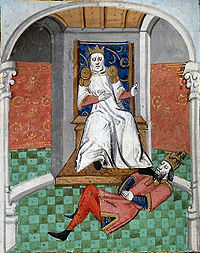
Alp Arslan humiliating the
Byzantine emperor
Romanus IV Diogenes could let the Normans have Sicily, but Armenia was the key to Anatolia and had to be defended. He gathered the main Byzantine army and began pushing east into Armenia. Alp Arslan, who had already turned toward Egypt, became alarmed about his lines of communication and did a 180. The two armies met at Manzikert on the shores of Lake Van, where Turkish horse-bow tactics ran the Byzantines ragged until the army disintegrated and the emperor was captured.

Short-sighted Greek generals competing for power hire Turkish mercenaries -- who turn on them and open the frontier for Turkoman herders to drive their flocks and herds into Anatolia.A palace coup overthrows Romanus and installs the Doukas family, who make a mess of things. Finally, Alexios I Komnenos takes control and steadies things up. He sends out peasant armies who take control of the coastlands of Anatolia


1095. Emperor Alexios I Komnenos writes to the pope for help.
 
The Arabs (wide cross-hatches) are out of the picture, although Second Wave Arabs have colonized Libya and interior Algeria flipping it from Berber to Arsb. The Berbers (tight mesh) rule in Spain and Morocco, the Algerian-Tunisian coast, and have set up a rival Caliph in Egypt. The Turks (border of open circles) have taken over Persia, Anatolia and are trading Syria/Palestine back and forth with the Fatimids.

Go!

When  already  that  time  drew  nigh,  to  which  the  Lord  Jesus  draws  the  attention  of  his  people  every  day,  especially  in  the  Gospel  in  which  he  says, “If any man will come after me, let him deny himself and take up his cross and   follow me”,   there   was   a   great   stirring   throughout the whole region of Gaul, so that if anyone, with a pure heart and  mind,  seriously  wanted  to  follow  God and  faithfully  wished  to  bear  the cross after him, he could make no delay in speedily taking the road to the Holy Sepulchre.
-- Gesta Francorum

Coming Soon: Power to the People!

References

  1. Crawford, Paul F. "Four Myths About the Crusades," Intercollegiate Review (Spring, 2011)
  2. Madden, Thomas F. The New Concise History of the Crusades (Rowman-Littlefield, 2006)
  3. McEvedy, Colin. The New Penguin Atlas of Medieval History (Penguin, 1992)
  4. Riley-Smith, Jonathon. The Crusades: A History, 2nd ed. (Yale University Press, 2005)
  5. Riley-Smith, Jonathon. "Crusading as an Act of Love," History 65 (1980): 177-92.
  6. Warren, David. "Of bombs and bulldozers," Essays in Idleness (3 Aug 2016)

Sunday, April 3, 2016

Deus vult! Part Two: On Your Marks

Part One was here.

The Great Boo-Hoo

Among the usual cris de coeur about Western Civilization are the Crusades, a series of unprovoked and dastardly aggressions against the Religion of Peace.™ These were, in this view, holy wars led by power-mad popes and fought by uncouth religious fanatics from an overpopulated and resource-poor backward Europe against the peaceful and enlightened Muslim culture, leaving it in ruins to this day. 

Depending upon which generation of occidentophobes we cite, these attacks are said to be due to evil Western capitalistic imperialism-colonialism or to evil Western Islamophobia. In either case, it is a projection of High Modern or Late Modern concerns onto a High Medieval milieu for which they are not exactly good fits. The eleventh and twelfth centuries were not exactly hot times for capitalism -- as Marx in fact knew. And is it really a phobia if someone has been attacking and raiding your lands for four hundred years and you at long last strike back?

Our modern view of the Crusades has been informed by Steven Runciman's influential text, A History of the Crusades. Most people today owe their view of oafish Frankish barbarians disrupting a suave and sophisticated Islamic culture to his work. Runciman greatly admired the Byzantine Empire, and regarded its destruction by the wayward "Fourth" Crusade as "the greatest crime committed against humanity." He delivered himself of this opinion only a decade or so after World War II, too; so it may be true what they say about academics. 

Thomas F. Madden (2005) stressed the impact of Runciman's style and viewpoint:
Marxist historians accepted that the crusades were imperialistic, but they rejected the idea that they were motivated by idealism. Instead, they argued, the crusades were the result of the growth of medieval European population and a shortage of available resources. The crusades were simply surplus labor seeking new territories for themselves abroad. These ideas meshed well with the increasingly discredited nature of imperialism. Historians who were not themselves Marxist nevertheless accepted the premise that the crusades were the child of avarice and greed, because as imperialistic enterprises, they were clearly exploitative. The crusaders were thus shorn of any semblance of religious motivation.

This view of the crusades was carved into stone with the publication of Sir Steven Runciman's three-volume
History of the Crusades (1951-54). It is no exaggeration to say that Runciman single-handedly crafted the current popular concept of the crusades. The reasons for this are twofold. First, he was a learned man with a solid grasp of the chronicle sources. Second, and perhaps more important, he wrote beautifully. The picture of the crusades that Runciman painted owed much to current scholarship yet much more to Sir Walter Scott. Throughout his history Runciman portrayed the crusaders as simpletons or barbarians seeking salvation through the destruction of the sophisticated cultures of the east.
The irony is that these 19th century Marxist assumptions were then taught to the Arabs, who had themselves largely forgotten about the crusades, thus creating a whole new set of grievances by which to explain away the repressive backwardness of their regimes. This worked to the advantage of both the regimes and those who wished to overthrow them, and in the latter case suited the agendas of both the nationalists and the Islamists. Previously, the crusades had been a short-lived series of set-backs interrupting a thousand-year long assault on Christendom. Now they became the scapegoat for everything that had gone wrong. Islamic culture, they argued, had never recovered from this unprovoked invasion.

But even Runciman described his work as literature, not history. He wrote in the older tradition of Gibbon, all full of Grandeur and Sweep and Pronouncements, not in the modern tradition of dispassionate and careful examination of the documents of everyday life. Sometimes, if you want to know why people did what they did, it is useful to ask them. They're not always honest, but they may be more accurate than projecting modern concerns back onto them.

To take one example: the Europeans could hardly have mounted these campaigns if there had been a shortage of resources in Europe. It is precisely because of Europe's economic recovery from the dark age of Saracen, Viking, and Magyar assaults -- from the sacking of Rome and the burning of Genoa and the jihadi castles blocking commerce through the passes in the Alps -- that they were able to go out from Europe at all. Europe did not get rich from exploiting the East. The East was a continual drain on her resources, and as time went on it became more and more difficult to find volunteers to risk their lives and fortunes to venture out there.

Likewise, the argument that the muslim world is poor today because of the devastation wrought by the crusades: The crusades never touched most of that world, and in the centuries following the snuffing of the last crusader states, muslim armies took Otranto in Italy preparatory to a march on Rome, conquered the Balkans and Constantinople, and twice approached the Gates of Vienna to menace the center of Europe. The Grand Turk was a very real threat to Europe down to the 1600s.

But even before Runciman wrote his great work, historians were taking another look and were examining the assumptions behind the modern analysis. They found, for example, that far from being landless "second sons" out to strike it rich, most who went on the crusade were important and wealthy barons who mortgaged themselves to the hilt in order to afford the journey. (Remember, they had to pay their own way there and back.) This has been learned by a statistical analysis of the memorials that crusaders posted with their bishops prior to setting out. They did not expect for the most part to be coming back.
Our faith was strong in th’ Orient,
It ruled in all of Asia,
In Moorish lands and Africa.
But now for us these lands are gone
‘Twould even grieve the hardest stone...
-- Sebastian Brant, The Ship of Fools (1494)

The World in 1071

Okay, not the whole world maybe, but the world of the European-Near Eastern ecozone. On the eve of the crusades, that world looked like this.
Penguin Atlas of Medieval History from Columbia.edu
Different shadings indicate different nationalities of the rulers of each territory.
Berber states e.g. have tighter cross-hatching than Arab states.
Hilaire Belloc (1936) described the situation thusly:
They [the muslims] were ultimately thrust back to the Pyrenees, but they continued to hold all Spain except the mountainous north-western corner. They held all Roman Africa, including Egypt, and all Syria. They dominated the whole Mediterranean west and east: held its islands, raided and left armed settlements even on the shores of Gaul and Italy.  They spread mightily throughout Hither Asia, overwhelming the Persian realm. They were an increasing menace to Constantinople. Within a hundred years, a main part of the Roman world had fallen under the power of this new and strange force from the Desert.
 

Such a revolution had never been. No earlier attack had been so sudden, so violent or so permanently successful. Within a score of years from the first assault in 634 the Christian Levant had gone: Syria, the cradle of the Faith, and Egypt with Alexandria, the mighty Christian See. Within a lifetime half the wealth and nearly half the territory of the Christian Roman Empire was in the hands of Mohammedan masters and officials, and the mass of the population was becoming affected more and more by this new thing.
Normans liberating Sicily
By 1071, things had been tidied up somewhat around the edges. Some of the Mediterranean islands had been recovered by the Byzantines or by the Pisans, and the Normans were halfway to liberating Sicily. The jihadi castles were gone from the Alps and the Riviera, and southern Italy had been freed. The Spaniards had begun to debouch from their mountain redoubts. The Byzantines still held the line in Anatolia, despite constant attacks; and Dongola, the northernmost successor state to Nubia (off the bottom of the map), held the upper Nile against the Beni Sulaym colonizers from Arabia who had been Arabizing Upper Egypt. Northern Sudan was still Christian.

Within the House of Submission, the relative pax of the Arab Caliphate of Baghdad had shattered and Berber and Turkish warlords were now in charge with all the fervor of recent converts. The imperialist-colonialist Saljūqs held Persia and Mesopotamia. The Shi'ite Fatimids had come out of North Africa and now ruled in Egypt. When their left-behind Zirid governors had proven too independent back in Mahdi City and ditched the Shi'a for the Sunni, the Fatimids passed along the migrating tribes of the Beni Sulaym (who settled Cyrenaica in 1050) and the Beni Hilal (who colonized Tripolitania and Tunisia in 1051), changing these areas from Berber to Arab and driving the Berbers to the coastal cities. (To this day, "Libya" breaks naturally into these two parts.) The old Umayyad Caliphate of Cordoba had broken up into a score of independent taifas, Arab and Moor, and with it passed the Golden Age of Al-Andalus. Meanwhile, the al-murabitim (Almoravids), Sanhaja Berbers who had recently converted to Islam had flooded out of the Sahara, taken over the Emirate of Fez, and renamed it Marrakesh (Morocco). Shortly, some of the losing taifas in the muslim civil war will invite them to come into Spain to help out. They will, but will then refuse to turn control back over to their Moorish cousins and will make Spain an Almoravid colony.

Turkish warriors: Dude, who took my horse!
The Turks were composed of mutually warring clans and factions, and so they disrupted the pax Arabica that the original muslims had established within the House of Submission. When they took Jerusalem from the Fatimids, they were astonished to find flourishing Christian churches and monasteries. (The "Mad Caliph" who had destroyed the Church of the Holy Sepulcher had been an aberration; his successor had allowed the Byzantines to send architects to restore them.) Like all new converts, the Turks were more muslim than the muslims, so they destroyed churches, murdered clergy, and seized pilgrims for ransom.

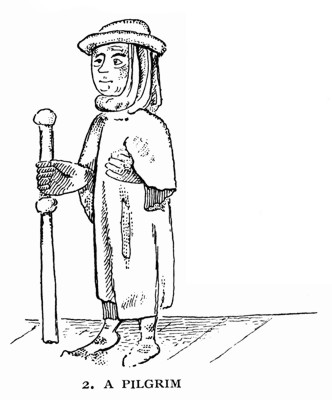
A pilgrim with big hands
Then they discovered that Jerusalem was profitable only by dint of the pilgrims she attracted, so they eventually stopped direct persecutions in favor of tolls and taxes. However, fragmented nature of the Turkish realm meant that local petty rulers could do pretty much as they pleased, so the pilgrimages to the Holy Land became more arduous and often fatal. In 1065, when Bishop Gunther of Bamberg led 7000 pilgrims to the Holy Land, only 2000 returned to the Germanies -- after a harrowing siege and rescue by a friendly Fatimid emir.

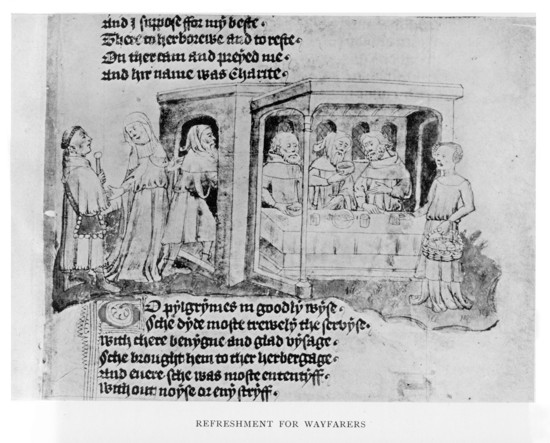
Pilgrims stopping at an inn
This may seem unbelievable to Late Moderns convinced that no one actually believes in a religion, but by this point the Europeans were thoroughly spooked. What with the Mad Caliph, the Saljūq destruction of churches, the attacks on pilgrims, and all what have you, they had little faith in the ability of the New Muslims to safeguard the Holy Sites the way the Old Muslims had. We can imagine them in their pubs and bistros and Bierstuben grumbling over their pints, "Somebody oughta do something!"


All that was needed was a trigger.

Disaster!

That trigger came on 26 August 1071, when the Turks crushed the Byzantine Roman army on the shore of Lake Van in Armenia: the Battle of Manzikert. While not militarily unrecoverable, the subsequent coup and disorder in the Empire allowed the frontier to collapse. Turkish colonists drove their flocks onto the Anatolian plateau -- and drove the peasants off the land. Anatolia had been the breadbasket of the Empire and its major source of manpower for the army. Without it, the Byzantines recoiled to the coast and the Balkans and could now look out across the Straits and see... "Turkey," in what had once been a Greek and Orthodox country¹ and the ancient land of the Cappadocian Fathers. The sites of three of the first four Ecumenical councils (Nicaea, Ephesus, Chalcedon) were now in muslim hands.

After ten years of chaos, an actually competent emperor, Alexis I Comnenus (1081-1118), rallied the Byzantines and raised a mercenary army against the surrounding barbarians. And he wrote to the Pope begging for Help! He needed fighting men. Soon. Like now?

The Byzantines did not call on the West blithely. In their opinion, all of the West was Roman territory occupied temporarily by Frankish barbarians with pretensions. (And when the Normans freed Sicily and Southern Italy from the muslims, they also kicked out the remaining Byzantine garrisons.) Furthermore, although Christian, the Westerners were committed to various liturgical errors and possible doctrinal errors. Then there had been that matter of mutual excommunication about twenty years ago. A minor affair; not like it was the first time the two Sees had gotten in a snit with each other, and the assumption was that things would work out eventually. Both sides were trying to patch things up at this point. 
Dude, where's my Anatolia?! The Fatimids are wondering what happened to Jerusalem. The Armenians are wondering what happened to Armenia: Some have taken refuge in Cilicia (a/k/a "Little Armenia"). The Shi'ites of Alamut are wondering where they can get some more pot and whether they can train more assassins to take out the damned Sunni Turks.

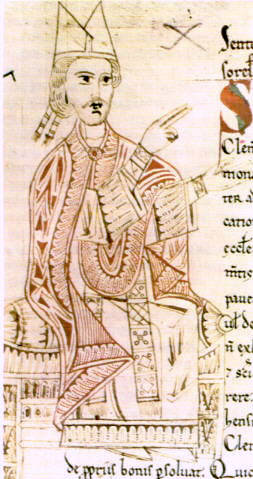
Greg 7
But even before receiving this plea for help, Pope Gregory VII (1073-1085) had made plans to rectify Manzikert. He saw the effort not as a "holy war" but as an errand of mercy and charity. He even envisioned himself at the head of the army and that the subsequent liberation would help reunite the two halves of Christendom now sorely vexed by that excommunication thingie. In his absence, he would entrust the care of the Church to his BFF, Kaiser Heinrich IV. Hank was glad to oblige.
Notes
1. Greek and Orthodox. Western and coastal Anatolia remained largely Greek and Orthodox down to the 1920s when, in the wake of WW1, following an unsuccessful Greek attempt to reclaim the region, it was ethnically cleansed by the Turks. They got rid of the Armenians too around the same time.

The Crusade That Didn't Happen

But Greg was a Reformer™, and the first step to quenching clerical abuses was to remove the kings from control of the clergy. So he issued a "Declaration of Independence" for the Church. From now on, only the Church could invest her bishops: no kings, emperors, or presidents need apply. Hank did not take the separation of Church from State well. (Oddly enough, the first thing the Protestant Reformers did, centuries later, was return their churches to secular control.)

Matilda moderates the agreement
between Hank and Greg
So Hank declared Greg a papal booger-head and the nobles of Germany said, in very loud whispers, maybe we need a new emperor and Hank went off to ask Greg for forgiveness. Greg left town before Hank could catch him and bunkered up in the castle of Canossa, held by the redoubtable warrior, la gran contessa Matilda of Tuscany, Imperial Vicar and Vice-Queen of Italy.¹ But Hank tracked him down and pulled off a PR coup.

He approached as a barefoot penitent, knelt in the snow before the gates, and prayed admittance. Faced with this religious end run, Greg had no choice but to forgive him and lift the excommunication. He and Hank and Tilly had communion together. This cut the legs off the nobles' rebellion, which did not please them.

Matilda's castles
Afterward, of course, Greg held firm to the separation of Church from State, so Hank raised an army and came after him. Matilda called up her levies and blocked the passes of the Apennines against the emperor.² Eventually, however, Greg was driven into exile and died there.³

Meanwhile, the whole mission to the east was put on the back burner.
Notes:
1. La gran contessa. In her own right. Christendom was the first civilization in which women could be equal players in the public square.
2. Matilda. Her prominent role in supporting the pope against the emperor has led some Late Moderns (can we say "Wikipedia"?) to suggest Greg and Tillie were getting it on. They can imagine no other reason, apparently, than pelvic ones; another example of how we project our own obsessions onto the past.
3. Canossa.
Some people think that the Canossa episode demonstrates that the medieval Church dominated the secular powers. Yeah, right. That's the problem with superficial, stereotyped theories of history.

Let's Get Back on Track Here
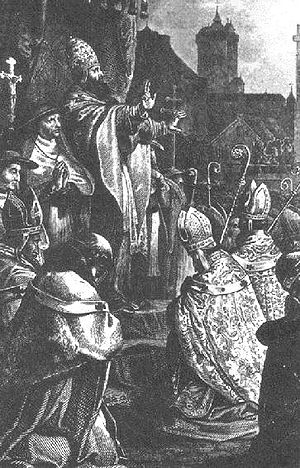
Urban renewal
Where were we? Oh, yes. Roman Empire called for help. West got sidetracked with the Investiture Controversy. In 1095, Alex sends an envoy to ask, Where are you guys? Hello? New pope Urban II holds a council at Clermont in November of that year. At a broader gathering outside the council (which was largely concerned with church matters) he addressed the problems of the Eastern Christians and called on the Western knights to go to their assistance. The text of his address (which varied from place to place) does not survive, but we have accounts written by others in the audiences. Robert the Monk tells us:
They [the Turks] have completely destroyed some of God’s churches and they have converted others to the uses of their own cult. They ruin the altars with filth and defilement. They circumcise Christians and smear the blood from the circumcision over the altars or throw it into the baptismal fonts. They are pleased to kill others by cutting open their bellies, extracting the end of their intestines, and tying it to a stake. Then, with flogging, they drive their victims around the stake until, when their viscera have spilled out, they fall dead on the ground. They tie others, again, to stakes and shoot arrows at them; they seize others, stretch out their necks, and try to see whether they can cut off their heads with a single blow of a naked sword. And what shall I say about the shocking rape of women?
This, and not promises of plunder, got folks riled up. Granted, he also urged the knights to stop fighting one another in Europe and turn their swords outward, but this was not the motive for the call. But he also shifted the focus from simply the liberation of Anatolia to the liberation of Jerusalem.

This was an age of relics and pilgrimages, and no place was more relic-heavy than Jerusalem, where Jesus himself had done his thing. Bad enough that the Arabs had taken it from the Byzantines four hundred years ago. At least they had allowed the pilgrims to come and go unmolested, for a fee. But the new situation was intolerable. It being a feudal age, the whole thing was cast in feudal terms. A vassal is pledged to assist his lord in recovering his lands, and everyone is vassal to Jesus, the lord of all. So how much more are we obligated to recover his lands!
"Whoever wishes to come after me must deny himself, take up his cross, and follow me." (Matt 16:24)
Deus vult! the crowds shouted. God wills it!

Of course, Late Moderns wonder if anyone actually raised such a cry. They cannot imagine it really meant anything to the people of the era, since it means nothing to them today. 

Pilgrim's Progress

So the whole thing became a pilgrimage! It was imagined as an errand of mercy and charity. Everyone taking part took a pilgrim's vow to visit the Holy Sepulcher. Because of the great expense and hardships of the journey, each pilgrim was granted a remission of sin -- just as any pilgrim to any shrine would. His lands were placed under the protection of the Church until his return. Additional vows dealt with fasting, abstinence from sex, particular devotions to be performed along the way, etc. A pilgrim's cross was sewn to the shoulder of his tunic.

Armed pilgrimages were not a novelty, given the unsettled times. But this time around, the pilgrims were not only armed but trained in the use of arms. And there were a lot of them. Their oath was sworn to God, not to the pope or to any secular leader. In fact, none of the "cross-bearers" was actually in command. There was no hierarchy, no organization. It was a mass of several thousands of armed pilgrims heading more or less in the same direction with more or less the same purpose. Lords among the pilgrims could expect to command their own vassals, but no one else. They would elect a commander-in-chief as was customary, but the post was largely honorary and like any large feudal levy there would be much time spent negotiating issues of precedence and honor. No feudal lord worth his fief was going to take stinking orders from a peer! It was a very libertarian era, in a way.
Naturally, as among any large group of people, there were those who ran to the contrary. Knights on the run, robber barons, those out to get rich, those out to impress the troubadours. But they were the exceptions, not the rule. The arduousness of the journey weeded out all but the most serious and committed.
Christendom was aroused. They were pumped! The Vikings and Magyars had been tamed. The cities had been rebuilt. New northern trade routes had replaced the lost Mediterranean ones. The moldboard plow, horse collar, and three-field rotation had unloosed an agricultural cornucopia from the heavy northern soils. As global warming set in, the growing season expanded and more and more land was brought under the plow. At Bologna, in the Holy Roman Empire, a new word was coined: "university." A second like it was formed in Paris, on the Left Bank, and about the time of this commentary, a third, at Oxford, was starting up. Formal charters would come later. Meanwhile, let's see if we can find copies of these Greek books the Latins mentioned. The Byzantines must have some.

After four hundred years of taking it on the chin, of seeing their heartlands seized, their cities raided and sacked, their churches burned and priests killed, and more recently (with the fervent Turks and Moroccans) a renewed intensity of persecution, Christendom was finally going to strike back! A wave of enthusiasm spread over their mountain fastnesses, their fortresses and towns. Those taking the vow included women, the aged, the infirm, clergy, and Spaniards, and some rhetoric was expended to discourage them from going. (Spaniards, in particular, were needed at home for their own crusade, and the others might sorta get in the way.) But since it was a pilgrimage and not a war, it was hard to forbid anyone from trying and the prohibitions were often honored in the breach. Still, you could wear the pilgrim's cross as one of "those that pray."

Except the Spaniards had picked up this weird idea of a "holy war" from the folks they had been fighting with to recover their country. 

References

  1. Belloc, Hilaire. (1936) The Great Heresies, Ch. 4: The Great and Enduring Heresy of Mohammed
  2. Madden, Thomas F. (2006) The New Concise History of the Crusades (Rowman & Littlefield)
  3. McEvedy, Colin. The Penguin Atlas of Medieval History and The New Penguin Atlas of Medieval History. Maps from former are online here.

Tuesday, March 22, 2016

Deus vult! Part I: The Preludes

"But before we become too certain of our rectitude and complacent about how far our society has advanced, we should remember that secular ideological violence -- "ethical" in the sense that it is employed on behalf of a religious or cultural or even pseudoscientific ideal that is considered by its adherents to be of universal importance -- has manifested itself recently in wars waged in the names of imperialism, nationalism, Marxism, fascism, anticolonialism, humanitarianism, and even liberal democracy."
-- Jonathan Riley-Smith, The Crusades, Christianity, and Islam

The Stage Setting

Map from The New Penguin Atlas of Medieval History: Trade Routes and Towns
The World of Late Antiquity was in serious decline. Global warming, with its longer growing seasons and more expansive agriculture, had ended and global cooling had set in. The bubonic plague had, well, plagued the Empire. Population had dropped 20% and cultivated land had contracted, esp. in North Africa, Rome's breadbasket after the wheat of Egypt had been diverted to Constantinople by the New World Order. Town life in Western Europe had virtually ceased even before the Germans crossed the frozen Rhine on the last day of AD 406.

The Empire itself was being called Romania by folks sensing that they were now all in the same lifeboat together. The Gauls had finally given up Gallic for Latin, and the Iberians likewise, though both spoke it with funny accents. Case endings were no longer being pronounced, though they were still being meticulously spelled. (Though odd spelling mistakes are creeping in as the new semi-literate elites have begun spelling things they way they sound.) The Latin demonstrative ille has been clipped to become il or le or even el in different dialects and the definite article has appeared as if by magic.

The Empire is a large agribusiness with luxury goods coming in from the east and bulk commodities circulating on the Mediterranean, the backbone and center of the classical world. Anyone much more than a day's cart ride from the sea coast is S.O.L. bulk shipment-wise, save for what can be raised locally. The grain grown in Egypt and Africa is destined for the welfare lines in the great cities. The peasants in the provinces live in poverty and oppression, and many have been placing themselves under the protection of local counts or (in the West) barbarian barons. (Outside the Empire, in Ireland, it is different: the farms are smaller, the peasants are independent, and they are well-armed.)

North of the Alps, the city lamps have gone out, but there are still four sizable metropolises around the Mediterranean, though only Constantinople is still growing. None of them exceed 125,000 people. Rome itself is only a shadow of its old imperial glory. Anybody who is anybody is headed for Constantinople to kiss imperial butt.

At the time of the map, all the territory shown in the map is Christian of one sort or another except for the North, where the Scandinavians, Saxons, Lombards, Slavs, etc. remain pagan, and the East, where the Persians practice Zoroastrianism. The Arabian peninsula is a mixture of pagans, Jews, and Christians; and there are additional Christians off the map in Ethiopia (Axum), India (Malabar Coast), and in Central Asia.

There are also Jews ruling Yemen, in the city-state of Yathrib (now Medina), and in the empire of the nomadic Khazars north of the Caucasus. Also, as agriculture contracts with the cooling climate, the pagan Berbers of the Sahara have begun raiding the Christian Berbers of the coast.

The Patriarchs

As the Church had grown, so had the need for some sort of organization.  Each of the four metropolises has become the seat of a Patriarch of the Church and under each is a set of local bishops. The idea is to keep the beliefs reasonably uniform. This network parallels roughly the organization of the Empire in which the Church found herself.Or did until trans-alpine Europe began to deflate.

1. First in dignity is Rome, the See of St. Peter, which has administrative authority over all the West, including North Africa as far as Tripolitania (Tunisia) and northern Europe as far as anyone dares go a-calling. About a hundred years before the map, Patrick chased snakes out of Ireland, and about a hundred years after it, Boniface will cut down the Donar Oak in Hesse. The bishop of Rome, who started calling himself "Pope" about a hundred and fifty years before the map, has a collegial doctrinal authority over the whole church. That is, when the others cannot agree on a troublesome matter, they would appeal to Rome.
Alexandria
2. Second in dignity is Alexandria, the See of St. Mark, whose Patriarch is also called "Pope", and who has administrative authority over All Africa east of the Libyan desert and south into Nubia and Ethiopia. It is a raucous and rowdy city, given since ancient times to frequent rioting over even the election of a patriarch.

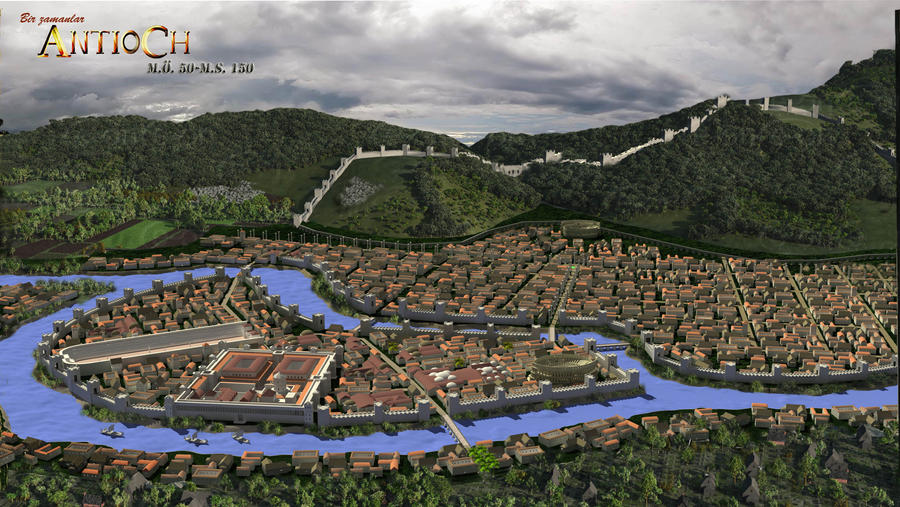
Antioch
3. Third, but disputing precedence with Alexandria from the get-go, is Antioch, the city where folks were first called "Christians." This See, too, was founded by Peter. It has authority over "all the East," including lands under Persian rule, on the Malabar coast of India, and even in China. Antioch is at the end of the Silk Road and the Spice Route and is known even to the Chinese (who call it Tai Ch'in (Daqin)). [The term actually refers to the whole Roman Empire, but the Chinese only knew it as the terminus of the Silk Road.]

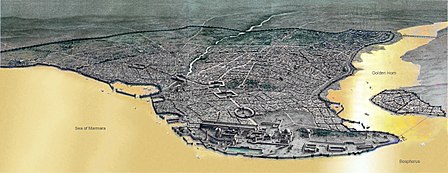
Constantinople, with the Land Walls in the background
4. Finally, the bishop of Constantinople, the See of St. Andrew, has recently been raised by the Council of Chalcedon to the status of Patriarch over the objections of Antioch and Alexandria. But it's hard to say no when one of your parishioners is the Emperor of the Whole Freaking World. Well, of what is still being called the Roman Empire. This gives the Ecumenical Patriarch considerable throw-weight of metal, especially when that metal is carried by Gen. Belisarius and Gen. Narses who, shortly after the time of the map will bring all the cities shown (except the Persian ones) back into the "Roman" embrace. They will even bring in some of the uncitied regions: the remainder of North Africa, the southern third of Spain.

5. A fifth Patriarch, Jerusalem, the See of St. James, administers three provinces in Palestine; but this position is mostly honorary as being the Mother Church. Jerusalem at the time is nowheresville and was given the honor at the council of Chalcedon. Jews had been forbidden to live in Jerusalem by the pagan Romans after the failed revolt of Bar Kockba. This really frosted them and they are eager to return from Arabia and Persia.

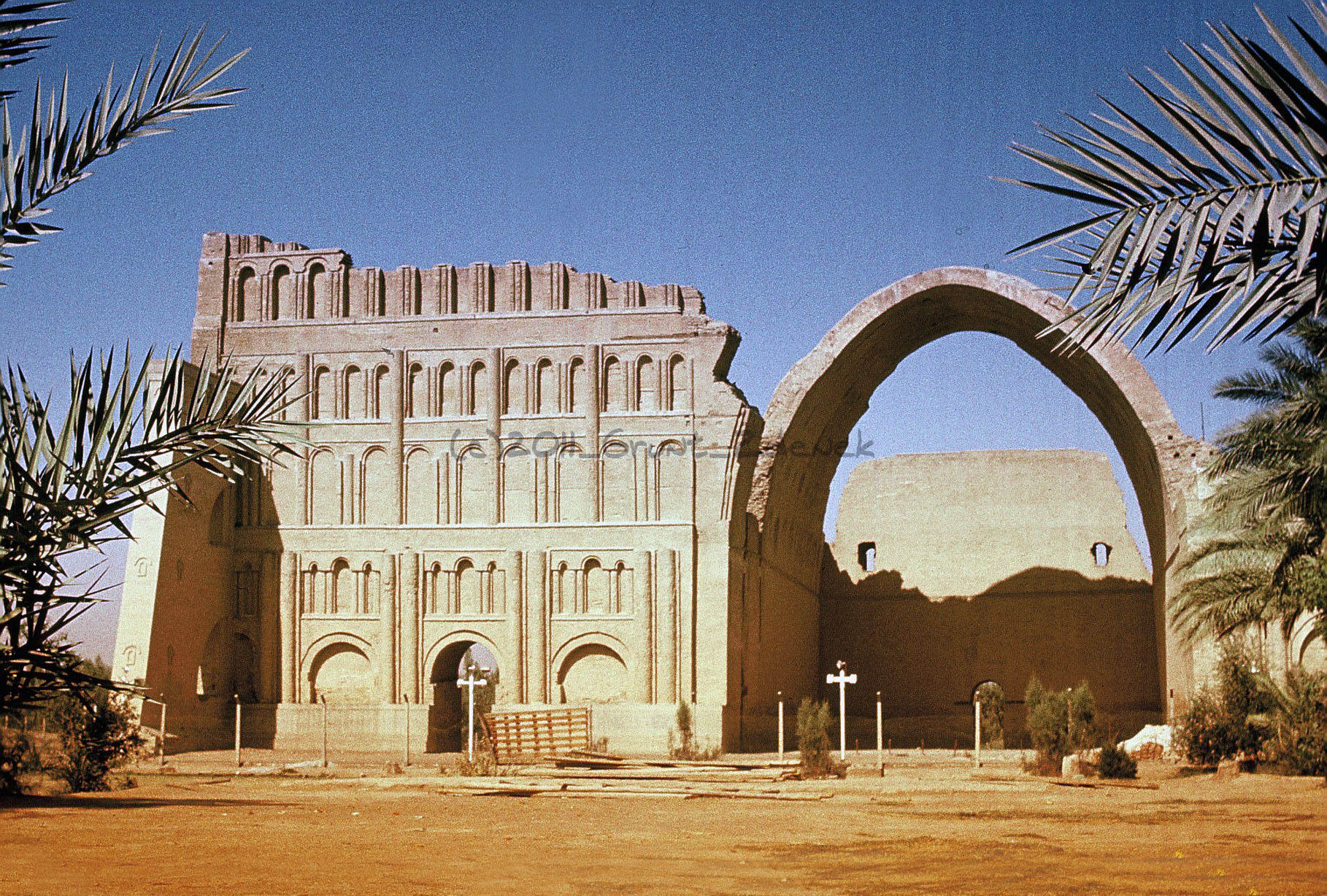
Ctesiphon, what's left of it
6. Outside the system, a sixth patriarch is the Patriarch of Ctesiphon, in Iraq, near what is now Baghdad, and was then part of the Persian Empire. This is the center of the Ancient Church of the East and is not in communion with any of the other Patriarchal Sees. It achieved its status by being outside Roman control. The Nestorians expelled by the Empire after the Council of Ephesus had gone there. Their descendants are the Assyrian Christians currently being massacred and expelled by ISIS.


But all is not beer and skittles. (Except maybe in German lands, where there is at least beer. Come to think of it, they may also have played an early form of skittles. Who knows?)

Vandals behaving badly. Why are football teams named Vikings
and Pirates, but not Vandals and Visigoths?
Rome, away off in the mostly-rural West has her own problems. The Eternal City has proven not so eternal. She had been sacked (almost reverently) by Alaric's Visigoths (410) demanding their back pay as foederati, then by the Vandals (455) (who thereby gave us "vandalism"), and will shortly be besieged and wasted in the upcoming 10 Years War between Byzantium and the Ostrogothic kingdom shortly after the time of the above map. The Ostrogoths are trying to keep up appearances for the sake of the kids, but otherwise the Western Patriarchate consists of a gaggle of Germanic warlords, and their spiritual shepherd is more like a border collie. The situation around map-time is roughly this:

Clovis united the Franks into a single nation, and converted to Catholicism a generation or two before the map. But the Frankish custom of dividing the inheritance among all surviving male heirs means a) unified kingdoms split up in the next generation and b) the next generation starts killing one another. The Visigoths in Spain are about to switch from Arian to Catholic ca. 589, but the Ostrogoths in Italy will remain stubbornly Arian until the Byzantines arrive, kick their butts, and snuff out the lights in Rome.

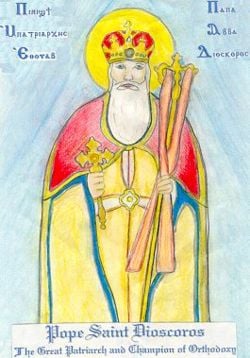
Pope Dioscorus of Alexandria
is a saint in the Coptic Church
But the truly fatal flaws are in  the East, where religious tumult brews over Christological matters that seem rather obscure to Moderns. A succession of heresies -- Arianism, Nestorianism, Monophysitism, and others in between -- have inflamed passions. Somehow.

In overreaction to Nestorianism, there had been a swing to the opposite extreme of Monophysitism. So a Council had been called at Chalcedon in 451 to settle things. This Council declared that Monophysites had cooties and deposed Patriarch Dioscorus from the See of Alexandria, installing Proterius in his place.

Pope Proterius of Alexandria is a
saint in the Eastern Orthodox Church
The non-Chalcedonians in Alexandria took offense at the deposition of Dioscorus and thought the pro-Chalcedonians looked too much like neo-Nestorians. In time-honored Alexandrian fashion, they settled the debate by mob violence. A mob attacked Proterius in the cathedral baptistery during Holy Week, dragged him through the streets behind a chariot, dismembered him, and burned his body, thus showing their displeasure in that very special Alexandrian way (cf. Arian Bishop George (361), philosopher Hypatia (415), and Prefect Callistus (422)). Thus began the line of Coptic Popes of Alexandria. Most of the Egyptians went with the non-Chalcedonians so this represents the majority, but an official (Chalcedonian/Orthodox) Patriarch continued to administer the church in the name of the emperor, and persecute the Copts, who began to look around for someone, anyone to liberate them from Greek oppression. The irony is that the non-Chalcedonians were not really Monophysites. The real problem was that the Greeks were in freaking charge and did not want anyone to forget it.

The situation in Antioch was similar, but instead of killing the Orthodox patriarch, the Syrians simply continued to recognize the deposed heretical one and after AD 518 Antioch wound up permanently with two Patriarchs. Again, much of this was rooted in Syrian resentment against heavy-handed Greek rule. Ironically, both the Egyptians and the Syrians also regarded genuine Monophysites as heretics and preferred to call themselves Miaphysites.
From our distant perspective, much of the problem seems to have stemmed from the difficulty of translating Greek philosophical terms into Syriac and Coptic. These were not only different languages, but were from different language families! Concepts that were distinct in Greek overlapped in Syriac. Discussions in 1984 between St. John Paul II and Mar Ignatius Zakka I Iwas, the Patriarch of the Syriac Church, concluded the whole thing was a matter of "differences in terminology and culture and in the various formulae adopted by different theological schools to express the same matter."

In 525, shortly before the above map and off its southeast border, Dhu Nuwas, a pagan Yemeni convert to Judaism rebelled against the Ethiopian garrison and attempted to forcibly convert the Christian Arabs of Najran, throwing those who refused into a burning ditch. Survivors who escaped to Ethiopia secured a punitive expedition from Axum, which crossed into the Yemen and kicked Yemeni butt. The story of the Martyrs of Najran spread all over the Middle East.
The Relevant World in AD 600, on the Eve of the Byzanto-Sassanid Was
Last but not least, a new round (602-628) of the neverending war between the occupier of the Iranian Plateau and the occupier of the Anatolian Plateau -- a war that goes back to Achaemenid Persia vs. Lydia -- was being played out between the Sassanids and the Byzantines. The Persian Sassanids take advantage of a Roman Civil war, which we won't Phocas on, and invade Anatolia, Syria, and even Egypt. Woo-hoo. It's Cyrus the Great reborn! The Persians bring a force of Jews along with them and restore them to Jerusalem. Even more shades of Cyrus! The Jews then proceed to slaughter all the Christians in town. Bad tactical move.

The Persians think this is going a little too far and begin to suppress the Jews, who respond WTF? Fun and games in the early 7th century. Heraclius, the governor of Africa, overthrows Phocas and after a penalty flag for offsides, throws long and goes straight for the Persian heartland. The shah pulls all his troops out of the Empire to block him and gets himself assassinated by his brother, who sues for peace. He's like, Dude, what were you thinking?

Jerusalem is now back under Christian rule. The Jews are like uh-oh.

Shah and Emperor look around and realize that nearly thirty years of continuous war has seriously depleted their military resources. Oh well. We'll just take some time to patch things up and rebuild.

But they would not have time, because....

It's Jihad Time!

Prometheus Awards: Read & Watch

 Hello Friends & Fans of Michael Flynn,       The Libertarian Futurist Society has made available the text of the acceptance speech Dad...