Who could forget that remarkable discovery that gave Anatolia pride of place for the world's first big city? It turns out that one of its investigators
. A bit of a Piltdown situation, eh what?
. Now, like the DNA lab that faked some of its results or the detective that planted some of his evidences,
of the data now needs to be revisited. What a bummer.
, especially now that they can have a president for life.
In Russia, the population is stagnating, the economy is stagnating, investment is stagnating. Who's going to invest money in a country where it could get stolen by the kleptocrat the moment you fall out with him? The US, with a population about double that of Russia, attracts ten to twenty times the foreign investment.
4. Sociopaths Rule!
 |
| H. sociopatheticus |
The estimable
Joseph Moore points out the key role of sociopaths in today's society, one of whom he tags as Mr. Zuckerberg, founder of the Book of Faces. Really, sports fans, can anyone suppose that this device was ever intended as anything other than a vehicle for delivering personal information to various advertisers, commercial and political? How do we suppose they made their billions? Remember,
the product is that for which someone pays cash money; and where
Facebook is concerned, advertisers pay cash money for the eyeballs of the users.
You, mi amigo, are the product.
Some advertising guru once noted way back in the days of Mad Men, in between sleeping with their secretaries and each others wives, that
only about half of all advertising was effective. The problem was that no one knew which half. And so the public was spattered with twice as many ads as necessary in the hopes that half of them would stick. In the Fifties, it was believed that the sight of a man in a white lab coat using approval-words like "scientific" would entice people to purchase the desired shampoo or toothpaste; but this has changed to images of alluring models clinging to the product and using the approval-word "sexy," thus signalling a new mode of processing sales pitches.
 |
The Lost Generation discovers
sex right in their back yard |
A hundred years ago, advertising contained thick blocks of text with complete product specifications. Ho ho. How naive our great grandfathers were! Or else they were more hard-headed and no-nonsense and preferred their sexy babes live and in person rather than in magazines. (There were no televisions.)
The genius of the Book of Faces was to replace broadcast with narrowcast. People hated getting flyers and brochures for crap they didn't care about. So by carefully sorting through people's interests as expressed by themselves, advertisers could ensure sending adverts pretty much to people who had some interest in the material to begin with. So far, so good. No need for Big Brother to spy on us when we could spy on ourselves for free.
Well, you can't expect politicians to pass that up. After all, they are also in the advertising business, and this would enable them to spend their campaign money sending flyers, info, robocalls, and all the rest of that welcome and heartwarming outreach to people who might actually be inclined to listen. (TOF pauses to clean up the hot-beverage-snarfed-out-the-nose from your keyboards.)
So the Great Scandal of
Cambridge Analytica was not that they scraped Facebook Data, but that they did so for the purpose of helping the Devil Incarnate, i.e., Donald Trumphiltler and/or Brexit. Had they done so to benefit Hilary Clintonstalin, we would never have heard squeak about it, for then it would have been in aid of Heaven's Purpose, i.e., the Worker's Paradise, or Venezuela. (We know this because no one had a cow about
the Obama campaign scraping customer data back in the 2008 election, indeed they were lauded for being "tech-savvy.")
The one thing we have not heard is whether anyone paid the slightest attention to any of the ads that were intended to move them to get out for Trump. Indeed, the fact that people's eyeballs cruise over nasty (or nice) ads seems to have
very little influence at all, despite either the boasts of providers of these services or the apocalyptic warnings of the fear-mongers. We are only told that folks were "exposed" to them, as if people were particles devoid of will, moved by mechanical forces. But since the whole purpose of the exercise was to identify those who were inclined to Trump in the first place, it's hard to see the horror of it all. Unless there is Something we're not being told beyond the "boo words" of our information being "weaponized."
Of course, the real danger of the giant rumor mill/echo chamber known as "social" media is that it is simply a set of bubbles and not very social at all. It's a way of sealing ourselves off under the illusion of being "connected." At least, in the old "broadcasting" paradigm you ran the occasional risk of a chance encounter with something that you were not already interested in. A point of view that was not already your own. A product or book or movie that was not already on your radar screen -- and you might,
might, decide to give it a shot and find that it wasn't half bad. Or that what the Other Side said about itself was not the same as what Your Side told you that They had said. And your bubble might expand, even if just the tiniest bit.
Or not.
5. Speaking of Russia
Which we were, sorta.
What exactly was the "meddling" which the Russians were supposed to have done? It's not very clear, only that it was surely nefarious, it involved the infamous Internet. and it was engineered by people who do not use articles or the present tense of the verb "to be." Despite all the news stories about how bad the meddling was, it has never been made entirely clear to TOF of what the meddling exactly consisted. Was it like, say the meddling in the Iranian election of 1953 when the CIA helped overthrow the elected government; or the interference in the Chilean election in 1973 with the overthrow [and killing] of Allende. Or Italy in 1948, or the Clinton-assisted
election of Yeltsin in Russia?
No one has ever accused the Russians of being more deft than the US, but it seems that the Russian interference has created barely a ripple on the surface of a still pond, while sundry US interferences have created choppy waters indeed. Surely, the CIA is more adept at this sort of thing. Or is this more like pranking than serious "interference"? To TOF, the term "interference" implies a perturbation in the outcome of the election, or at least in the process. As far as we can tell, the only ones trying to alter the election outcomes are Tammany Hall and its allies in media, academe, and the Deep State.
The Nation, a somewhat left-of-center journal, notes:
A $100,000 Facebook ad buy seems unlikely to have had much impact in a
$6.8 billion election. According to Facebook, “the vast majority of
ads…didn’t specifically reference the US presidential election, voting
or a particular candidate” but rather focused “on amplifying divisive
social and political messages across the ideological spectrum—touching
on topics from LGBT matters to race issues to immigration to gun
rights.” Facebook also says the majority of ads, 56 percent, were seen
“after the election.” [emph. added]
As nearly as TOF can tell, the Russians -- TOF fondly remembers when they were "the Reds" and the Republicans railed agin' them and the Dems favored detente -- supposedly hacked the emails of the Democratic Party and gave them to Wikileaks and furthermore -- and this is the connection with the previous item -- placed Fake News™ on Fakebook in order throw Shade on the Election.
If this last were the Russians' objective, then we must ask ourselves who has been running about casting doubts on the legitimacy of the recent Election, because
they are the ones furthering the Russian agenda. But no one seems to be asking that, so we are cast back on wondering anew at the incredible subtlety of the Russians.
 |
| Feel the Bern |
No one, least of all when they were embarrassing George W. Bush by leaking all that stuff about the Iraq war, suspected that Wikileaks was a secret tool of Russian intelligence. Wikileaks itself claims that the emails came from a disgruntled Democratic insider. (From the appearances, it would seem to have been a Bernie supporter who was disgusted at the way the Party had, against its own rules, taken sides in the primaries against the Bern and for the Hill.) Consequently, enough Democratic Socialists sat on their hands during the elections that the Blue Wall cracked and Mr Trump, after completing his assigned task of wrecking the Republican Party, found himself in unexpected possession of the oval office and to all appearances unsure what to do with it. Mrs Clinton, deceived into expecting a petal-strewn coronation by a worshipful media, found herself gobsmacked by flyover country and unable coherently to account for it.
 |
The "Blue Wall" -- the "reliably Democratic states" -- cracked red in 2016:
A few hundred kilovotes shifted WI, MI, PA. Even MN stayed blue by a mere 44,765 votes.
Darned clever, those Russians, I say. Or was it Comey? |
The Russians also apparently planted false or slanted stories in Fakebook --
quelle surprise! -- although TOF has not seen any illustrative examples cited. Since more than half of these ads appeared
after the election had already taken place, we are doomed. The Russians have already violated causality. They have found a way to meddle largely after the fact!
However, planting false or misleading stories is a fine old tradition in US politics. Remember when the Democrats (the president of Yale University, no less) spread stories that John Adams was a
"hideous hermaphroditical character"? Or the Federalists told us that Jefferson would create a nation where “
murder, robbery, rape, adultery and incest will openly be taught and practiced” by Jefferson's Democrats? [OK, so the Federalists came close...] TOF suspects any fables of specific Russian origin would have been lost in the chum of those planted by Democrats, Republicans, news reporters, bloggers, and other free-lance operatives. Any spurious stories about Mrs Clinton, we suspect, would be swallowed only by those already inclined to swallow spurious stories about Mrs Clinton. IOW, not likely to shift any votes. (BTW, the converse is true of spurious stories about Mr Trump. But this is harder to perceive because you already believe those stories and don't realize they are spurious. You are probably still hiding your wimmin from the notorious Mr. Jefferson.)
But no one has provided evidence that anyone previously inclined to vote for Mrs. Clinton voted for Mr. Trump instead as a result of any of these ads, let alone as a result of a specifically Russian ad. Or vice versa. IOW that, as a practical matter, there was any effective meddling by anyone except the DNC, who apparently very effectively torpedoed the campaign of Mr. Sanders.
6. Numbers, We Got Numbers.
Or not.
You have to remember that biology is sorely deficient in numbers when compared to physics or chemistry, and is therefore a sort of Junior Varsity member of Team Science -- at least from the 18th century Scientific Revolution perspective. You may recall that one of the pillars of the Revolution was the privileging of Mathematics as the language of discourse in Science. And so we have equations for Newton's Theory, Maxwell's Theory, Boyle's Theory, Einstein's Theory, and sundry others. But we have, alas, no equations expressing Darwin's Theory.
Well, fair is fair. Math does show up in places in biology, usually in bio
physics and bio
chemistry; but also in genetics and in bio
statistics. Although statistics is not the same thing as mathematics. A topic for another day, except that the softer the science, the worse its praxis in statistics. And when the science is social it gets downright mushy.
Case in point, as Rod Serling used to say:
correlation. Ever since David Hume (or perhaps since al-Ghazali), correlation has held pride of place over causation because of the inability of inductive reasoning ever to establish causation with any certainty. Correlation establishes only a co-relation between two variables measured on the same unit. This requires:
- measurements
- on the same units
An example recently promoted by "The Gift that Keeps on Giving," a.k.a. Jerry Coyne, is that "
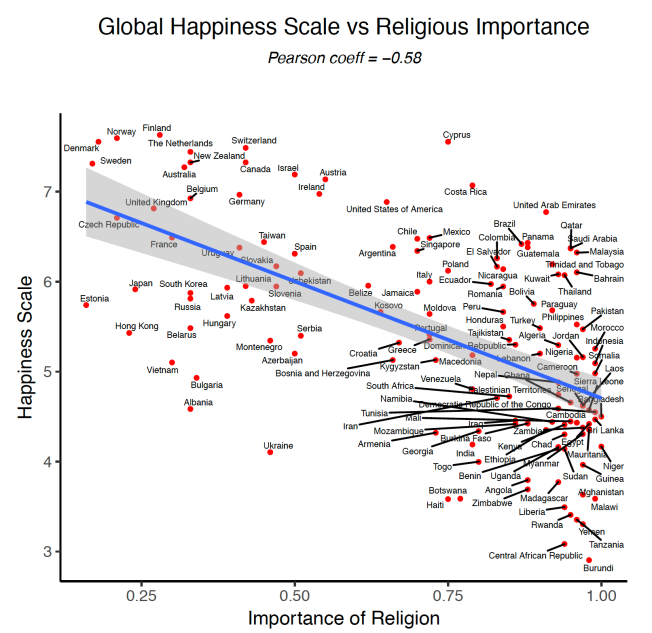
the happiest countries are the least religious." It is a happy¹ illustration of Thucydides' dictum that people will swallow anything if it accords with their prior beliefs.²
We first note that the Coynester has committed the scientific crime of reifying an abstraction. Countries cannot be "happy" (or "religious"), only a human being can be either.
Second issue: how do you measure "happiness" even on an individual? With a hap-o-meter? (Preferably one calibrated to a standard certified by NIST). This is perhaps more evident a problem to a physicist than to a biologist or a social scientist. The latter in particular is conditioned to accept a questionnaire as an "instrument."
More particularly, did respondents mean the same thing by "happiness" in Bhutan as they did in Tanzania? Was a person who scored a happiness of 6.4 on the "happiness scale" twice as happy as one who scored a 3.2? That is, is the happiness scale a ratio scale? If not, the whole procedure of averaging and correlating is illegitimate to begin with.³ Did happiness ratings within a country form a single statistical population? If not, there may be no average for that country. (What is the average number of testicles possessed by a human being?)
All of the same questions apply to the religiosity scale. What exactly is "importance of religion"? What us meant by a religion? Is shamanism even the same
kind of thing as Buddhism?⁴ In those countries possessing established churches, citizens are enrolled in the approved churches for tax purposes, whether they attend that church or not. Does this count? Does
pro forma attendance? Does the devoutness of attendees? Who measures such subjective attitudes? How do they do so? With what precision? Does "religiosity" mean the same thing in China as it does in Bolivia?⁴
Notes:
1. happy. Lucky, fortunate. See also may-hap, happen, happenstance, hapless.
2. Thucydudes, History of the Peloponnesian War, IV, 108
3. ratio scale. See Deming,
The Statistical Adjustment of Data.
4. Buddhism. Yeah, we know which religion they really mean; but let's go with the flow.
A vital issue:
Were the happiness and the religiosity "measured" on the same units (people) or only within the same geographical region (country)?
Imagine trying to determine the relationship between nitrogen content and tensile strength of steel if the two properties were measured on different heats. Even a biologist might hesitate to rely on such results even if he did not notice the metallurgist rolling on the floor laughing his guts out. As a thought experiment, imagine Coyne's reaction to a correlation across US metropolitan areas of the cancer rates in census districts versus the usage of lawn services in those same districts, with no attempt to discover whether the households experiencing the cancers were the same households employing the lawn services!
Another issue to be considered is whether one should treat all countries as equal units when they vary widely in size: Singapore is small and compact; Brazil is not.
The reported correlation coefficient is r= ‒0.58. No self-respecting engineer would entertain such a value or r for a New York minute, although TOF has been told that soft "scientists" put much stock in any r greater than zero, provided they have wee p-values. This can be ascribed to their training in "cookbook statistics". But let it be said that you can have a very high "confidence" around a completely wrong value. An r= ‒0.58 means an r²= 0.34. This means that only about one-third of the
variation-in happiness among-countries is "explained" by its association with religiosity of those countries. (Whatever that means.)
But is that even the correlation? A good correlation will often form a 'hot dog' pattern on a scatterplot; a poor one, a 'hamburger.' It is not clear that the scatterplot here is a hot dog or a hamburger with a tail. That is, the weak appearance of a correlation may be due to multiple clusters of points. See below, right. The vast majority of points form an amorphous ball on the right. A second cluster in the northwest consists of Western Europe and a third cluster in the southwest consists of Eastern Europe and East Asia. This is a common pattern on scatterplots: several hamburger clusters so arranged that they line up as a hot dog.
Apparent correlations between X and Y can indeed come about when:
- X is a cause of Y
- Y is a cause of X
- Z is a lurking cause⁵ of both X and Y
- coincidence
 |
| A hot dog [l.] is actually tow hamburgers [r.]. |
The correlation in the left hand plot apparently shows that errors decrease with increasing workload on the clerks. The managers were delighted. To reduce errors we will give the clerks more work! But wait. There were two clerks: Adam and Betsy. Betsy was more experienced. She got more work done and made fewer errors than Adam. There was a causal relationship,
but it was not between X and Y! It was between Z and X and between Z and Y. (In the actual case, there were four clerks. The case has been simplified for presentation purposes.)
These are all technical issues associated with the use of the statistics; but there are also substantive issues associated with the hypothesis supposedly being tested.
A flawed hypothesis
Everyone gives lip service to the fact that correlation is not causation, but then turns around and acts as if it were. The Coynester is no exception to this rule and chortles over the "fact" that religion does not result in happiness for its practitioners. (Notice the leap in logic here. That is not even what the data is supposed to show. These are
countries, not people.) But why should anyone suppose that "religiosity" however defined should be expected to entail "happiness" however defined? It may be the opposite case: unhappiness may entail religiosity, at least of certain types. Recall that the Church is sdaid to be a hospital for sinners, not a country club for saints. One would no more expect religious people to be happy than hospital patients to be well.
Furthermore, the original UN survey on happiness concluded that happiness was correlated with other vatiables like social support, GNP, and other factors.People sampled from Western countries were happier because they were wealthier and had more Stuff. not because they were less religious.
Although he is only a biologist, Coyne acknowledges much of this scientific lore, and even admits that religious people may be unhappier because their unhappiness leads them to seek the consolations of religion rather than vice versa; and then suggests that, once their creature comforts are ensured, they can let go of religion.
Perceptive TOFians will realize that since religiosity questions and happiness questions
were not asked of the same people, he can' even say that much.
Notes.
4
. (a)cross-country comparisons should be made with great care because different countries often use different operational definitions of the variables.
Infant mortality is a well-known example. Even within a country, definitions sometimes change. See the
Historical Abstracts of the United States for examples
5. lurking cause. A nice article on the subject is Brian Joiner. "
Lurking Variables: Some Examples."
The American Statistician 35(4): 227-233 (Nov 1981)
7. Instantaneous Propagation of Causation Without Violating Relativity
This is regarded as impossible by non-Aristotelians, but is trivial to Aristotelians. The example is derived from
Matt Briggs, based on
Heisenberg's interpretation of quantum mechanics.
Suppose you and your buddy Nathan Detroit have agreed to meet tomorrow evening at a social club run by Sky Masterson at six PM for beer and
skittles. The probability that you will do so is now P=1.
However, unbeknownst to both you and Nathan, the IRS has raided the joint this very afternoon for running a numbers game -- i.e., something very like the state lottery, but not authorized by the State, and therefore unfair to the betting public -- and has closed and padlocked the establishment. The probability that you and Nathan will meet there tomorrow for beer and skittles has now become intantaneously P=0. There is no speed of light limitation on the propagation of this cause. It became effective immediately [no time lag] everywhere [even widely distant places] once it was served. (Of course, you will not
know about it right away, but that is epistemic, not ontic.)
Spooky action at a distance? Who'd'a thunk it?
8.Foam armor
One of the cute features of the Spiral Arm series was a vault warded by a door of marshmalllow. Cf. The January Dancer and the excerpted short story, "Sand and Iron" [Analog, Jan 2008]. Now we have
this announcent. Even SF set thousands of years in the future is not safe!


