From Publishers Weekly's Sept. 28 issue:
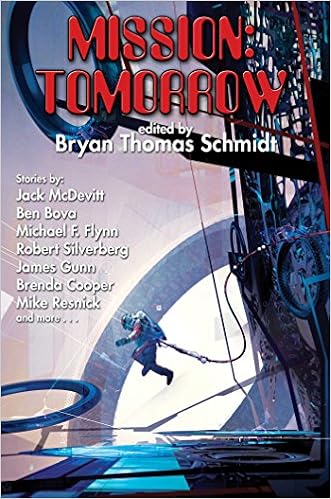
Mission: Tomorrow
Edited by Bryan Thomas Schmidt. Baen, $15 trade paper (336p) ISBN 978-1-4767-8094-8
What happens to the final frontier when corporations replace NASA?
These 19 often satirical, sometimes hopeful stories (17 original to this
volume) depict a variety of near futures in which “outer space
technicians” replace astronauts (“Ten Days Up” by Curtis C. Chen) and
work-from home asteroid miners fight off claim-jumping hackers (David D.
Levine’s “Malf”), while eccentric billionaires promise the stars (Jay
Werkheiser’s “Around the NEO in 80 Days” and Christopher McKitterick’s
“Orpheus’ Engines”). While there is some variation—China is the last to
launch in “Tribute” by Jack Skillingstead, but the first to capitalize
on space in “Rare (Off) Earth Elements” by Ben Bova—most pieces revolve
around small-time operators and their struggles to survive the oncoming
corporate space race. Readers looking for a solar system tour from
Mercury to the Kuiper Belt will be entertained by Old West–style
marshals rounding up the usual suspects (Michael F. Flynn’s “In Panic
Town, on the Backward Moon”) as well as robots seeking justice and
battling loneliness in the great dark night (Brenda Cooper’s “Iron
Pegasus”). Editor Schmidt adds grandmasters to a mix of newer
established names and balances the tragic with the humorous. (Nov.)
A stellar list of contributors, sez TOF, among which TOF was inexplicably included.
The OFloinn's random thoughts on science fiction, philosophy, statistical analysis, sundry miscellany, and the Untergang des Abendlandes
Showing posts with label stories. Show all posts
Friday, September 25, 2015
Friday, April 24, 2015
From the Corner of the Eye
The first of the Irish Pub stories, now up on the Story Page, was actually the second one written. "From the Corner of the Eye" appeared in Analog (Nov. 1993). Like all its successors, it is a frame story; that is, a story-within-a-story, amounting to some 3900 words. As such it is an heir and homage to Pratt and deCamp's Tales from Gavagan's Bar and Clarke's Tales from the White Hart as well as more recently, Spider Robinson's Callahan's Saloon.
A frame device is distancing, so to maintain a degree of conflict, we have the denizens of the bar engaged in an argument, which elicits the story from Professor Cooker.
The regulars at the bar introduced in this story are O Daugherty Himself (the bartender), Mickey (the narrator), Danny Mulloney, Doc Mooney, and The O Neill. The latter has the habit of ducking out whenever one of these stories begins.
The compleat Irish Pub stories to date are:
A frame device is distancing, so to maintain a degree of conflict, we have the denizens of the bar engaged in an argument, which elicits the story from Professor Cooker.
The regulars at the bar introduced in this story are O Daugherty Himself (the bartender), Mickey (the narrator), Danny Mulloney, Doc Mooney, and The O Neill. The latter has the habit of ducking out whenever one of these stories begins.
The compleat Irish Pub stories to date are:
- From the Corner of the Eye (3900 words)
- Flame of Iron (2200 words)
- Built Upon the Sands of Time (6000 words)
- 3rd Corinthians (3900 words)
- Still Coming Ashore (11,000 words)
- Probably Murder (930 words)
- Where the Winds Are All Asleep (18,300 words)
Thursday, February 26, 2015
Great Sweet Mother
Another old story is posted on the PREVIEW PAGE: "Great Sweet Mother" from Analog (June 1993). It is a 4100-word short story that sits in the NANOTECH CHRONICLES universe, although it was written after that collection came out. Timewise, it sits after The Washer at the Ford and perhaps roundabout "Remember'd Kisses." Singer is dead and Peeler is running Singer and Peeler.
It is half of a dialogue. The narrator is addressing the reader, who has come across the narrator under odd circumstances. The reader's portion of the dialogue is omitted, and is indicated by "..." You may have questions or comments at different points in the narration, and it will be amusing to see if any of the narrator's responses align with them.
Saturday, January 31, 2015
The Blood Upon the Rose
The latest Blast From the Past is up on the Story and Preview Page. "The Blood Upon the Rose" is a 2100-word short story. It appeared first in Analog (Feb 1991) then in the collection The Nanotech Chronicles. Later it was pirated by a German agent who had gone rogue and sold his clients' stories without the ugly necessity of actually paying the clients. It appeared without payment in the Heyne Verlag collection Lenins Zahn und Stalins Tränen.
The story is set futureward of "Werehouse," which we showcased here a while back. (Hence, the reference, "...people became animals...") Even so there is a quaint reference to "...make the videotape..." The United States at this time is under the control of an ecumenical heresy symbolized by the "star-cross-and-crescent" and everyone is being ecumenically persecuted, proving that the enemy of my enemy may be simply one more enemy. Hence, the odd laundry list of offenses and defiances.
The intent was to tell the story after the manner a fable, so the narrator and the two characters speak in high language.
The story is set futureward of "Werehouse," which we showcased here a while back. (Hence, the reference, "...people became animals...") Even so there is a quaint reference to "...make the videotape..." The United States at this time is under the control of an ecumenical heresy symbolized by the "star-cross-and-crescent" and everyone is being ecumenically persecuted, proving that the enemy of my enemy may be simply one more enemy. Hence, the odd laundry list of offenses and defiances.
The intent was to tell the story after the manner a fable, so the narrator and the two characters speak in high language.
Tuesday, December 16, 2014
Sisters of the Sacred Heart
This was one of the toughest stories to move. It was written originally in June 1989, and Gardner Dozois said it was a perfect story for The Twilight Zone magazine. Alas, TZ magazine had folded, and Gardner wasn't looking for that kind of story. Also, it was too long. I shortened it and tried some more. KK Rusch did not like the original ending. Neither did some others who looked at it. It was substantially revised in 1991, 1992, and 1997. Along the way, it got tightened, rewritten, re-ended. The version posted here at the STORY PREVIEW PAGE is like rev.5 or something. It is, however, substantially the same story of 1989.
Eventually, it found a home in the magazine Dappled Things (Easter 2010)
Tuesday, November 11, 2014
Werehouse
In the late 1980s I set out to write hard science fiction fantasy stories. These included pixies ("From the Corner of the Eye"), dragons ("Dragons"), ghosts ("Mammy Morgan Played the Organ; Her Daddy Beat the Drum"), mummies ("Flame of Iron"), demons ("The Feeders"). "Werehouse" is the werewolf story.
It is very likely the most awful, hopeless, cynical, and depraved story I've ever written. In a strangely literal sense, it stinks. There is a rape and several murders. It uses some bad words and the future in which it takes place is one where things have gone not just wrong, but very, very wrong in multiple ways. It was inspired by the then-popular slogan "Sh*t H*ppens" and the mindset which that implies about agency and responsibility. What happens if indulging the appetites is given free rein. I thought for a time that I would not post it, and perhaps I shall only leave it up for a short time. Let's call it a cautionary tale. It's told in the first-person illiterate
At 11,000 words, it is novelette length. I sent it to Analog, which turned it down as too disgusting, then to Asimov's, which didn't buy the science. Omni also turned it down and Amazing responded that it was not accepting unsolicited mss. Finally, Toni Weisskopf told me about New Destinies, a Baen paperback "magazine" and it appeared in their Fall 1990 issue. It was included in my collection The Nanotech Chronicles and again in a Baen anthology titled Tomorrow Bites.
The carters in the story take the name from Henry Carter in "Remember'd Kisses" and the old newspaper headline Kops Katch Killer Klone refers to "The Laughing Clone," both also included in The Nanotech Chronicles. A close reading of the later Nanotech stories and the "Neighborhood" stories in Captive Dreams indicate an alternate history within the cycles. "Werehouse" is a darker future than the others.
To read the story, if you've the stomach for it, go over to the the story preview page.
It is very likely the most awful, hopeless, cynical, and depraved story I've ever written. In a strangely literal sense, it stinks. There is a rape and several murders. It uses some bad words and the future in which it takes place is one where things have gone not just wrong, but very, very wrong in multiple ways. It was inspired by the then-popular slogan "Sh*t H*ppens" and the mindset which that implies about agency and responsibility. What happens if indulging the appetites is given free rein. I thought for a time that I would not post it, and perhaps I shall only leave it up for a short time. Let's call it a cautionary tale. It's told in the first-person illiterate
At 11,000 words, it is novelette length. I sent it to Analog, which turned it down as too disgusting, then to Asimov's, which didn't buy the science. Omni also turned it down and Amazing responded that it was not accepting unsolicited mss. Finally, Toni Weisskopf told me about New Destinies, a Baen paperback "magazine" and it appeared in their Fall 1990 issue. It was included in my collection The Nanotech Chronicles and again in a Baen anthology titled Tomorrow Bites.
The carters in the story take the name from Henry Carter in "Remember'd Kisses" and the old newspaper headline Kops Katch Killer Klone refers to "The Laughing Clone," both also included in The Nanotech Chronicles. A close reading of the later Nanotech stories and the "Neighborhood" stories in Captive Dreams indicate an alternate history within the cycles. "Werehouse" is a darker future than the others.
To read the story, if you've the stomach for it, go over to the the story preview page.
Wednesday, July 9, 2014
The Longford Collector
Continuing our series of Early Flynn, we have "The Longford Collector" (Analog, Jul 1988) now appearing on the Story Preview page. The year 1988 was the annus mirabilis of Flynnic fiction, for no less than six stories and one fact article appeared that year in Analog, albeit two of the stories under pseudonyms. The fact article, "An
Introduction to Psychohistory," was a two-parter. The four stories under the Flynn name were "The Steel Driver," "The Longford Collector," "The Adventure of the Laughing
Clone," and "Remember'd Kisses." The pseudonymous works were "Throop's Revenge" and "Grave Reservations."
"The Longford Collector" was supposed to be the first in a series of mystery stories, each named after an Irish tune and involving the Shaw-Locke detective agency and their artificial intelligence. For some reason, it never gelled and this is the only story that got written, though the main characters show up in a cameo in the story "Buried Hopes," which appeared in the collection Captive Dreams.
One of the things present readers will notice is that the Web did not then exist and our detectives had to arrange for modem links to access various data bases. [As TOF had to do while writing cross-country with Niven and Pournelle.] Also, this was just before neural nets became sexier than knowledge bases and decision trees as a foundation for AI. At one point Jamie has to explain to his relatives how a scanner works 'like a printer in reverse.' How times do change! Also the statement that "the price of gold is over $400/oz." seems a bit quaint, but it had been $35/oz. when it was liberated. The Lt. Charles Schwar mentioned is the story was a cousin of TOF's grandmother. Back in the 1920/30s he was head of the Phila. Missing Persons Bureau, and is mentioned in two separate news stories found here and in another story here.
Luckin is real. TOF worked with Dick Luckin at the old Coors Container Company back in the day, and he really was a railroad enthusiast who made a catalog of railroad china titled Eating the Rails. By some weird coincidence, my brother Kevin was asked a couple weeks ago to address a railroad group in Denver about the extension of the RTD light rail system. Kevin is a spokesman for RTD. During casual conversation, Dick realized that Kevin was my brother and he mentioned this story, amazed that such an ordinary thing as railroad china could become the germ of a story idea. Kevin called me just after I had prepped this story and staged it in the cue for posting today. Coincidence? Cue Twilight Zone music.
###
"The Longford Collector" was supposed to be the first in a series of mystery stories, each named after an Irish tune and involving the Shaw-Locke detective agency and their artificial intelligence. For some reason, it never gelled and this is the only story that got written, though the main characters show up in a cameo in the story "Buried Hopes," which appeared in the collection Captive Dreams.
One of the things present readers will notice is that the Web did not then exist and our detectives had to arrange for modem links to access various data bases. [As TOF had to do while writing cross-country with Niven and Pournelle.] Also, this was just before neural nets became sexier than knowledge bases and decision trees as a foundation for AI. At one point Jamie has to explain to his relatives how a scanner works 'like a printer in reverse.' How times do change! Also the statement that "the price of gold is over $400/oz." seems a bit quaint, but it had been $35/oz. when it was liberated. The Lt. Charles Schwar mentioned is the story was a cousin of TOF's grandmother. Back in the 1920/30s he was head of the Phila. Missing Persons Bureau, and is mentioned in two separate news stories found here and in another story here.
Luckin is real. TOF worked with Dick Luckin at the old Coors Container Company back in the day, and he really was a railroad enthusiast who made a catalog of railroad china titled Eating the Rails. By some weird coincidence, my brother Kevin was asked a couple weeks ago to address a railroad group in Denver about the extension of the RTD light rail system. Kevin is a spokesman for RTD. During casual conversation, Dick realized that Kevin was my brother and he mentioned this story, amazed that such an ordinary thing as railroad china could become the germ of a story idea. Kevin called me just after I had prepped this story and staged it in the cue for posting today. Coincidence? Cue Twilight Zone music.
###
Subscribe to:
Posts (Atom)
Prometheus Awards: Read & Watch
Hello Friends & Fans of Michael Flynn, The Libertarian Futurist Society has made available the text of the acceptance speech Dad...
-
TOF once wrote an article entitled "The Great Ptolemaic Smackdown and Down 'n Dirty Mud-Wrassle" which described the century-l...
-
Hello family, friends and fans of Michael F. Flynn. It is with sorrow and regret that I inform you that my father passed away yesterday,...
-
Previously: Part 8, Trial and Error From Plausible to Proven The great dishonesty of Galileo’s Dialogue was to present a contes...