Showing posts with label evolution. Show all posts

Wednesday, February 14, 2018

That Tabs Be Cleared!

1. You Need a Leap of Faith

The Manhattan Contrarian casts a gimlet eye on the New York Times and their reporting on renewable energy using non-renewable wallets. The Times huzzahs the lower costs of renewables generation equipment, but the MC reminds us that installing additional capacity more cheaply actually means more expensive electricity. [see graph, below] Because the wind does not always blow and half the day is night, the best renewables capacity is only 40% available. This instability in renewables generation requires a traditional power back-up capacity at least as great. Speaking of the German Energiewende, he writes:
The total [capacity] for all "renewables" [in Germany] is 83.8 GW -- a figure higher than the peak demand of 83.3 GW.  [This sounds good, b]ut, then there's also the fossil fuel and "conventional" capacity of 108.4 GW.  That's essentially the same amount you would have if you had no wind or solar capacity at all.¹  To put it another way, despite having built what would seem to be enough wind and solar capacity to supply all the electricity needs of the country, they have not been able to get rid of any of their fossil fuel generation capacity.  They need all of it as back-up for when the wind and solar go dead. 

Electricity costs vs. Installed renewables capacity (by country)

Notes:
1. capacity needed. If peak demand is P, then installed capacity should be ≈1.2P to allow for maintenance downtime, emergencies, and the like. That would be somewhere around 100 GW, and Germany has 108.4 GW of conventional generating power.

2. Not an Instruction Manual

Thomas Aquinas "On Evil"

3. Slip-Sliding Away

https://www.nature.com/articles/ncomms10524
"The Greenland ice sheet (GIS) is losing mass at an increasing rate due to surface melt and flow acceleration in outlet glaciers," say the scientists. As the glaciers recede, they reveal early medieval settlements and the stumps of substantial forests; so in one sense, the climate is returning to normal. However, if you have ever tried to brew your tea [or coffee] by blowing on the water with a hair drier, you might wonder if increased air temperature can really account for this. Perhaps the glaciers are being heated from below? Now we learn that, Lo!, just as Iceland has underground volcanic hot springs, so too does Greenland, and these happen to underlie the recessional glaciers. This nicely explains why the melting glaciers are concentrated in specific regions. 

4. Scotty, Lock on with the Tractor Beam!

And you thought is was sci-fi? Apparently not. When Bridget ban serves he guest, Ravn Olafsdottr, from a "gravity cart" that floats above the floor, she is no so far ahead of the curve as we might think.

5. For Some Values of "Identical"

Another odd datum on the notion of "race." A pair of identical twins -- that is, genetically identical, from the same egg -- were born in the UK to a mixed-race couple. One twin had white skin while the other twin had black skin.

They are not the first case of twins born with different skins, though the first that are genetically identical. Makes one wonder though how genetically meaningful racial identification is in an objective sense.
Twins, but not monozygotic.

6. Iracatanam Antapakirantamthe

TOF's Faithful Reader may recollect passages from On the Razor's Edge describing how the Capital of All the Worlds was reassembling and repairing itself.
Inner Child was constantly alert to alterations in his environment and the Brute was keen to all his senses, and between the two of them they brought the scarred man to a halt by the block upon which they had earlier sat.

The Brute remembered that the crack had made the block uncomfortable to sit on.  Donovan went to his knees and the Sleuth studied the stone closely.  He ran their fingers across it.
I can feel where it was.  Like a scar.  
“It’s been spackled,” said the Fudir.

He turned suddenly and looked down the empty avenue behind him.  The freshening evening wind stirred the grasses.
“Who?” scoffed Donovan.  “A stealthy stonemason who creeps through the ruins patching up the cracks?”
The wind drove pebbles and grit before it, stinging Donovan’s cheek.  They rolled across the surface of the foundation block like a miniature barchan.  A grain found the slight groove where the crack had been and nestled within it.
There’s your answer.  Windblown grit has simply filled in the crack.  He reached out to dislodge the grain – to free it, as he thought – and found that it was fused with the stone.  When he put pressure on it, he experienced a sudden wave of foreboding, as if the entire city would tumble itself upon him and bury him.
He pulled his hand away, stood, withdrew a pace from the wall.
Certain materials of the Commonwealth, called metamaterials, were said to be self-repairing.  Like the self-sealing hulls and pressure suits we have.
“But,” said Donovan, “self-repairing stone?”
It is not true stone, said the Pedant, but some sort of Commonwealth material.  
Donovan looked out over the ruins.  The Capital of All the Worlds has been rebuilding itself all these centuries, the Sleuth decided.  Listen to that sound, that unending rustle.
The young man in the chlamys thought it sounded like the rustle of leaves on the ground of autumn, and thought how lonely the stones must have been over the ages.  
And now we have concrete infused with fungi! A new self-healing fungi concrete, co-developed by researchers at Binghamton University, State University of New York, could help repair cracks in aging concrete permanently, and help save America's crumbling infrastructure.

7. Two Brothers

Using 'next generation' DNA sequencing scientists have found that the famous 'Two Brothers' mummies of the Manchester Museum have different fathers so are, in fact, half-brothers. The Two Brothers are the Museum's oldest mummies and amongst the best-known human remains in its Egyptology collection. They are the mummies of two elite men -- Khnum-nakht and Nakht-ankh -- dating to around 1800 BC.

8. Colorful Dinosaurs

The feathers of this particular dinosaur were so well-preserved that scientists could determine their color from their molecular structure!

9. The Cambrian Explosion was a Tumor?

The sudden appearance and rapid proliferation of animal life known as the Cambrian Explosion, which has been conventionally ascribed to the increase in atmospheric oxygen caused by plants eating the CO2 with which the early atmosphere was composed (similar to present-day Mars and Venus). But the timing is off: high oxygen content is actually detrimental to stem cells and hence cell replacement.

But by studying the ability of tumor cells to imitate the properties of stem cells, a team at Lund Univ. in Sweden, has observed how tumor cells can high-jack specific mechanisms that evade the negative effects that high oxygen has on stem cells. As a consequence, the tumor cells are able to maintain stem cell properties, despite being surrounded by the high oxygen concentrations that are present in the body.

The result was a cancer-like explosive growth in multi-celled animals.


Thursday, February 25, 2016

The Platonic Idealism of Richard Dawkins

A while back James Chastek made an interesting observation about genes, as defined by Richard Dawkins in The Selfish Gene.

Lloyd Gerson objected to Dawkins’s selfish gene theory by noting that nothing – genes included – lives any longer by reproduction. It’s not as if anyone thinks that having kids will add years to your life. But Dawkins’s whole theory of the gene can be viewed as a response to this since he denies that genes are the chemical bits within the cells, or anything else that can live or die. While “gene” is more a placeholder for a unit of genetic information than an agreed upon structure, no physical structure is a gene but merely encodes them. Asking “where is a gene?” is like asking where the song Chopsticks is. There is probably sheet music for it somewhere, but we wouldn’t destroy the song by burning that page; there are particular performances of it, but the song doesn’t cease to exist when the performance does; and all this is just as true of my memories of the song or your ability to play it. Anything with a particular, concrete existence – whether in ink, air, neurons or soul – merely encodes the song.
 The gene, which generalizes to the meme, is exactly what Plato called form, and which has proven a concept that Western thought has found it extremely difficult to live without. Dawkins’s teaching on genes is just an instance of the Scholastic axiom that first actuality is for the sake of second, or that the structure of things is caused by something we want them to do.  We explain the structure and powers of a human being in exactly the same way we explain the parts of a can opener – we engineered it by starting with an action we wanted to happen. For Dawkins, this action is simply the continued existence of the gene by its continual encoding, and which makes it a unit of natural selection.
But does the gene pre-exist its encoding, or does it need the encoding to exist? The two are obviously incompatible, and the first renders the second superfluous. But we can solve the paradox easily if we recognize that the gene isn’t striving to avoid non existence, but to communicate the existence it has. In other words, it isn’t existence or survival that the gene is striving for but incarnation. The gene transcends material existence, but it did not view this transcendence as something to be grasped at.

Saturday, January 30, 2016

The Pupfish of Nevada

"The pupfish of Nevada" sounds like a great title for a folk song, like the Hunters of Kentucky or Moon of Alabama.(*)


Devils Hole pupfish is pair at far right at 2:00. Amagosa pupfish is pair at 5:00
(*) Yeah, TOF knows: Berthold Brecht and all that; but Dave van Ronk done sung it and that makes it a folk song. So there.

Getting Specious

This ain't nothing but a hound dog.
The notion of species is somewhat elastic in biology, expanding and contracting with the desire to uncover new ones. The usual definition, due to Mayr, is that a species is a population that can interbreed to produce fertile offspring. But this is problematic. The Northern Spotted Owl, so recently famous enough to drive loggers out of work, is interfertile with the California Spotted Owl (and the Mexican Spotted Owl), about which few bothered their pretty little heads because they were as common as ticks on a hound dog. So the definition was extended slightly to include populations that could interbreed, but in fact do not for behavioral or geographical reasons. Recently, the African elephant was discovered to be two different species. Who knew. The sundry snail darters of Tennessee were deemed separate species because, while interfertile, they dwelt in separate branches of the Tennessee River system and did not dart into the same singles bars. The two gyres of Atlantic tuna do not arrive at mid-ocean at the same time of the year, presumably due to the Atlantic slowly widening over time, and thus do not have the opportunity to embrace the elusive Other. But if we accept this, what are we to make of the Eskimo and the Hottentot, who likewise in the common course of nature do not date very often.

In sum, dogs/wolves (and polar bears/grizz) are separate species despite being interfertile while otherwise identical populations are accounted as separate species on other grounds entirely, such as to block a damn or logging. This sort of thing tends to bug mathematicians, who prefer their terms well-defined.

Meanwhile, the idea of species per se sits poorly on plants and not at all on asexual critters, not to mention some fungi of weirdness that alternate between asexual and bisexual generations.

Evolution

It has become a truism today that species evolve by
  • mutations of randomness
  • filtered by natural selection
 As Darwin noted, this is a negative filter and neatly explains why species are not unfit. It does not readilyexplain where species come from, however. That requires the elusive Favorable Mutation, although "favorable" is one of those teleological terms, implying a preferred direction, and Moderns like to think they have done away with telos. However, the assumption is that enough of this sort of thing will cumulatively account for evolution over the very long term and not simply greater fitness of the species.

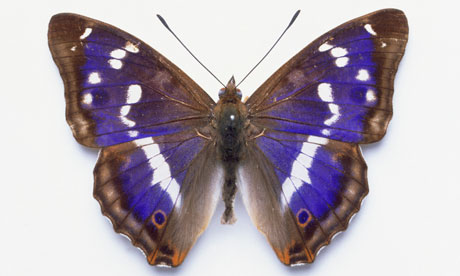
This led to the Darwinian Just-So Story. These stories take some trait: the peacock's tail, the Purple Emperor butterfly's diet, human speech, and so on, and spins an "adaptation tale" that shows how it is an evolutionary advantage to have it. (Of course, there are other species who do not have the trait, so the task is also to show how not having it is also advantageous.) There is no requirement to show that this story is in fact what did take place. It must merely sound plausible.

An example is the preference of the Purple Emperor butterfly to dine on carrion and fecal matter. Euuw! Adaptationists love to explain outre and transgressive behaviors, the more outre the better. In this case, the "reason" is that "the males replenish themselves after mating with sodium and other chemicals from the rotting matter." Thus we see, says philosopher Mary Midgley, the conscientious butterfly holding its proboscis and resolutely taking its medicine so as to be sure of keeping its love-life in order. 

 Presumably, Purple Emperors too fastidious to dine in this manner proved unfit and dropped out of the gene pool.The problem is that there is seldom any evidence for these evolutionary losers.

 But as Midgley goes on to say:
A recent controversy about the origins of nose-picking in humans showed the oddity of this. Since this habit is common, scientists suggested an amazing number of arcane physical mechanisms by which it might have directly improved people’s survival-prospects. What nobody did was to ask about this habit’s relation to motives – for instance to curiosity, to our tendency to explore and investigate things. Like other primates we like to pry into mysterious places such as holes and this interest surely has affected our species-survival in many ways, both helpful and otherwise. The details of the endless acts that it produces don’t matter; what affects survival is the general interest. Thus, human behaviour is not a ragbag of disconnected behaviour patterns with separate evolutionary histories. What evolves is an emotional constitution which shapes our lives as a whole. We have to explain particular actions by finding their place in it. [emph. added]
IOW, there is nothing particularly advantageous about nose-picking -- unless explaining it enables one to obtain grant money. That can be advantageous, we suppose. The advantage of the holistic approach is that it not only accounts for nose-picking, but also grant-seeking.

Charles Darwin wasn't always
old and bearded
Interestingly enough, Darwin himself did not engage in adaptationist Just-So stories. In fact, he insisted that while natural selection was the primary source of speciation, it could not possibly be the only source. He devoted an entire section of The Descent of Man to what he called "sexual selection." He considered this to be quite distinct from natural selection, although Late Moderns tend to lump the two together. They think "natural" is an adjective modifying the term "selection." But what Darwin meant was that Nature played the role of the metaphorical selector.

In sexual selection, what matters is the aesthetic preference of the females, and it is a genuine, no-fooling actual selection taking place.

His Victorian compadres didn't catch on. They had convinced themselves that beauty was subjective and subjective things did not really exist. But ol' Chuck doubled down.
Hey, babe! Come here often? How ya like these feathers?
"The case of the male Argus pheasant is eminently interesting, because it affords good evidence that the most refined beauty may serve as a charm for the female, and for no other purpose. We must conclude that this is the case, as the primary wing-feathers are never displayed, and the ball-and-socket ornaments are not seen in their full perfection, except when the male assumes the attitude of courtship.... Many will declare that it is utterly incredible that a female bird should be able to appreciate fine shading and exquisite patterns. It is undoubtedly a marvellous fact that she should possess this almost human degree of taste, though perhaps she admires the general effect rather than each separate detail. He who thinks that he can safely gauge the discrimination and taste of the lower animals, may deny that the female Argus pheasant can appreciate such refined beauty; but he will then be compelled to admit that the extraordinary attitudes assumed by the male during the act of courtship, by which the wonderful beauty of his feathers is fully displayed, are purposeless; and this is a conclusion which I for one will never admit.” [emphases Midgley's]
Mwahahah! You can run
but not hide!
Charm, taste, beauty... Darwin placed a clear emphasis on the subjective preferences of the female birds. Adaptive natural selection may play a role, perhaps not quite so important as Darwin thought. Right to the end, he kept looking over his shoulder at Lamarck. Natural selection is an entirely negative filter. It could account for maintenance of type, since it winnowed out the less fit gray squirrels; but it could not account for the fact of the gray squirrels themselves.

There is a sense in which Lamarck was on to something, but it turns selection inside out. What makes a trait "favorable" or not depends in large measure on what an organism is trying to do. Thus, a trait may become favorable because the members of a species have sufficient plasticity that they can adapt their behavior to the trait, not because the trait adapts them to the behavior.

This cuts against the grain of the Early Moderns, who regarded the lower animals as meat puppets enslaved to a instinct. But Aristotelian instinct was more supple than machine-agers assumed, and Darwin's sexual selection points toward it. It matters what the organism is trying to do.

Which brings us back to the pupfish.

It seems that natural selection is more actively selective than previously believed. 
Devil's Hole pupfish
The entire species of the Devils Hole pupfish lives in a rocky pool, 20 meters long and three meters wide, in a cave entrance in Death Valley, California. In 1976, conservationists established the fish in other pools elsewhere just in case Devil's Hole dried up. "But the refuge-bred fish began to look different, with deeper bodies and smaller heads, although all the fish [were] pretty much the same genetically."

Sean Lema, a graduate student at UC Davis, and Gabrielle Nevitt, professor of neurobiology, physiology and behavior, ... reared a related but unthreatened species, the Amargosa pupfish, in the lab on a restricted diet and with slight changes in water temperature. The Amargosa pupfish began to look more like the wild Devils Hole pupfish."

In other words, one kind of pupfish changed into another kind of pupfish when placed in the particular environment of the other. Significant adaptive variations appeared within two years. Since pupfish reach full maturity within 2 to 3 months and spawn from late February through the summer, that's about four or five pupfish generations. "No new information had appeared in the guppies’ DNA; instead, the expression of the existing information had altered."

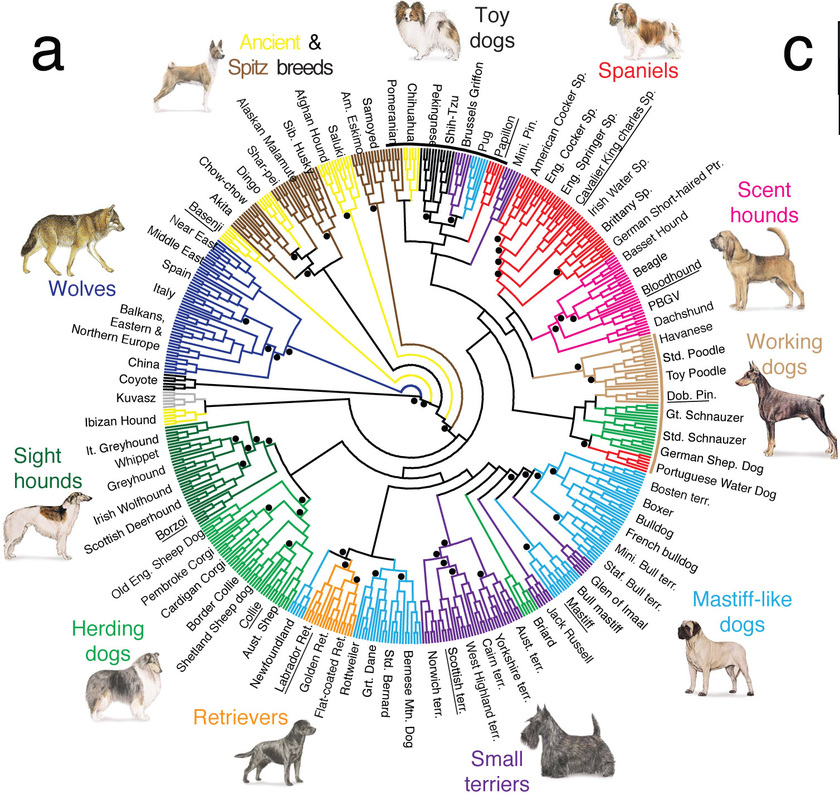
This is called phenotype plasticity. The selfsame set of genes can express itself very differently, turning as it were on a genetic dime. Think of the range of variations of the domestic dog, from Chihuahua to St. Bernard, not just in size but in temperament. They range from sharp as a Border Collie to dumb as an Irish Setter, all on the same gene set. (There has been no cross-breeding with other species.) They are all variations on the theme of gray wolf. All this was accomplished within the blink of an evolutionary eye, essentially the span of human history.

Yet biologists find the speech of humans lurking in a gene (FOXP2, located on the long arm of chromosome 7 at position 31) and then say that since Neanderthals had the same gene, they must have had speech, too. They have also identified a "warrior" gene that is supposed to account for violent behavior. Koch's postulates have been forgotten, it seems.

The more we learn about genetics, it seems, the less certain we become of the origin of species -- or of the adequacy of natural selection to explain it. The lack of fit between natural selection and the fossil record is notorious. If natural selection theory were true, the evolutionary record would be a smear of continual incremental changes. Instead we see species appear almost fully formed in a geological instant and then persist until they clear out. It's not that the links are missing. It's that they should be the rule and not the exceptions. But the more we learn about epigenetics, genome plasticity, molecular edit/repair, and the like, the more it appears that evolution can be swift and specific and not a slow, gradual editing of a range of "random" mutations.

Mutations are not -- or at least, need not be -- "random." They can be focused and massive. There need not even be a mutation; simply a different expression of the same genes.

Well, what other mid-Victorian theory has survived unscathed?

References

  1. Sharon Begley, "Water-Flea Case Shows That Ability To Adapt Is What's Really Innate," The Wall Street Journal (April 22, 2005)
  2. Kimberly Johnson, "Lizards Rapidly Evolve After Introduction to Island," National Geographic News (April 21, 2008)
  3. Mary Midgley, "The Mythology of Selfishness," The Philosophers' Magazine online (05 January 2016)
  4. James A. Shapiro, "Rethinking the (Im)Possible in Evolution," Progress in Biophysics and Molecular Biology (2013) 
  5. David Warren, "Phenotype plasticity." Essays in Idleness (28 Aug 2015)


Thursday, January 23, 2014

Post-Darwinian Evolution

A Commonplace Observation

It is said that "we humans share more than half our genomes with flatworms; about 60 per cent with fruit flies and chickens; 80 per cent with cows; and 99 per cent with chimps."

This demonstrates something very important.

Namely, how little our genes signify.

Some folks take those percentages to show that humans are not all that different from cows or chimps. Others observe empirically that humans differ tremendously from these others -- you are not reading this on the bovine intertubes -- and wonder whether the genes are a meaningful metric of anything other than physiology.

The great scientific revolutions, Chastek once observed, turned on seeing the significance in things that were negligible within their context. The difference between a circular orbit and the actual elliptical orbits that the planets follow is negligible. The difference between the Newtonian and Einsteinian dispensations matter only at high speeds.  Yet the sliver of difference matters a great deal, even in so quotidian a thing as GPS. So the delta between man and monkey may well be very small genetically speaking -- but no one says we must speak only of genes.

A Glove Thrown Down


Thursday, October 24, 2013

An Interview with David Berlinski


Found upon the Web and reprinted here without comment, but with some formatting. Berlinski is a mathematician and well-known gadfly and works with the infamous Discovery Institute. However, he also has a wicked sense of humor, very much like the late C. Hitchens. TOF does not know when this interview was written or for what outlet. He is not, for all that, a supporter of "intelligent design." He's better described, says Jonathan Witt, as a skeptic toward Darwinism and a friendly critic of Intelligent Design.

An Interview with David Berlinski

Jonathan Witt


Monday, March 25, 2013

What's the Matter With Matter


A reader at the Auld Blogge on LiveJournal who goes by the caligosian name haunterofmists has engaged in an extended conversation on form, spinning off the orthodox reaction to Nagel's Darwinian heresy, the gist of his questions, like the fogs he haunts, appeared inchoate. Suspecting that the disagreement -- if there even was one -- was due to terminological slippage over the centuries, TOF will here endeavor to lay out as best he can his understanding of the nature of natures.

The first thing to note is that "natural" has taken on a fuzzier meaning in the Late Modern ages, encompassing something like "it happens to to physical causes."  The Late or Post Modern thus is unable to grasp why a baseball thrown by a pitcher exhibits unnatural motion while one falling off a shelf exhibits purely natural motion.  It has to do with "natures" as opposed to Nature.

Thursday, February 28, 2013

Natural Genetic Engineering

Shapiro, looking excited
We live in exciting times, when we are finally beginning to understand the workings of evolution.

One of the things Aristotle said about living beings is that they contain within themselves the principles of their own movement.  The more we learn about genetics, the more this seems true, down to the deepest levels.   In  his latest blog on natural genetic engineering, James Shapiro has some interesting things to say.  It is worth quoting the entry extensively. 

First caution.  By "natural genetic engineering" (NGE) Shapiro does not mean an explanatory principle, but rather all the biochemical mechanisms cells possess to "cut, splice, copy, polymerize and otherwise manipulate the structure of internal DNA molecules, transport DNA from one cell to another, or acquire DNA from the environment. Totally novel sequences can result from de novo untemplated polymerization or reverse transcription of processed RNA molecules." 

Sunday, December 30, 2012

Post-Modern Evolution


From time to time TOF has touched upon the peculiarities of the various theories of evolution: Lamarck, Blythe, Darwin/Wallace, Mendel, Kimura, Shapiro, et al.   Prior posts include:
And some of the topics that have bubbled up include
  • the persistence of teleology in evolutionary thought (apparently tworked off Fodor, who dissed natural selection precisely because it was inescapably teleological)
  • the importance of the environment, including the organism's own behavior at shaping evolution
  • that genetics and molecular biology may be more important than natural selection
James Shapiro
Some of these thoughts were initially triggered years ago by an essay for the educated lay public by James Shapiro that deconstructed both Michael Behe (the ID-guy) and Richard Dawkins (the science popularizer).  Both, he said, were dealing with obsolete metaphors of genetics.  This resulted in a correspondent immediately denouncing Shapiro as a shill for the Discovery Institute.  He wasn't and isn't, but it is interesting to note that the first reaction of the Third Way-denialists was to make up something scurrilous about the guy. Similar thing happened to Eldrege and Gould when they introduced punctuated equilibrium.  Students of the history of heresies will recognize the behavior instantly. 

Wednesday, August 1, 2012

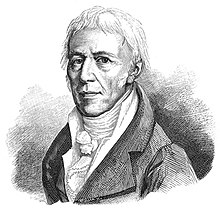
Happy Birthday, dear Jean-Baptiste Pierre Antoine de Monet, Chevalier de la Marck, Happy Birthday to you!

Johnny Lamarck,
birthday boy
Johnny Lamarck was born today in 1744 and achieved note for being among the first to devise the idea of evolution and origin of species.  Curiously, natural selection had earlier been proposed by Edward Blyth, but as a means of ensuring fixity of species!  While we are taught today to scorn Lamarck as one of the fools of the history of science, we do have the following encomium:

Lamarck was the first man whose conclusions [concerning the origin of species] excited much attention. This justly-celebrated naturalist first published his views in 1801, and he much enlarged them in 1809 in his “Philosophie Zoologique,” and subsequently, in 1815, in his Introduction to his “Hist. Nat. des Animaux sans Vertébres.” In these works he upholds the doctrine that species, including man, are descended from other species. He first did the eminent service of arousing attention to the probability of all change in the organic, as well as in the inorganic world, being the result of law, and not of miraculous interposition. Lamarck seems to have been chiefly led to his conclusion on the gradual change of species, by the difficulty of distinguishing species and varieties, by the almost perfect gradation of forms in certain organic groups, and by the analogy of domestic productions. With respect to the means of modification, he attributed something to the direct action of the physical conditions of life, something to the crossing of already existing forms, and much to use and disuse, that is, to the effects of habit. To this latter agency he seemed to attribute all the beautiful adaptations in nature; — such as the long neck of the giraffe for browsing on the branches of trees. But he likewise believed in a law of progressive development; and as all the forms of life thus tend to progress, in order to account for the existence at the present day of very simple productions, he maintains that such forms were now spontaneously generated.
Charles Darwin, "An Historical Sketch of the Progress of Opinion on the Origin of Species," an essay added to third edition of The Origins of Species.  
So Chuck thought well of his predecessor.  (Interesting that the origin of species from other species is a "doctrine" that evidently preceded any sort of scientific theory to explain it.)  Unless Lamarck did have such a theory:
"Great alteration in the environment of animals leads to great alteration in their needs...  Now, if the new needs become permanent, the animals then adopt new habits which last as long as the needs that evoked them....  Every new need, necessitating new activities for its satisfaction, requires the animal, either to make more frequent use of some of its parts which it previously had used less, and thus greatly to develop and enlarge them; or else to make use of entirely new parts, to which the needs have imperceptibly given birth by efforts of its inner feeling."
Leave aside the "inner feeling" whackadoodle and what we see is that Lamarck had anticipated the modern idea of the "extended phenotype."  Classically, the environment was perceived as a sort of static and passive thing toward which the animal was well or poorly suited.  Thus, when a finch was born with a beak ill-suited to nut-cracking, it would be unfit and selected out.  (This was Blyth's view.)  If a finch by happenstance was born with a more powerful beak, it would be better at the job of nut-cracking and become in Darwin's phrase a "favored race."

What was overlooked was why the finch was trying to crack nuts in the first place?  Surely, there were other jobs available!

What defines a trait as "better fit" or not depends on what the critter is trying to accomplish.  Darwin observed that organisms had an inner drive to continue living.  Born with a long thin beak unsuited to nut-cracking, our mutant finch need not go off into a corner and die.  Instead, she tries this or that or the other thing, trying to survive and reproduce.  It might be that she tries pecking insects instead; and lo! it works and she thrives and a race of insect-pecking, thin-beaked finches redefines what it means to be "fit" for her descendants.   

IOW, the organism actively participates in its own evolution.  Natural selection may indeed sculpt a species toward greater fitness to its niche; but what Lamarck almost saw was that the animal's own habits, derived from its need to survive, help define that niche. The mistake lay in thinking that the striving alone can effect an evolution without the material to work with. 

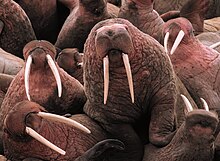
Something once quite doggy became a seal, a bearish critter took up walrusing, and elephantic thing became a manatee.  We can't suppose that a fortuitous set of mutations just so happened to be favorable for a bear to take up swimming when all her sisters were bearing.  It is much more likely that the walrobear, cursed with certain walrusy traits, set about trying to survive and in the process managed to get by along the sea shore, thus redefining the criteria for future selection. 

So, all hail Johnny Lamarck!  Who almost got things right.

Friday, June 29, 2012

The Fundies are Coming! The Fundies are Coming!

The Huffington Post, a news repackager privileged by AOL, has an interesting tidbit entitled:
Louisiana Private Schools Teach Loch Ness Monster Is Real In Effort To Disprove Evolution Theory

The story opens thusly:
Some students at private schools in Louisiana are being taught that Scotland's fabled Loch Ness monster is real, a claim that is then held as evidence disproving Charles Darwin's theory of evolution, the Scotsman reports [on 29 June 2012].
Heavens!  Nellie, bar the door!  "Some" students equals how many exactly?  A colleague of mine is a creationist -- and a Ph.D. chemist.  He is a gentle soul, and funds out of his own pocket a microlending bank in West Africa, helping African women become economically self-sufficient.  Truth to tell, I'd rather know such a man than a snarky atheist who does nothing to help. 

Evolution inaction
As far as I know, the theory of natural selection does not require that when a new species emerges that the old species must vanish in an instant.  The facts may tell us that no dinosaurs survived to human times, but the theory of natural selection does not.  I have seen people claim that "birds are dinosaurs," which is tantamount to the claim that men and dinosaurs have existed at the same time.  So I guess sometimes it's okay to make that claim. 

I don't know which is funnier: creationists who want to downgrade the Bible to a science text or people who get attacks of the vapors over creationism. 

The real puzzle is: Why should The Scotsman care about Louisiana private academies?  Well, the Loch Ness connection may be sufficient for a human interest story.  But where did The Scotsman get the story? 

Hard to say.  The Scottish Sun ran a similar story four days earlier, on 25 June, but it is only a precis.  And on 24 June, the Herald of Scotland ran the Scotsman story almost verbatim. 

The earliest report seems to be the Times Educational Supplement - Scotland, dated 31 July 2009, but "updated" on 28 June of this year.  It focuses on UK recognition of the curriculum rather than on Louisiana.  The TES quoted extensively from one "Jonny Scaramanga, a music lecturer who attended an ACE school in Bath as a child."  That is, given Scaramanga's age (27), the story is at least a decade and a half old.  And notice how the thrust changed from the UK approving the curriculum in TES in 2009 to "Louisiana" in 2012.

So why the sudden interest three years later?  There is a Romney connection. 
  • Romney advocates school vouchers
  • Some parents use vouchers to send their kids to schools using these books
  • These books have some mighty silly or obnoxious stuff in them.  
  • Therefore, we suppose, we should vote for Obama. 
HuffPo cited all "four" Scottish sources, although three of them seem to be simply cut 'n paste.  Curiously, no US sources were cited.   (A Google search on turned up numerous blogs repeating the story like a head cold at a day care center, but no independent confirmations that I saw.) 

The Scotsman story states:
Critics have slammed the content of the religious course books, labelling them “bizarre” and accusing them of promoting radical religious and political ideas.
Well, we can't have religious course books promoting religious and political ideas.  They should be more like regular text books which never do any such thing. 

But who were these unnamed "critics"? 

Who Are the Critics?
Apparently, the untermenschen teach that if the Flood happened only 4000 years ago, then a sea serpent could have survived.  Actually, it's hard to see how a flood at any time would bother a sea serpent at all.  What would it do, drown?  But then why is it necessary that dinosaurs perished in a Great Flood?  What in the story of the Flood, even if we take it at face value, requires that no other animals ever went extinct prior to it? (Remember, the Biblical clock starts running, as it were, with the beginning of human history; and that seems to have gotten rolling in the Middle East around 6000 years ago.) 

A little further on, The Scotsman tells us of "one former pupil, Jonny Scaramanga, 27, who ... now campaigns against Christian fundamentalism."  Hard to see how someone who campaigns against X would ever distort X, especially after his nervous breakdown.  This fellow is the only source mentioned in the Times Educational Supplement article. 

The other source mentioned in The Scotsman (and therefore in the Huffington Post) is one "Bruce Wilson, a researcher specializing in the American political religious right," who tells The Scotsman:
"It has little to do with science as we currently understand. It’s more like medieval scholasticism."  
The first thing to note is that "a researcher" apparently means someone who co-founds a blog as a sort of professional anti-rightist.  Calling him a "researcher" sounds so much more academic. 

The second thing is that this Wilson is also a blogger for ... (wait for it) ... none other than the Huffington Post.  This makes HuffPo blogger Laura Hibbard somewhat disingenuous when she refers to Wilson as a "researcher," if he were an outside source.   

And the third thing, which is what actually got my attention in the first place was that neither Wilson (who said it) or Hibbard (who "reported" it) seem to have a clue about medieval scholasticism.  They seem to think it has something to do with Late Modern, scientificalisitc fundamentalism. 


The scholastics, it is well to recall, had no reason to suppose that there were such a thing as evolution, having never seen an example of a new species arising.  In fact, all the kinds known to Aristotle were known to Darwin; and those known to Darwin within Aristotle's geographic scope were already known to Aristotle.  There is no reason to concoct a theory to explain a phenomenon that has never been observed. 

Tommy Aquinas
One scholastic who did consider the concept in passing was Thomas Aquinas (aka Da Man), who wrote:
Species, also, that are new, if any such appear, existed beforehand in various active powers; so that animals, and perhaps even new species of animals, are produced by putrefaction by the power which the stars and elements received at the beginning.
-- Summa theologica, Part I Q73 A1 reply3
IOW, if any new species ever did arise, they would do so through the immanent powers of nature actualizing the existing potentials.  (Much as the word "gat" exists beforehand in the word "cat," being actualized by a simple mutation/phonemic shift.)  Moderns, who do not believe in immanent natures, have a mechanical philosophy "in which nature is seen as a kind of unnatural composite of passive, unintelligent, preexisting matter, on which order has been extrinsically imposed."  This led inevitably to Paley and Dawkins. 

The Louisiana textbook material is further presented as saying:
"God created each type of fish, amphibian, and reptile as separate, unique animals." 
Gus Hippo
But there is nothing that actually requires this, and it is a belief that dates pretty much to the 19th century novelty sects.  If we go back a millennium and a half, we find Augustine (who was not a medieval scholastic, the middle age having not yet quite begun).  He wrote:
It is therefore, causally that Scripture has said that earth brought forth the crops and trees, in the sense that it received the power of bringing them forth.  In the earth from the beginning, in what I might call the roots of time, God created what was to be in times to come.
-- On the literal meanings of Genesis, Book V Ch. 4:11
IOW, various species need not have come into being at the same time, since God created "what was to be in times to come."  Not only that, but it was the "earth," that is, the natural world, which received from God the immanent power to do this, Gus citing the Bible as his source. 


Were I of a puckish frame of mind, I might even say that this means that evolution can be found in the Bible.  Fortunately, I am not; and so I will not. 
+ + +

This is too good.
On his blog, Wilson sheds crocodile tears because the fundamentalist textbooks he cites denigrate Catholicism and Mormonism, although they apparently do not say anything about them that atheists don't say as well.  (Fundies and atheists share a remarkable overlap of beliefs.)  He also finds it strange that Mr. Romney advocates school vouchers even though some parents use them to send their kids to schools that use books that disparage Mormonism.  He has apparently never heard the dictum "I may not agree with what you say, but I defend to the death your right to say it."  It's called freedom of speech; but in the circles inhabited by Mr. Wilson it is evidently considered normative to shut down any expression with which one disagrees. 

He goes on to write:
In the economic realm, as researcher Rachel Tabachnick describes, the texts "teach a radical laissez-faire capitalism. Government safety nets, regulation, minimum wage, and progressive taxes are described as contrary to the Bible."
This strays a bit from the narrative of scientific illiteracy into kvetching that the untermenschen do not share the orthodox belief in Marxism or the Bismarkian welfare state.  By associating these stances with creationism he apparently hopes to color opposition to laissez-faire capitalism with the aura of being scientificalistic.  Being a man of the left, he cannot imagine a safety net not held in government hands, or how nets can be used to entangle the prey in captivity.  But that is another question entirely and does not have a categorical, ideologically-defined answer. 

And there is the further irony that Darwinian evolution is clearly modeled on laissez-faire capitalism.


But notice we once more see a "researcher" being cited.  Wilson fails to mention that by an amazing coincidence "researcher Rachel Tabachnick" is his partner.  (Undoubtedly, Tabachnick also refers to the "researcher Bruce Wilson.")  This is a little like the old 60s gimmick in which a small group of activists would form several organizations, all with pretty much the same membership, so that the SDS could cite the MEVW and the YSL as being "in solidarity" with them. 

This whole thing reminds me of what Kissinger allegedly said about the Iran-Iraq war.  Why can't they both lose? 

Thursday, December 29, 2011

Oh Happiness! our being's end and aim!

So said Pope.  No, not that Pope.  The one who wrote poetry. 

In another venue, TOF chanced to encounter the following encomium to evolution:
The brain evolved in the same way the fins evolved: because their evolution conferred survival advantages in given situations.
Now the curious thing was that this statement was made by an individual (whom we will call "Adam Apple") who also asseverated that there was no τελος in nature.  I will wait a moment for my reader to stop banging his forehead against his desktop.  You could damage your computer screen that way.   

....(waiting)
....(waiting)

Wednesday, October 5, 2011

De evolutione evolutionis

Contents: A Ramble Inspired by a Passing Remark
  • Peas Be With You
  • Evolution Without Mendel
  • Darwin without Evolution
  • Natural Selection vs. Evolution
  • Origin Without Species
  • Species Without Origin
  • The End of Evolution
  • The Principle of Proportionate Causation
  • Where Has All the Telos Gone?  
  • Efficient Causes Without Telos 
  • That Which Does Not Kill Me Makes Me Stronger
  • Revenge of the Stagerite

Mendel, monk-eying with peas
In the December issue of ANALOG Science Fiction/Science Fact, Dr. Stanley Schmidt, in the course of addressing a broader issue, quotes one E.W.Howe as saying, "one of the great discoveries in science was made by a man cultivating the ordinary garden pea."  This makes it sound like the discovery was a backyard happenstance by an amateur.  But it was not an ordinary pea garden, nor even ordinary garden peas.  It was a set of greenhouses specially constructed to carry out a series of carefully planned scientific experiments, and pea strains carefully cultivated to breed true.  (Howe also fails to mention that Gregor Mendel, O.S.A., was an Augustinian monk.)   

Peas Be With You

Mendel chose pea plants partly because they i) had easily identifiable features, ii) could self-fertilize, and iii) were easy to protect from cross-fertilization.  But before he could even start, he needed true-breeding plants; that is, plants that when self-crossed would always produce the same phenotype. This took two years of preliminary work.  Mendel then spent years making thousands of crosses, discovering that
  • traits were inherited whole and
  • traits that seemed to disappear in one generation could reappear in another generation
He described these observations in a set of mathematical relationships (laws) regarding the inheritance of dominant and recessive traits.  (These were similar to Darwin's mathematical laws of natural selection setting out the relationship between fitness and reproductive success...  Oh, wait.  Never mind.) 

People sometimes wonder where Mendel found the time to do all this, considering his monastic responsiblities.  I have even seen it alleged that the abbot shut him down, a nice example of "model-based history"*.  But the answer is easy.  His research was one of his monastic responsibilities.  The monastery had been conducting hybridization research even before Mendel arrived.  The Augustinians freed up his time for the research, allocated large plots of land for his research, and built a greenhouse where he could establish a control group for his studies.  The Order did not sorta kinda "give Mendel a research grant" to pursue his personal hobby as some historically ill-informed have grudgingly allowed: The research was part and parcel of the Order's program.  Mendel himself had trained as a physicist, not a biologist, so this would not likely have been his own personal choice.  Mendel was simply doing the scientific research that his Order asked him to do.**

Mendel's results were published in the Proceedings of the Natural History Society of Brünn in 1866. No-one noticed.  Over the next 35 years, his work was cited... three times!  Oh well.  In the early 1900s, Mendel's work was rediscovered by Correns, deVries, and others, and developed into an entirely new discipline within biology -- genetics.

*model-based history.  This is where one starts with an idee fixe and deduces "what must have happened" in the light of that prior assumption.  This dispenses with the laborious requirement for actual empirical evidence. 


** Oddly, Mendel's work and the support from his Order are seldom mentioned during debates about church-science relationships.   See first note (*).

Saturday, December 11, 2010

Looking for Space Aliens?

Here's a good candidate.  Pretty eerie-looking critter.  And what are those balls atop its thorax for?


Thursday, December 2, 2010

The War Between Fact and Theory

Another message board had the following exchange: 

A: So much of what is taught in school is still technically "Theory" even as it is being taught as fact - like The Big Bang, for instance.

B: The statement quoted above mostly just signals a rather low level of scientific literacy--a lack of awareness of how the words "fact" and "theory" are typically used in science and how that usage differs from the vernacular.

Now my own peculiar experience is that many folks who make the latter point understand the difference no better than those who make the former.  This includes scientists, who frequently make very poor philosophers.  (The distinction between theory and fact is a philosophical one, not a scientific one.  Neither theories nor facts are physical bodies measurable by science.)  There are those who suggest, for example, that a theory that has been verified a great many times becomes a fact.  This is a little like saying that a baseball team that wins a great many games becomes a base hit. 

The Layer Cake of Science

The distinction between Fact, Law, and Theory was laid out by the logical positivists of yore.  These were philosophers of science like Poincare, Mach, Duhem, and Einstein that P.Z.Meyers once derided as running alongside the mighty Locomotive of Science, hollering advice and observations to the likes of the puissant Baconian engineer P.Z.Meyers. 

Start from the bottom, at which we find Empirical Experiences.  Things that we see, hear, feel, etc.  Both science and philosophy start here, but move in different directions.  The scientific direction runs thusly:

1. Facts.  When these experiences can be operationally measured, they become facts.  Factum est being the participle of "to make," a fact is "something made," a "feat."  Measurement creates facts because the same thing measured in two different ways will often produce two different results.  The experiment is the premier fact-producing machine, but facts may also be made by meticulously described qualitative observations, such as those Darwin made.  (The distinction is oft expressed as between "active" and "passive" statistics.) 

2. Laws.  Regularities or patterns in the facts are called laws, especially when they can be expressed in mathematical terms.  But they can also be expressed verbally.  Newton originally did so.  The equations associated with his three laws came later - and don't quite correspond to the three laws as he actually stated them.  There is no math at all in Darwin, but he did enunciate some laws or principles of evolution. 
          
3. Physical Theories.  These are stories or narratives in the context of which a specified body of facts "makes sense."  Newton's theory of gravitation "made sense" of Kepler's astronomical observations and mathematical laws.  Given a physical theory, the natural laws may be deduced and the facts predicted.  When facts are predicted beyond those originally used to develop the theory and then are subsequently found, the theory is further supported.  But no amount of support will change a theory into a fact, as such. 

Friday, October 22, 2010

Who Sez There's No Telos in Nature?


(Photo from Conversion Diary)

when even plants strive toward something beyond themselves? 

Without this "towardness" there would be no laws of nature, since there would be no reason why A→B "always or for the most part."  Efficient causes thus depend on finality for their coherence. This is why final causes have been called "the cause of causes." 

In particular, evolution (transformism) would make no sense without this intentionality of living things, since the efficient cause (natural selection) would at best simply weed out the unfit.  It is precisely the striving of living things to go on living that leads them to exploit new mutations and new environments.  To seek out new life and new civilizations; to go where no....  Wait a minute.    OK.  Natural selection, as an efficient cause would not necessarily select for better fitness unless there were an intentionality in living things, a towardness in nature for better fitness. 

Tuesday, February 16, 2010

The End of Darwinism Evolution

or
Evolutionism vs. Creationism

The surest way to gin up some traffic here is to put those terms into the post. Heheh.

Now, I cheated in the title, as will become apparent in a moment. Aristo-Thomists might already suspect the pun. If so, keep quiet until I'm done here.

On one side of the debate is a group of people with deeply held metaphysical beliefs who tell fables. On the other, a group of people who desire above all that their beliefs be recognized as a science. I speak, of course, of evolutionists and creationists, respectively. The atheist philosopher, Michael Ruse, once made an important distinction between evolution and evolutionism, the latter being a pseudo-religious commitment to the former. A similar distinction can be made between creation and creationism, with the latter desiring the former to be stamped a science. There is a symmetry to it all that is pleasing to geometers, string theorists, and auld curmudgeons.


Mary Midgley addresses this in her book Evolution as Religion. Another atheist critic of over-the-top evolutionism is David Stove: So you think you are a Darwinian?

1. Evolutionism.
You cannot draw a metaphysical conclusion from the physics. But it is baldly asserted by evolutionists that the "fact" of evolution has "proven" God unnecessary. This is as if the fact of the piano and the physics of vibrating strings "proves" there is no need for the pianist, as the music has been completely explained by the acoustics. 

The statement is silly on several levels. First of all, in philosophy God is not an hypothesis put forward to explain particular physical phenomena. Rather it is a conclusion reasoned from various facts about the world. (No, you don't have to accept the reasoning.  Just be aware that in classic theology, God is at the end of the string, not at the beginning.)  This is not the time for that discussion; but let it be said that neither God nor evolution is "necessary" for auto repair.  So what?  As Cardinal Schoenborn once said, "I certainly hope that God is not invoked in the course of an ordinary scientific explanation." 

But what gives evolution such lofty credentials? Does it possess the Subtle Knife? Why not suppose that Maxwell's Equations made God obsolete? Back in the old days, Gregory of Nyssa engaged his dying sister Macrina in a Platonic dialogue, which is what people did before Twitter, I suppose. Gregory told her that mechanical automata were said to prove that God was unnecessary. So this sort of thing has been going on for a long time, with the death of God announced breathlessly every generation or so.

For St. Macrina's answer, see: Gregory of Nyssa, On the soul and ressurection and scroll down to the part beginning "But what, I asked, if, insisting on the great differences..." Basically, she said that such automata provided supporting evidence for God's existence. And the same is true of evolution.

Secondly, as James Chastek has pointed out:
Presumably, evolution means we can stop looking for some magical elf-and-Santa-workshop where God busily assembles new species. Great. Call off the search. If evolution were to fail, what then? Would it leave the sort of hole that could be filled by the the magical mystery species shop? No. We would just look for another natural explanation, whatever it was. If evolution were to fail, it would not leave a God-shaped hole, and so it follows that it is not filling one now, nor has it ever done so.
thomism.wordpress.com/2009/07/26/4392/#comments

Prometheus Awards: Read & Watch

 Hello Friends & Fans of Michael Flynn,       The Libertarian Futurist Society has made available the text of the acceptance speech Dad...