Showing posts with label passing of the modern age. Show all posts

Friday, September 8, 2017

Road Rage, Buddha, and Beeldenstorm

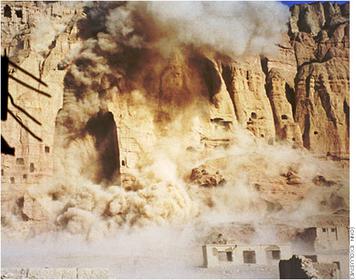
What do these pictures have in common?

Buddha Statues blown up by fanatics at Baminyan, Afghanistan

Confederate statue pulled down by fanatics
at Durham, NC
In both cases the vandals belonged to a triumphalist people who found the monuments of their foes hateful to their eyes. The muslim Taliban regarded statues of the Buddha as demons and the Buddhists themselves to be demon-worshipers. Similarly, the "Antifa" regarded the statues of former Democratic office-holders and generals to be statues of demons, and those who wish to preserve them as demon-worshipers.

Friday, April 1, 2011

Contra pusillanimitatem saeculorum

There is a scene in the movie Of God and Men, in which an official of the crypto-fascist Algerian government blames the then-current Islamist terrorism on, you guessed it, France.  None of this would be happening, he said, had it not been for colonialism.  I don't know if this is a true recounting of the meeting - for the movie is about actual events - or if the movie makers simply added a gratuitous "so there!" against wicked colonialism.  That is not our point today.  Nor are we determined to point out that Algeria prior to the French period was nothing to write home about either, it being a center for the Barbary pirates. 

No, it is the "anthropology" of the comment that drew our attention.  The official clearly saw the unrest as something that had been done to his countrymen, rather than something his countrymen were doing. 

Saturday, December 18, 2010

The Interchangeable, Suburban Men

John Lukacs wrote in The Passing of the Modern Age (1970):

Except for two republics [France and Switzerland] as late as 1910 every European state was still a monarchy, but the actual political power of the monarchs was dwindling everywhere.... 

Of course it is very often true that officials of a central government, sitting in their capital, gravely and injudiciously interfere with the lives and property of citizens in distant provinces or towns, without having consulted them at all, and without either considering or understanding their particular problems.  But there is no longer any guarantee (if there ever was) that people elected or appointed locally will be more capable or even more considerate...

Why is the election of supervisors of townships, or mayors of small towns, an even less inspiring exercise of one's civic duties than the election of a governor or a president?  Is it because people feel... that these locally elected men have little power?  Not necessarily: the budgets that local governments and school boards handle nowadays are enormous, their powers of regulating properties are very large indeed.  The answer, I submit, is to be found elsewhere.  People have become distrustful of the kind of men and women who are interested in holding this kind of power at all. 

In the long run the rule of aristocracy has been succeeded not by the rule of democracy but by the rule of bureaucracy.  Let us examine this pallid aphorism a little more closely.  If one does not like aristocracy one is, most probably, a democrat by preference; or the other way around.  But one's exasperation with bureaucracy is a different matter: it is at the same time more superficial and more profound than our dislike for either form of government.  The democratic exercise of periodic elections does not compensate people sufficiently against their deep-seated knowledge that they are being ruled by hundreds of thousands of bureaucrats, in every level of government, in every institution, on every level of life. 

These bureaucrats are not the trainees of a rigid state apparatus, or of capitalist institutions, as their caricatures during the nineteenth century showed them.  They are the interchangeable, suburban men and women of the forever present, willing employees of the monster Progress
Wednesday, December 15, 2010

On the Disappearance of Science Fiction

Kirkus Reviews has revealed the Best SF of 2010.  I am sure that all the books they list are very good, but I was interested to note the virtual absence of SF from the list.  As near as I can tell only two of the fifteen books are SFnal, and there is something very borderline about the last one. 

How much of this is due to the collapse of the Modern Ages?  Recall that the modern ages were bourgeois, industrial, and scientific, and it is no surprise that a type of fiction developed that featured imaginable technological innovation as a key background element.  In early genre fiction, it even comprised the foreground! 

Prometheus Awards: Read & Watch

 Hello Friends & Fans of Michael Flynn,       The Libertarian Futurist Society has made available the text of the acceptance speech Dad...