Showing posts with label thomism. Show all posts

Sunday, April 15, 2018

Hillbilly Thomism

My brother Sean sent me this, for which I thank him.


No Question, These Dogs Can Bark
Washington Free Beacon / Micah Meadowcroft

Question. Whether Dominican Friars Can Play Bluegrass

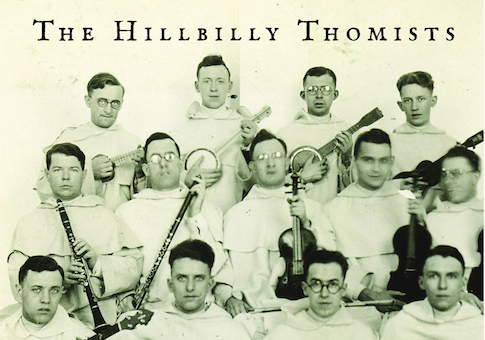
Objection 1. It seems that a handful of Dominican friars (two handfuls on the album<https://www.amazon.com/Hillbilly-Thomists/dp/B077Y9JNF3>) should not be a bestselling bluegrass band. Bluegrass is Protestant stuff, soulful songs for whitewashed independent Baptist churches and big homey kitchens and not Latin nerds in white habits in Northeast D.C.

Objection 2. Further, bluegrass is as Americana as anything, and until John F. Kennedy bedded the White House and Bill Buckley built the conservative coalition, Catholics were not exactly accepted or accepting of the American thing. Americanism is a heresy after all.

Objection 3. Further, as Fr. Thomas Joseph White admitted in opening their concert near the White House this past week, bluegrass is as often about murder and unrequited love as it is about God. That a bunch of religious should sell thousands of copies of such music may strike as odd, considering their vows of poverty, chastity, and obedience.

On the contrary, inspiring these good Catholic boys, Flannery O'Connor said of herself, "Everybody who has read Wise Blood thinks I’m a hillbilly nihilist, whereas . . . I'm a hillbilly Thomist," and band-member Br. Justin Bolger said in his original song "I'm a Dog"—after the traditional domini canis "hound of the Lord" pun on Dominican—"I’m a dog with a torch in my mouth for my Lord / Making noise while I got time."

I answer that, in an eponymous album and great live show under the watching eyes of the Catholic Information Center's wall-covering icons, "The Hillbilly Thomists" have marked their territory in the bluegrass world. To combine jargon hip both with the kids these days and with Dominicans—this music is fire.

Reply to Objection 1. They came to bluegrass and Thomism the usual ways, which is to say, through their culture—Catholics south of Dixie who love and play music. Fr. White learned mandolin in Kentucky while living in Cincinnati 16 years ago before moving to D.C., and with time, enough like-minded and like-voiced friars congregated here to make Hillbilly Thomists a going concern.

Reply to Objection 2. While bluegrass became what it is, adopting and combining English ballads and hymns and gospel and blues, Catholic sacred music was set in a traditional Latin liturgical context with Gregorian chant and all the other related resplendent smells and bells. But that hardly means when they take up the banjo that Thomas Aquinas's spiritual brothers are engaged in the—post-Vatican II—fairly common appropriation seen in singing a Luther hymn at Mass. For another influence on Americana is distinctly Catholic: Irish folk music.

Reply to Objection 3. The fathers and brothers of the Dominican House of Studies take a break from their scholarship to record an album of sacred music every year, to be sold to support the house's work and facilities, and the funds raised by this kitchen-table casual departure from convention will go to, apropos, a new kitchen. But homey as the music is, it is sacred nonetheless. Here's to hoping for more from the Hillbilly Thomists.

The post No Question, These Dogs Can Bark appeared first on Washington Free Beacon.

Wednesday, January 28, 2015

Sunday, October 26, 2014

In Psearch of Psyche: Man the Animal

Man, the Animal

Man, the Animal: Making Sense 

It seems like only a couple days ago that we were speaking of that strange borderline between plants and animals; viz., the possibility of sentient plants. Wait a minute, it was only a couple days ago! How time flies when you're having fun. Or reading this blog, which is not always the same thing.

Today, we take up the animal soul and see what that means for human life.


Thursday, October 23, 2014

In Psearch of Psyche: Day of the Triffids!

Chapter One: A Sensational Show

Psyche, in psearch of you
Is TOF's Faithful Reader ready? Yes, that's right. It's the next inpstallment of that pscintillating pseries, In Psearch of Psyche!  For those coming late to the party, the previous chapters were:
  1. "To Deepen into Art..."
  2. In Psearch of Psyche: Some Groundwork 
  3. In Psearch of Psyche: Man the Vegetable
For those disinclined to wade once more through those swamps, some key points are these:
  • Psyche, or soul, is the substantial form of a living body, no more mysterious in its way than the sphere that somehow informs a basketball.
  • There's more to it than that, of course: the form is "in motion" and not simply shape and arrangement. That's what makes the Argument from Motion (q.v.) so interesting.
  • Soul is whatever a living body possesses that a dead body does not. It cannot be the matter of the body itself, since materialistically-speaking, the corpse consists of all the same matter as the organism that immediately preceded it. And in fact, your matter is continually changing at the atomic level. You are not today the stuff you were ten years ago. Since you are in fact the same person, you cannot be only your stuff.¹
  • Inanimate forms possess (generically) four powers: gravity, electromagnetism, strong (nuclear), and weak (radiative). Without these powers, atoms would have no substantial form: The negative charges of the electrons would cause them to plummet into the positively charged nucleus. The positive charges of the protons would cause them to fly apart from one another, rather than huddle together in a nucleus.
  • Living things are those whose actions are immanent: that is, their acts originate within the thing itself and are done for the sake of the thing. A basketball does not bounce for its own sake; but a petunia blooms for its.² 
  • The simplest of living things are the vegetative things, which include plants, fungi, and the like. (This is psyche-ology, so we won't worry overmuch about distinctions of bodily classifications made by creative taxonomists.
  • The vegetative psyche, a/k/a the reproductive soul, possesses (generically) four powers in addition to the powers of the inanimate form: nutrition/metabolism, development/growth, and reproduction, plus homeostasis to maintain these in balance.
  • A plant does not have two souls. Its inanimate powers are recruited into the service of the organism, so that (e.g.) the chemical processes of electromagnetism provide for the digestion and incorporation of food into the stuff of the organism.
  • Man³ likewise incorporates both the powers of his inanimate stuff and his vegetative powers, which is why the Late Modern obsession with eating and reproductive acts reduces Man to little more than a vegetative state.
Clarifications:
1. not your stuff. This so upsets the Usual Suspects that they deny the minor premise. You are not the same person you were ten years ago. You only think you are. How "you" can think without being "you" is carefully ducked.
2. Note to the excessively literal-minded:
This does not imply conscious intention.
3. Man.
Do we really need to reiterate that this is the base meaning of "man" as "a rational animal," the same root as "men-tal"? When we mean Man, the Male, we'll say so. Males, alas, lack an exclusive word for themselves as rational beings, to which lack their wives will nod wisely in agreement. The original word for males in Anglo-Saxon was weremann (in contrast to wifmann), abbreviated wera ond wifa as it reads in Beowulf.

Tuesday, July 29, 2014

In Psearch of Psyche: Man the Vegetable


Psyche in search of you.

Quick Recap

This series began with a brief reflection on a comment made by Thomas Disch shortly before his tragic suicide. Disch had said that to "deepen his fiction into art," he would have to return to Catholicism, which he was unwilling to do. Wondering what Disch might have meant by this, and rereading (for the first time since college) Robert Brennan's text Thomstic Psychology, TOF speculated that he might have meant a "thicker," more insightful depiction of characters, for the modern view of human nature is astonishingly thin. You have no will, no mind, not even a self.

Jody Bottum, to whom the remark was made, informed TOF that the remark was more broadly meant:

Monday, July 14, 2014

Dispatches from the Age of Reason

Portions of a true exchange on another form where TOF was amusing himself one day:

Quora Question: Why do people disagree about whether there exists proof of God's existence?

[TOFNote: Notice the question is not whether these proofs are valid or compelling, but only why people disagree about them. However, the Usual Suspects immediately responded with reflex rejection of the conclusion.]

Frank Dauenhauer, literature lover
There can be no disagreement about whether there exists proof of "God's" existence -- because there is none. No proof at all.

Friday, July 11, 2014

In Psearch of Psyche: Some Groundwork

A Psience in Psearch of a Psubject

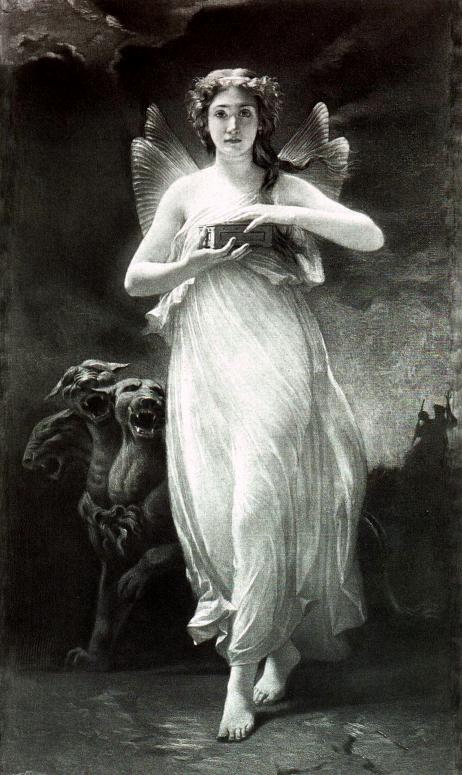
Psyche retrieving a bit of Persephone's
beauty from the underworld.
Paul Alfred de Curzon, (c.1840-1859)
Psychology means "λόγος of the ψυχή," which is to say 'science of the soul.' Since many Late Moderns are too way kool and sophisticated to believe in soul, they aver that psychology is a science without a subject matter and have turned in their diplomas.

Ho ho. TOF jests. No self-respecting scientificalistic labcoater will ever admit that he spends his time studying something that does not exist.  Well, except for string theorists and exobiologists. But this raises an important puzzle.  If psychologists are not studying psyches, then what in blue blazes are they studying?

It depends on whom you ask. One school "restricts itself to consciousness and its immediate data."  Another focuses on human behavior and rules out any mention of consciousness. And so, "having lost its soul, its mind, and its consciousness, in that order, psychology is now in danger of losing its scientific standing." (Brennan, Thomistic Psychology).

You won't find such debates among "schools" of physicists or chemists. Physicists and chemists may have their own problems, like quantum gravity versus string theory, but not believing in chemicals or physical bodies is not one of them.  Biologists do sometimes deny that life exists, but usually they're okay with it.¹ Even sociologists, who otherwise practice a debased form of voodoo, do not deny that society exists. So psychologists are very nearly unique among scientists. O brave new world, that has such people in it!

Friday, June 13, 2014

"To Deepen into Art..."

The Despair of Thomas Disch


Thomas M. Disch, the late SF writer (poet/critic/...), once told Jody Bottum that part of the reason he quit writing science fiction was that, to deepen it into real art, "I would have to be like Gene Wolfe and return to the Catholicism that I barely got away from when I was young -- and I can't do that, of course."

That "of course" is heartbreaking. Bottum commented that Disch "never escaped his escape from Catholicism." And there is something to that. It's a sort of intaglio, defining oneself by what one is not; and one cannot help but be reminded of holes and gaps left unfilled. His suicide was a tragedy and a loss to literature in general and SF in particular. He was once called "the most respected ... and least read of all modern first-rank SF writers." He ought not have been.

Tuesday, January 28, 2014

Feast of St. Thomas Aquinas

Today is the Feast of St. Thomas Aquinas. Do something logical in his honor.

Brandon has a very nice post regarding Aquinas and government:
With regard to the good ordering of the government of some city or nation, two things must be attended to. One is that everyone should have some part in the government, for through this is conserved the peace of the people, and everyone loves and takes care of such an ordering...
-- Summa Theologiae 2-1.105.1
And in the same spirit:
"If to provide itself with a king belongs to the right of a given multitude, it is not unjust that the king be deposed or have his power reduced by that same multitude if, becoming a tyrant, he abuses his royal power."
-- On Kingship, I:6

We also have his thoughts that a multiplicity of species across time and space is a positive good: creation participating in the infinity of God. There is a two-part post on why evolution is a fitting way for God to create species, here and here. And in line with this, we have Thomas' thought on where new species would come from:
Species, also, that are new, if any such appear, existed beforehand in various active powers; so that animals, and perhaps even new species of animals, are produced by putrefaction by the power which the stars and elements received at the beginning.
-- Summa theologica, I.73.1 reply3


Friday, April 1, 2011

Contra pusillanimitatem saeculorum

There is a scene in the movie Of God and Men, in which an official of the crypto-fascist Algerian government blames the then-current Islamist terrorism on, you guessed it, France.  None of this would be happening, he said, had it not been for colonialism.  I don't know if this is a true recounting of the meeting - for the movie is about actual events - or if the movie makers simply added a gratuitous "so there!" against wicked colonialism.  That is not our point today.  Nor are we determined to point out that Algeria prior to the French period was nothing to write home about either, it being a center for the Barbary pirates. 

No, it is the "anthropology" of the comment that drew our attention.  The official clearly saw the unrest as something that had been done to his countrymen, rather than something his countrymen were doing. 

Wednesday, March 23, 2011

Obama, Ockham, Wind Turbines, and Sex

Another Milestone Passed!

An anonymous Twitter notes that "Obama has launched more cruise missiles than all other Nobel Peace Prize winners combined."

Friday, October 22, 2010

Who Sez There's No Telos in Nature?


(Photo from Conversion Diary)

when even plants strive toward something beyond themselves? 

Without this "towardness" there would be no laws of nature, since there would be no reason why A→B "always or for the most part."  Efficient causes thus depend on finality for their coherence. This is why final causes have been called "the cause of causes." 

In particular, evolution (transformism) would make no sense without this intentionality of living things, since the efficient cause (natural selection) would at best simply weed out the unfit.  It is precisely the striving of living things to go on living that leads them to exploit new mutations and new environments.  To seek out new life and new civilizations; to go where no....  Wait a minute.    OK.  Natural selection, as an efficient cause would not necessarily select for better fitness unless there were an intentionality in living things, a towardness in nature for better fitness. 

Wednesday, April 28, 2010

De moralitate atheorum

Elsewhere, the Usual Suspects brought up a perennial question, and it amused me to take the counterarguments and the sed contra from what seem at first unlikely sources.

Question: Whether those who do not believe in God may act morally. 

Objection 1. It would seem not, because  as Jean-Paul Sartre held in
"Existentialism is a Humanism, there disappears with God all possibility of finding values in an intelligible heaven. There can no longer be any good a priori, since there is no infinite and perfect consciousness to think it. It is nowhere written that 'the good' exists, that one must be honest or not lie, since we are now upon the plane where there are only men.

Objection 2.  Furthermore, as Friedrich Nietzsche wrote in 
The_Twilight_of_the_Idols,   "when one gives up the Christian faith, one pulls the right to Christian morality out from under one's feet. This morality is by no means self-evident: this point has to be exhibited again and again, despite the English flatheads. Christianity is a system, a whole view of things thought out together. By breaking one main concept out of it, the faith in God, one breaks the whole: nothing necessary remains in one's hands."

Objection 3. In addition, the atheist philosopher Richard Rorty wrote, in
Contingency, Irony, and Solidarity, "For liberal ironists, there is no answer to the question 'Why not be cruel?' - no noncircular theoretical backup for the belief that cruelty is horrible. ... Anyone who thinks that there are well grounded theoretical answers to this sort of question - algorithms for resolving moral dilemmas of this sort - is still, in his heart, a theologian or metaphysician.  He believes in an order beyond time and change which both determines the point of human existence and establishes a hierarchy of responsibilities." 

Objection 4.  Also Voltaire did not believe in God but wanted his butler to believe because he thought he would then be robbed less. And Rousseau thought that a nation needed a religion if it was to accept laws and policies directed at the long term future. Without religion, people would insist on immediate gain, to their eventual cost. Clearly, they believed that without religion there would be no morality, save among the Enlightened. 

Objection 5. Also Alex Rosenberg, in
"The Disenchanted Naturalists Guide to Reality, asserts that naturalism denies the existence of objective moral value, of beliefs and desires, of the self, of linguistic meaning, and indeed of meaning or purpose of any sort. All attempts to evade this conclusion, to reconcile naturalism with our common sense understanding of human life, inevitably fail, and we just have to learn to live with that. A belief in meanings and purposes is what puts us on a “slippery slope” to religion.

On the Contrary, St. Paul
writes in
Romans 2:11-16, "There is no partiality with God.  All who sin outside the law will also perish without reference to it, and all who sin under the law will be judged in accordance with it.  For it is not those who hear the law who are just in the sight of God; rather, those who observe the law will be justified.  For when the Gentiles who do not have the law by nature observe the prescriptions of the law, they are a law unto themselves...  They show that the demands of the law are written in their hearts, while their conscience also bears witness and their conflicting thoughts accuse or even defend them on the day when, according to my gospel, God will judge people's hidden works through Christ Jesus." 

Prometheus Awards: Read & Watch

 Hello Friends & Fans of Michael Flynn,       The Libertarian Futurist Society has made available the text of the acceptance speech Dad...