Showing posts with label amateur theology. Show all posts

Monday, August 30, 2021

Adam and Eve and Ted and Alice

 A discussion meandered past TOF's optics the other day and put him in mind of a post of his from way back in 2011. This proved at the time to be a favorite among TOFian followers and racked up large numbers of eyeballs. So, TOF bethought himself to tweak the writing a bit and repost it. 

John Farrel has written a column at his Forbes site entitled "Can Theology Evolve," quoting from an epistle of Jerry Coyne:
Adam and Eve discover
they are naked. 
Human race follows.
"I’ve always maintained that this piece of the Old Testament, which is easily falsified by modern genetics (modern humans descended from a group of no fewer than 10,000 individuals), shows more than anything else the incompatibility between science and faith. For if you reject the Adam and Eve tale as literal truth, you reject two central tenets of Christianity: the Fall of Man and human specialness." 

Now, by "literal truth" Coyne undoubtedly intended "literal fact," since a thing may be true without being fact, and a fact has no truth value in itself.  I do not know Dr. Coyne's bona fides for drawing doctrinal conclusions or for interpreting scriptures, although he seems to lean toward the fundamentalist persuasion of naive Biblical literakism.  Nor am I sure how Dr. Coyne's assertion necessarily entails a falsification of human specialness (whatever he means by that).  I never heard of such a doctrine in my Storied Youth(^1) though it is pretty obvious from a scientific-empirical point of view.  You are not reading this on an Internet produced by kangaroos or in a language devised by petunias, so there just might be something a weensie-bit special about humans. 

It is not even clear what his claim means regarding the Fall.  Neither the Eastern Orthodox nor the Roman Catholic churches ever insisted on a naive-literal reading of their scriptures, and yet both asserted as dogma the Fall of Man.(^2

Now modern genetics does not falsify the Adam and Eve tale for the excellent reason that it does not address the same matter as the Adam and Eve tale.  One is about the origin of species; the other is about the origin of sin.  One may as well say that a painting of a meal falsifies haute cuisine.

Still, there are some interesting points about the myth of Adam and Eve and the Fall.  Not least is the common Late Modern usage of "myth" to mean "something false" rather than "an organizing story by which a culture explains itself to itself."  Consider, for example, the "myth of progress" that was so important during the Modern Ages.  Or the equally famous "myth of Galileo" which was a sort of Genesis myth for the Modern Ages.  With the fading of the Modern Ages, these myths have lost their power and have been exploded by post-modernism or by historians of science.  Before we consider the Fall, let us consider the Summer.  No.  Wait.  I mean the Summary. 
___________________________
(^1) storied youth.  Literally.  My brother and I wrote stories when we were kids. 
(^2) Makes you wonder what their actual reasoning was, if it was not some backwoods 19th century American reading an archaic English translation of some Greek texts.

Friday, August 28, 2020

Acceleration

Inertia is the tendency of a Thing to maintain its current state. As Buridan wrote in Quaestiones super caelo et mundo (14th cent.)

"When God created the celestial spheres, He gave them an impetus [i.e., momentum] and this impetus is not corrupted or diminished unless there is resistance."

Centuries later, Newton used this as one of his three axioms

In biology, inertia is called "the struggle for survival." The efforts of a living Thing to go on living is simply a more animated version of the "efforts' of a boulder to remain stubbornly in place.

However, a Thing subject only to its own Inertia would remain... well, inert. Nevertheless, we see around us that some things are changing. A green apple changes to red; an acorn grows into an oak. A kitten crosses the room. Uranium decays to lead; sodium and chlorine combine into salt. A boulder tumbles down a hillside. Inertia would prevent all this from happening.

The potential redness of apples

Therefore, anything that is changing is being changed by something else, or as Newton put it "by an outside force." A green apple is potentially red but is made actually red by sunlight in the 3,600 to 4,500 Å range (which causes the anthocyanin in the skin to absorb the near-ultraviolet, violet, blue and green regions of the spectrum, thus reflecting red). A boulder tumbles down the hillside because wind and rain have undermined its support. It didn't make a break for it on its own initiative. 

Actualizers must already be actual. Since something that is merely potential can't do diddly-squat, a Thing that is potentially X cannot be made actually X, except by something which is already actually X, either in itself or in a higher sense. Paint cannot make a wall red unless the paint is already red itself. But the light that makes an apple ripen to red contains red only in a higher sense. 

The boulder moves down the hillside because the ground supporting it has moved, and this happens because the wind that moved [eroded] the dirt was itself actually in motion. [The air in turn is moved by a difference in air pressure, which contains the motion in a higher sense.] In either case, nothing that is only potentially so can make something actually to happen.

An important distinction. Among actualizers of potentials, some are like toppling dominoes. The capacity of domino #2 to topple #3 does not depend on Domino #1 still existing. If an email sent by Adam to Betsy to Chuck, the power of Betsy to forward the email to Chuck does not depend on Adam hanging around. Such actualizers are "sequential."

Other actualizers must continue to act or the result ceases. For example, the sunlight must continue to act on the apple for it to redden. If the sunlight is blocked, the apple will cease to redden. A clarinet has the potential to make music but will only actually do  so if a clarinetist actually plays on it. If she stops playing, the music-making will cease.

Turtles all the way down. A golf club swings because the hand grips it and the arms swing. These in turn actually happen only insofar as the muscles contract. The muscles contract due to the nerve impulses. The nerves signal only because certain motor neurons are firing. And these in turn depend upon the intentions of the golfer. If any of these actualizers cease -- e.g., if the golfer changes his mind or relaxes his grip -- the golf swing does not take place.

A chain of continual actualizers, which drills down in the present moment, cannot proceed backward indefinitely. It must be finite. If the sequence does not begin, if there is no primary actualizer, then none of the instrumental actualizers depending on it will act. The clarinet, the golf club, et al. would remain inert. 
 
The primary actualizer must be entirely actual, since if it were not, it would be in potential for something and thus not the primary actualizer. It changes without being itself changed, an unchanged changer. But everything natural is subject to change; e.g., evolution of species, radioactive decay, orogeny in geology, stellar evolution, et al. So the primary actualizer cannot be natural. But that which is "above" nature is what "all people call God."


Sunday, May 15, 2016

Diversity!

One of the shibboleths of Late Modern thought is something called 'diversity.' It is supposedly to be treasured, but actually it is applied only in certain contexts. No one wants diversity in a Big Mac. The last thing you want when biting the big bun is a surprise, inasmuch as such a surprise is more than likely to be unpleasant. In other cases we find a lack of enthusiasm for diversity of speech on campus, where disfavored speakers are shut down or shouted out by people chanting uniform three-word slogans. Diverse speech is likewise likely to be unpleasant or at least unwelcome. The same applies to diversity in the DNA code. Without consistency, there is no species and no formal cause of evolution. Most mutations kill the organism.

And yet... Without diversity in the genome there is nothing for natural selection to chew on. It is the material cause of evolution. Diversity enters too between kinds of things: the same outlet that offers the Big Mac also offers chicken breast sandwiches, cheeseburgers, nuggets, and a diversity of other kinds. And if diversity within a species is iffy, diversity between species is another matter. Aquinas held that the multiplication of species across time and geography was a way in which creation participated in the infinity of the Creator.

Today being Pentecost, we celebrate the single most diverse assemblage on Earth: the Communion of Saints. It includes peasants [St. Joan of Arc] and emperors and empresses [Sts. Heinrich II and Kunigunde]. They are 12 years old [Maria Goretti] and 86 [Polycarp of Smyrna]. They have included schoolteachers [Jean Baptiste de la Salle] and highwaymen [Moses the Black]. They have been martyrs [Habib the Martyr], musicians [Ephraem of Syria], and mystics [Hildegarde of Bingen]. They have come from every people on the face of the earth. Naturally, this Church must be celebrated by the champions of diversity....

In addition to the big names, a sampling in time and space:

Habib
Jews: Joseph of Palestine, Pope Zozimus, Romanus the Melodist, Daniel of Padua, Julian of Toledo, Edith Stein of Dachau, etc.
Syrians: Habib the Martyr, John of Damascus, Pope John V 

Lebanese: Nimatullah Kassab Al-Hardin, Rafka al Rayes, Sharbel Makluf
Anatolians: Nicholas, Gregory Nazianzen, Macrina the Younger
Greeks: Irene, Athanasia of Aegina, Alexander Akimetes
Romans: Agnes, Cecilia, Pope Cornelius
North African: Augustine of Hippo, Perpetua and Felicity, Cyprian of Carthage
Egyptians: Anthony the Hermit, Mary of Egypt, John the Merciful, Catherine of Alexandria
Arabs: Moses the Arab, Cosmas and Damian, Sheikh Aretas of the Banu Harith and the Martyrs of Najran, Mary Baouardy, the Little Sister to Everyone
Assyrians/Iraqis: Thaddeus and Maris, Maruthas of Maiferkat, Ephraem, the Harp of the Holy Ghost
Persians: Anastasius Majundat, Abdon and Sennen
Ethiopians: Iphegenia of Ethiopia, Kaleb Elesbaan of Axum, Moses the Black
Armenians: Isaac the Great, Gomidas Keumerigian
The Little Flower
Georgians: Euthymius the Enlightener, George Mtasmindeli
Italians: Thomas Aquinas, the “Dumb Ox,” Clare of Assisi, John Bosco, Pope John XXIII
Spaniards: Nathalia and Aurelius, Theresa of Avila, Bonifacia Rodríguez de Castro  
Basques: Ignatius Loyola
Portuguese: Anthony of Padua, Isabella 
French: Jane Frances de Chantal, Margaret Mary Alacoque of the Sacred Heart, Theresa of Lisieux, the Little Flower  
Bretons: Alan de Solminihac 
Belgians: Mary of Oignies 
Irish: Brigit of Kildare, Columba, Colmcille of Iona, etc.  
Scots: David, King of Scots, Margaret of Scotland 
English: Margaret Clitherow, the Pearl of York, Thomas More
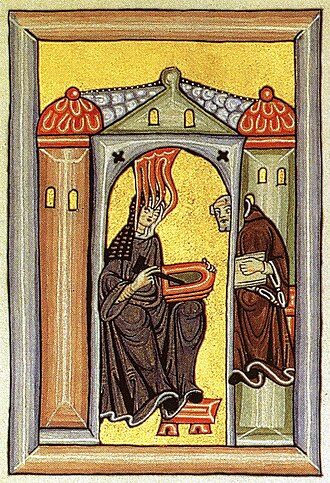
Hildegarde of Bingen
Welsh: Winefride of Holywell, Cadoc of Llancarfan
Germans: Gertrude of Helfta, Herman the Cripple, Hildegarde of Bingen, the Sybil of the Rhine
Austrians/Swiss: Nicholas von Flue, Jakob Gapp
Scandinavians: Willehad of Denmark, Hallvard of Oslo, Bridget of Sweden, Thorlak Thorhallsson of Iceland
Balts: George Matulaitis
Magyars: King Istvan the Great, Elizabeth of Hungary
Czechs: Good King Wenceslaus, Agnes of Bohemia
Poles: Hyacinth Ronzki, Stanislaus Szczepanowski, Mother Mary Theresa Ledochowska, Pope John Paul the Great
Albanians: Mother Theresa of Calcutta
Slovenes: Lojze Grozde
Serbs: Sava
Kateri Tekakwitha
Croats: Mark Korosy
Romanians: Ieremia Stoica
Bulgars: Bishop Eugene Bossilkov
Russians: Olga of Kiev, Sergius of Radonezh, Euphrosyne of Polotsk
Native Americans: Kateri Tekakwitha, the Lily of the Mohawks, Black Elk of the Oglala, Juan Diego Cuauhtlatoatzin of Guadeloupe
Puerto Ricans: Carlos Manuel Rodríguez Santiago 
Mexicans: María Guadalupe García Zavala, “Mother Lupita”, Bartholomew Laurel, Padre Pio   
Central Americans: Peter Betancurt of Guatemala, Bishop Oscar Romero of El Salvador
Peruvians: Rose of Lima, Ana de los Angeles Monteagudo
Ecuadorians: Mercedes of Jesus, Mariana de Paredes, the Lily of Quito
Brazilians: Pauline of the Agonizing Heart of Jesus, Antonio de Santa Ana Galvao
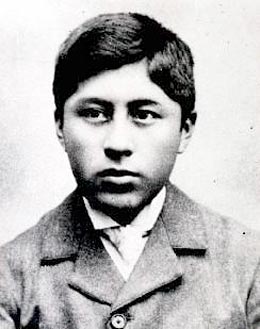
Ceferino Namuncurá
Paraguayans: Roque Gonzalez de Santa Cruz
Argentinians: Ceferino Namuncurá, the Lily of Patagonia 
Chileans: Teresa of the Andes, Alberto Hurtado Cruchaga 
Americans [USA]: John Nepomucene Neumann, Elizabeth Seton, Katherine Drexel, Mother Frances Cabrini
Canadians: Marguerite D’Youville, Mary Rose Durocher 
Indians: Alphonsa Mattahupadathus, Kuriakose Chavara, Mother Mariam Thresia Chiramel Mankidiyan 
Chinese: Thaddeus Lieu, Agnes Sao Kuy
Japanese: Father Thomas Hioji Rokuzayemon Nishi, Magdalene of Nagasaki
Koreans: Agatha Kim, Paul Chong Hasang
Thais: Philip Siphong, Sister Lucy Khambong
Victoria Rasoamanarivo
Vietnamese: Vinh Sơn Phạm Hiếu Liêm, Micae Hồ Đình Hy, Agnes De, Father John Dat
Filipinos: Lorenzo Ruiz
Australians: Mary of the Cross
African diaspora: Benedict the Moor, Martin de Pores
African: Charles Lwanga of Uganda, Mother Josephine Bakhita of the Sudan, Anwarite Nengapeta of the Congo
Victoria Rasoamanarivo of Madagascar


A: Jesus said, “Go, therefore, and make disciples of all nations, teaching them all that I have commanded you.” 
℟: And there before me was a great multitude which no one could count, from every nation, race, people, and tongue, standing before the throne and before the Lamb.

Wednesday, August 5, 2015

Evil as a defect in the good

Evil?
There has been a bit of disagreement over on another venue on the definition of an evil as a defectus boni. The interlocutor contended it was just the Catholic's way of getting God off the hook for having created evil. Pointing out that the definition stems from Aristotle, who was not actually Catholic, made no impression on his awareness.

When challenged to provide an example of an evil that was not a deprivation of a good, the interlocutor supplied things like genocide and torture. (Apparently, if an evil is really, really evil, the definition somehow no longer applies.) He missed the point that these things would not be thought of as evil in the first place if they did not deprive people of goods like their life, liberty, dignity, etc. But the reasons given were all emotive, not logical. How dare you say that something as horrid as genocide is "only" a deprivation of a good!

Sunday, May 31, 2015

Three in One Oil

Today is Trinity Sunday, a Solemnity. The concept it one of great bemusement and wonder to all. How can this be? How can three be one? How can one be three?

Thursday, November 6, 2014

First Way, Part IV: The Cascades


Previous episodes in this exciting series, now drawing toward its thrilling climax:
  • Background lays out the history of the Argument from Motion and the impatience of those who demand that it prove more than it asserts to prove (e.g., that it prove that Jesus is Lord or some such thing, as if the objector were genuinely concerned about this shortfall).
  • Part I A Moving Tale discusses the concept of "motion" used in the Argument from Motion, and how this is persistently misunderstood today. 
  • Part II Two Lemmas demonstrate that 
  1. Whatever is being actualized right now is being actualized by another. 
  2. There cannot be an infinite regress of instrumental changers,
  • Part III: The Big Kahuna combined the two Lemmas into the first theorem and its corollaries
A number of objections and misunderstandings were also addressed in these prior posts.

We are now ready for Thomas' throwaway teaser: "and this [the unmoved mover] is what all men call God." Folks who have never read any further (if they have even read that far) are often puzzled. How do you get God out of that? TOF hears them cry in bewilderment.

The answer lies in the several hundred further Questions and Articles in which these points are developed. In the interests of brevity, a few subsequent proofs will now be stated without extensive arguments, but ought to be intelligible in the light of what has already been said.

Monday, June 23, 2014

As Screwy as an Electron


Let us begin with a quotation from the quantum physicist Richard P. Feynman:
"Electrons, when they were first discovered, behaved exactly like particles or bullets, very simply. Further research showed, from electron diffraction experiments for example, that they behaved like waves. As time went on there was a growing confusion about how these things really behaved ---- waves or particles, particles or waves? Everything looked like both.

... If I say they behave like particles I give the wrong impression; also if I say they behave like waves. ... They behave in a way that is like nothing that you have seen before. ... Electrons behave in this respect in exactly the same way as photons; they are both screwy, but in exactly in the same way….

The difficulty really is psychological and exists in the perpetual torment that results from your saying to yourself, "But how can it be like that?" which is a reflection of uncontrolled but utterly vain desire to see it in terms of something familiar. ... Do not keep saying to yourself, if you can possible avoid it, "But how can it be like that?" because you will get 'down the drain', into a blind alley from which nobody has escaped. Nobody knows how it can be like that."
-- The Messenger Lectures, 1964, MIT

IOW, says Dr. Feynman, it's a mystery. But the mysterious nature of photons and electrons does not deter us from our beliefs. And that leads us to today's topic, here at an end of a Year.

Friday, April 18, 2014

TGIF!

"Reasons Why Christ Suffered"
"Furthermore men of all ranks and conditions were gathered together against the Lord, and against his Christ. Gentiles and Jews were the advisers, the authors, the ministers of his passion: Judas betrayed him, Peter denied him, all the rest deserted him. ... In this guilt are involved all those who fall frequently into sin; for, as our sins consigned Christ the Lord to the death of the cross, most certainly those who wallow in sin and iniquity crucify to themselves again the Son of God, as far as in them lies, and make a mockery of him. This guilt seems more enormous in us than in the ancient Jews, since according to the testimony of the same Apostle: if they had known it, they would never have crucified the Lord of glory; while we, on the contrary, professing to know him, yet denying him by our actions, seem in some sort to lay violent hands on him.”
Catechism of the Council of Trent, XVI cent.

Sunday, December 22, 2013

On the Natural Law

There is something in the human heart that recognizes wrong. As long as it is in other people. Ze'ev Chafets once wrote that "Mainstream Protestants tend to locate sin in the moral malfeasance of others—slaveholders, colonialists, capitalists, settlers, oil barons, and the Bush administration." Perhaps distance lends perspective. Or perhaps it is easier to spot a hole in front rather than one behind one's own eyeballs.

Friday, July 5, 2013

ISMism

Back in the Olde Days, when TOF was a practicing Quality Engineer, there was a popular three-step process for implementing the techniques known as "statistical process control" -- or better yet: SPC.  (The benefit of TLAs is that you don't have to think about what the words mean.)  The three steps were:
  1. The massive training of everyone in sight
  2. The great control chart race
  3. Beating up the vendors
SPC, Science™, and other panaceae
Of special interest are the first two steps.  Statistical process control -- which meant only that one should take account of the variable nature of manufacturing processes and not make adjustments unless there are reasonably certain evidences that the process has actually shifted -- was seen by some as a panacea.  Convinced of the great value of this technique, they would go hog-wild and start hanging charts everywhere.  Management would mandate that everyone would have charts; departments vied to see how many charts they had hung.  Yee-haw! 

It was belief in magic.  It was "control chart-ism."  If only we hang these Shewhart charts, magic will happen.  Magic did happen.  Whoever hung the charts eventually disappeared.

The Allegory of the VCD Machine

Once upon a time, TOF had the occasion to visit a computer assembly plant.  He was proudly shown the Great Wall of Charts.  See how many charts we have!  It is only a matter of time before our problems go away.  Huzzah!

TOF examined one of the charts.  It was replete with signals of assignable causes: that is, causes not normally part of the cause-system.  What was the assignable cause of this pattern?  Blank looks.  Did you investigate to discover the causes?  Investigate?

These were not foolish people.  They were quite bright.  But they had forgotten that the operative word in "control chart" was "control," not "chart."  They had confused the instrument with the objective.

A visit was paid to the process, which was currently rejecting many circuit boards.  It was a VCD machine (variable-center distancing).  The jaws plucked a component off a paper strip, inserted the leads through the holes in the circuit board, and crimped them on the other side.  Then the circuit board re-centered two other holes under the jaws, ready for the next component off the tape.  Behold its majestic glory:

(Geez, you really can find everything on the intertubes.)

TOF noticed a peculiar thing.  As each board was stuffed, the operator would remove the board, place a yellow sticky arrow on it, then inspect the board.  Sometimes he saw a smashed component (or whatever) and he placed a second sticky-arrow pointing to this.  The number of defects was counted and plotted on a u-chart as defects per 100,000 insertions. 

A question formed in the brain of TOF.  Neurons crackled.  Why did the operator place the first arrow before he inspected the board?

I don't know, the Host of TOF replied.

Shall we ask the operator?  The Host was reluctant that he, an Engineer, should ask a lowly Machine Operator, but his curiosity eventually triumphed.  The Operator pointed to the first marked component.  That's the wrong component, he said.  Design Engineering revised the board layout and changed the component to a different rating.  But no one reprogrammed the Sequencer that tacks the components in order on the paper tape, so we're still inserting the old component here.

Every time they ran that board, 100% of them had to be reworked.  Reprogramming the Sequencer was boring, and so after the excitement of board re-design and Engineering Change Orders and all the rest of the foo-foo, it fell between the cracks.  The Solution?  Reprogram the freaking Sequencer so it plucks the right component out of the bins.  Duh?  Additional solution: prepare a checklist for board re-design to flag all equipments and documentation that are to be revised or adjusted or reprogrammed as a result of the change. 

Despite all the charts, they had not had statistical process control, but statistical wallpaper.

Yet their enthusiasm had been undoubted.  Like the person who worships the intellect instead of using it, they admired the control charts without using them for actual, you know, control.  Like cargo-cultists, they thought that by replicating the outward forms and rituals they could achieve the same results achieved by those who had mastered the substance. In effect, although the charts were crying out to them, things the chart did not show -- the specific defects involved, the lack of configuration control at the Sequencer, etc. -- had become invisible.  They thought the answers were statistical!  But a thermometer only tells you you're sick.  It doesn't cure the sickness.  Instruments do not act on their own.
For those who might want to noodle the substance of the SPC methodology, TOF recommends the classic work: The Western Electric Company SQC Handbook, by a writing committee headed by the revered Bonnie Small, who once received a standing ovation at a conference of the American Society for Quality Control, when a speaker noticed her in the audience and pointed her out.  SQC was what SPC was called in its early days, but that word "quality" kind of spooked the turkey herd. 
TOF also modestly notes that when he worked summers at Mack Printing Company, this was one of the many technical publications that were then printed there.  TOF's father was pressroom superintendent, but this was not, repeat not, of any benefit to TOF, who received what we might call "character-building" work assignments, many of them involving steel wool and kerosene. 

Which leads us to today's topic. 

Saturday, May 4, 2013

The Passing of the Age of Reason

Da Man
Recently, on a forum called Quora, TOF was amused to see this topic:  What are the strongest arguments for atheism?

There are actually only two such arguments, both put forth by Thomas Aquinas some 743 years ago.  Each was stated in the form of an actual syllogism, and then answered.  They are:

Objection 1. It seems that God does not exist; because if one of two contraries be infinite, the other would be altogether destroyed. But the word "God" means that He is infinite goodness. If, therefore, God existed, there would be no evil discoverable; but there is evil in the world. Therefore God does not exist.
Videtur quod Deus non sit. Quia si unum contrariorum fuerit infinitum, totaliter destruetur aliud. Sed hoc intelligitur in hoc nomine Deus, scilicet quod sit quoddam bonum infinitum. Si ergo Deus esset, nullum malum inveniretur. Invenitur autem malum in mundo. Ergo Deus non est.
Objection 2. Further, it is superfluous to suppose that what can be accounted for by a few principles has been produced by many. But it seems that everything we see in the world can be accounted for by other principles, supposing God did not exist. For all natural things can be reduced to one principle which is nature; and all voluntary things can be reduced to one principle which is human reason, or will. Therefore there is no need to suppose God's existence.
Praeterea, quod potest compleri per pauciora principia, non fit per plura. Sed videtur quod omnia quae apparent in mundo, possunt compleri per alia principia, supposito quod Deus non sit, quia ea quae sunt naturalia, reducuntur in principium quod est natura; ea vero quae sunt a proposito, reducuntur in principium quod est ratio humana vel voluntas. Nulla igitur necessitas est ponere Deum esse.

These can be summarized as:
  1. Life sucks.  Therefore, no God. 
    (Vita sugit. Igitur nullus Deus.)
  2. Everything seems to work fine.  Therefore, no God. 
    (Omnia videtur ad bene operandum.
    Igitur nullus Deus.)
All other arguments are either padding or irrelevant.  So curiosity compelled a glance at this "Quora" site to see what the ingenuity of the Late Modern mind has come up with.  TOF was bemused. 

Thursday, February 14, 2013

Ash Wednesday

This is the first day of the Season of Doing Without.  The Christian Ramadan, as some have put it, perhaps confused a bit over which came first.  

One of the thing the Late Modern mind has difficulty grasping is allowing an appetite to go unslaked.  If it feels good, DO IT!  What do we want?  You name it.  When do we want it?  NOW! 

The ancient hedonists never confused pleasure with the good.  The indulgence of the senses results in a flabby mind and body; and modern neuroscience tells us that habituating such neural patterns interferes with the formation of neural patters originating in the neocortex.  Or in the older formulation: "Sin makes you stupid." 

But the Late Modern is as unfamiliar with the stern pagan virtues as he is with the laughing Christian ones.  But "virtue" means "strength" and a season of Lent could be thought of as a month at a fat farm or in the gym.  Exercising muscle groups is the flip side of exercising moral muscles.  Of course, as the "obesity epidemic" demonstrates, we are as adverse to the one as to the other.  As the Greeks, Romans, and Christians observed, the two tend to go together.  Mens sana in corpore sano


So Lent is not only about giving up pleasures (if only to prove that we can.  Who is the master, after all?)  It is also about building positive strengths.  Toning down lust may help strengthen love.  Fighting sloth may improve commitment.  Give me ten reps on the Temperance machine.  Half an hour on the moral elliptical. 
Some years ago, my friend Raj, who is a Hindu, announced that he was giving up both beef and single malt whiskey.  He wanted some favor from the gods and, as he explained it, if you want to get something, you must give up something.  It struck me as curious that, as a Hindu, he was giving up beef.  Wasn't he supposed to avoid beef to begin with?  I am not a northerner, he said by way of explanation.  Apparently, southern India is more laid back about such things.  When we went to eat, he would explain to the waiter, "I am being vegetarian this month."  The whole thing seemed oddly mechanical, as if his gods were cosmic vending machines.  If you inserted the requisite sacrifice in the slot, the desired good would fall into the tray.  But this is a blindness not at all restricted to him. 
But when it comes to Giving Up Something for Lent, Benedict XVI has set the bar awfully high.  I mean, look at what he is giving up...
+ + +

And of course the mainstream media can't get past the horserace mentality.  The touting has begun.  One really wishes the Spook would pull something out of his back pocket, just to irritate the punditry.  Everything is power and politics, of course; and matters are judged accordingly as they agree with Caesar's view of things or not.  Already, voices at the Times and the WaPo have  wondered breathlessly whether this time the Church will Get With It on the pelvic issues that so obsess modern secular culture, as if these thing were simply policy decisions made by an administration.  Life is hell for people stuck inside their own paradigm. 

Tuesday, January 29, 2013

Commemoration of Thomas Aquinas

Yeah, I know.  A day late and a thaler short.  But to make up for it, we have this link.

Whether St. Thomas is boring.

The Late Modern Age, which has substituted the locution "I feel that..." for "I think that..." undoubtedly finds the Dumb Ox boring.  Logic has that effect on the video-game mentality. 

Previously on the TOF Spot...

Monday, November 26, 2012

Fourth Way Corrigan

The well-known science popularizer, Richard Dawkins, once rebutted Aquinas' Fourth Way in an article in the Times (UK).  He first paraphrased Aquinas' argument thusly:
We notice that things in the world differ. There are degrees of, say, goodness or perfection. But we judge these degrees only by comparison with a maximum. Humans can be both good and bad, so the maximum goodness cannot rest in us. Therefore there must be some other maximum to set the standard for perfection, and we call that maximum God.

and then he comments
That's an argument? You might as well say, people vary in smelliness but we can make the comparison only by reference to a perfect maximum of conceivable smelliness. Therefore there must exist a pre-eminently peerless stinker, and we call him God. Or substitute any dimension of comparison you like and derive an equivalently fatuous conclusion.
whereupon Western philosophy crumbles.  What a knockdown!  Astonishingly, no one in history, not even Voltaire, ever noticed this before.  Instead, they sought to rebut at least one of the premises (usually the minor premise).  

Now the Fourth was never TOF's favorite argument, it being rather subtle, and TOF cannot say he follows it.  But let us see what can be made of it. 

Thursday, November 1, 2012

The Feast of All Saints

The come in all shapes and sizes, don't they?  Here's a list I've used before.  It is arranged along a not-too-subtle principle, which you are free to guess.  Sometimes it's good to know how exclusive the club is.  Those in the know are free to add the usual responsorials. 


Sunday, October 14, 2012

A blogger yclept

A blogger yclept Adam Gropnik at The New Yorker has averred, relative to that topic, that "It is conscious, thinking life that counts." It is not the lives of all members of the species radically endowed with the capacity for conscious, thinking life–it is all those actually presently enjoying the conscious life.  

Were I he, I should be wary of falling asleep and thereby not counting.  
+ + +

Wednesday, February 22, 2012

Make an Ash of Yourself

Ash Wednesday
Today is the most subversive day on the revolutionary calendar.  It is the day when we become fleetingly aware that maybe Nietzsche was not right and the will need not be triumphant.  Recall that ol' Crazy Fred told us in Will to Power
Through Christianity, the individual was made so important, so absolute, that he could no longer be sacrificed. ... All 'souls' became equal before God: but this is precisely the most dangerous of all possible evaluations.
Crazy Fred
Hence, the fierce determination of the Late Modern to deny the very existence of soul.  In Latin, this is anima, and is the same as "life."  So what follows from soul-denying is necessarily life-denying.  We also see the root of the Late Modern determination to subordinate the individual to the group, replacing individual human natural rights with state-granted group-entitlements.  And in that rejection of all souls being equal, we wound up with some lives being less equal than others, the lebensunwertes Leben, or "life unworthy of life," a pig which we sometimes tart up with the lipstick of "quality of life."  And those who fall too far down the "quality" scale may be denied life by their betters. 

Fred also wrote:

Wednesday, January 4, 2012

A Common Misperception

Creation is not a one-time event
but a continual holding in being
A correspondent in another venue, whom we will call Charles Cheese, writes:

[Scientific explanation] would be moot if Biblical creation were found to be true ... why bother to find out what makes people sick if it would only take prayer to cure you? Why bother to discover what cause earthquakes, volcanic eruptions or other natural disasters if it the just punishment of a displeased God?  There would be absolutley no need for any science if ... that's how God did it, is the answer to every question!


TOF is somewhat mystified by this contention, and for two reasons. 


Friday, May 20, 2011

Matthew 25:13


h/t Mark Shea

JC told his apostles, "Therefore, stay awake, for you know neither the day nor the hour."  However, some radio preacher in CA evidently has the straight skinny.  Using something suspiciously akin to numerology and the occult casting of horoscopes, he has determined that most of us are going to have our pickings of stereos, TVs, smart phones, abandoned cars, and empty houses come tomorrow.  Of course, if he's wrong, it won't be the end of the world. 

Amateur hour on the radio pulpit. 

That sound you hear is the echo of Matthew 25:12

Monday, May 16, 2011

Interview With a Physicist

The Commemoration of Jean d'Arc, Maid of Orleans

On this day in history, Joan of Arc was canonized a saint of the Roman Catholic Church.  It might could be that women in the Middle Ages did not have all the possibilities of their modern sisters.  But when we recall Joan -- and Sts. Hildegarde of Bingen; Hroswitha of Ganderheim; Gertrude of Helfta, Doctor of Theology; Abbess Petronilla of the dual-abbey at Fontevrault; not to mention Eleanor of Aquitaine and Blanche of Castile; or that the tax rolls of Paris (late 1200’s) list women as schoolmistress, doctor, apothecary, plasterer, dyer, copyist, miniaturist, binder, etc.; and the ‘Inquiries’ of King Louis mention women as hairdresser, salt merchant, miller, farmer, chatelaine, even a woman Crusader!  -- we might pause to consider that they likely had a wider scope of action than their Victorian descendants. 

Hawking Off the Reservation, Again. 

The propensity of physicists to regard themselves as gurus in non-physical matters continues unabated.  The eminent physicist Stephen Hawking was recently interviewed by the Guardian (nee Manchester Guardian) in which exchange he unburdened himself of a number of opinions of no great weight, save he wears the white vestments of the lab coat.  However, his eminence demands that he be taken every bit as seriously as the Dean of Westminster Cathedral should that worthy ever unburden himself on the matter of black holes. 

Prometheus Awards: Read & Watch

 Hello Friends & Fans of Michael Flynn,       The Libertarian Futurist Society has made available the text of the acceptance speech Dad...