Showing posts with label we're all gonna die. Show all posts

Friday, November 10, 2017

No Wonder We're Fat!

Factoids on Parade!

"Food inflation hit an 18-year high in April [2008], with grocery prices rising 1.5 percent for the month, the government said Wednesday. Prices rose in every aisle--dairy, breads, meats, beverages, fruits and vegetables. It means $53 more a month to feed a family of four with a typical food budget."
-- Pioneer Press of St. Paul, MN
05/15/2008 06:59:05 AM CDT

Sunday, August 28, 2016

Keeping Perspective

Hot Times in the Old Town


Speaking of forest fires:
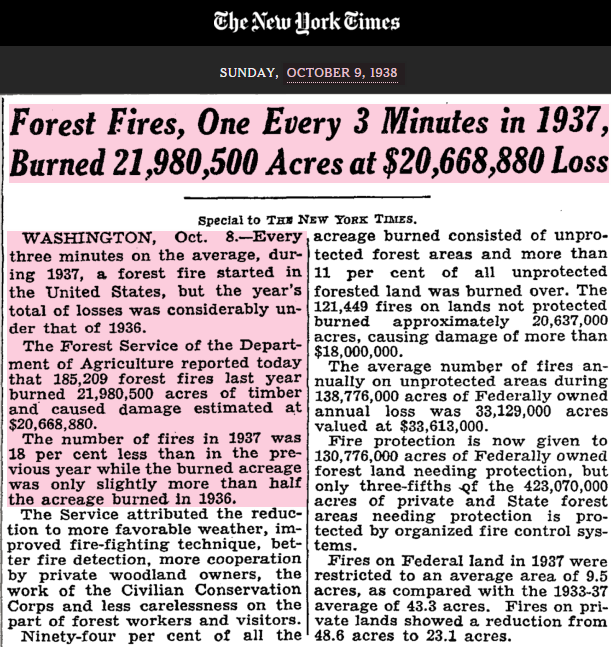
The 1930s were the banner years for forest fires. In 1937, there was one forest fire every three minutes per the NY Times.

But in 1910, a few years after the Forest Service was formed and not on the above graph, "a devastating series of forest fires swept over Idaho, Montana, and Washington, culminating on August 20–21 in what is known as the "Big Blowup." Coming only five years after the U.S. Forest Service’s establishment, this seminal event made a deep and lasting impact on the agency. ... [T]he young agency was undermanned, underfunded, and underprepared for what was to come. ...  On August 20 hurricane-force winds swept through the region and fanned embers and low flames back to life all across the Northern Rockies. There was no stopping or containing the fire; one could only hope to avoid it. Trains raced to evacuate towns just ahead of the flames." 

Thus began the Forest Service's Smokey the Bear campaign to prevent forest fires. Unlike most federal programs, it seems to have been successful and involved among other things a program of "controlled burns" in Forest Service lands to clear out inflammable underbrush. About 30 years ago, TOF read an article about the end of the controlled burn program because it was non-environmental: Nature should be allowed to take its course, even if that meant occasional wildfires. Hey, it's Nature!

Lo and Behold! As the underbrush and deadwood once more accumulated, the number of burned acres began to increase slightly, starting roughly ten years ago. 

Flood and Mud

Fires were not the only thing going on.

ALL EASTERN AMERICA UNDER FLOOD WATERS


Terrible Duststorm Rages In West


PRESIDENT SIGNS 
APPEAL AS 
CAPITOL FLOODED.


100 CITIES AND 14 STATES AFFECTED.
NEW YORK. Thursday.
A quarter of the area of the United States was
under flood waters today. It is a disaster ranking
with the worst calamities from natural causes that
have occurred in the history of the nation. Property
damage is so great that it is almost incalculable. Loss
of life may exceed 1000 for already 160 fatalities are
known and 40 people are missing.
As Eastern American States became almost
covered with water, terrible dust-storms raged across
the central and western States, tearing the crops out
by the roots and laying waste thousands of square
miles of country. Where the dust struck snow
storms, it rained mud.
So reported the Perth (Western Australia) Daily News on Friday, March 20, 1936
An extraordinarily dramatic
touch was given to the Presi-
dent's appeal to the nation for
Red Cross fund for, even as he
signed the proclamation, thous-
ands of Works Progress Admin-
istration workers were strug-
gling desperately to erect bul-
warks against the waters of the
Potomac River which rapidly
are approaching within a few
squares of White House itself.
Just in case you've been getting a-skeered by weather coverage lately.

Hurricane Season Off to a Whimper

Fascinatingly, the weatherfolk watching the tropical Atlantic have been reduced to reporting on a "scary," nameless "disturbance" (Invest 99-L) that might grow up to be a tropical depression that could deepen into a tropical storm that might be intensify into a hurricane that could reach Cat. One. This is because there has been, contrary to theory, a decided dearth of actual hurricanes to speak of for the past 11 years; although since we started naming tropical storms it does not actually seem so when one reviews the named storms. There is now a move to name tropical depressions in order to keep the count up. For now, the headlines will have to read:
An amazing stretch of almost 11 years without a major hurricane
may or may not be coming to an end.

Hot Enough Yet?

Speaking of heat waves, in 1936 a heat wave caused 12,183 deaths in the US, the NY Times reported (July 7, 1936)
The Chicago Tribune reported a week later (July 14, 1936) that hundreds had died in Detroit from the heat wave and that Chicago itself was also baking.Meanwhile, over in Ohio, the Chillicothe Constitution-Tribune in Ohio (July 25, 1936) tells us:
CROP CRISIS WORSE,
HEAT RISING TO 119°
with a sub-head that
31 CITIES ARE OVER 100°
Ach, du Lieber! TOF hears you ask, How many days went over 105°F?

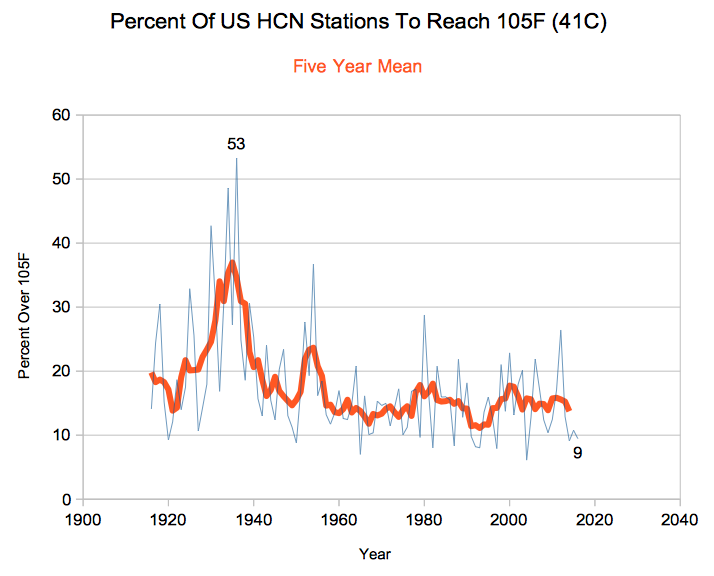
Hard to say, but here is the graph of the percentage of US HCN temperature stations that hit that level sometime during the year:
So the 1930s peaked pretty dang hot compared to today's less extreme climate. Of course, Alert Reader will note that there will always be a few weather stations hitting the 105 point, roughly 15% of them.

The 1930s also featured worries about global warming

Warming Arctic Climate Melting Glaciers Faster, Raising Ocean Level, Scientist Says 
“A mysterious warming of the climate is slowly manifesting itself in the Arctic, engendering a "serious international problem," Dr. Hans Ahlmann, noted Swedish geophysicist, said today.

New York Times, May 30, 1937

A ship was reported to have made the Northwest Passage across open waters, but TOF has not located the report.

So, the world rallied and did nothing and before you could say Jack Robinson, the Times was reporting:

“After a week of discussions on the causes of climate change, an assembly of specialists from several continents seems to have reached unanimous agreement on only one point: it is getting colder.
New York Times, Jan. 30, 1961

 And just to emphasize the everything old is new again theme, 1938 was also the year Hilaire Belloc wrote his warming that Islam, though then quiescent could easily revive and threaten once more the cities of the West

The common root to all this is short term memory.
"[M]en are always powerfully affected by the immediate past:
one might say that they are blinded by it." -- Hilaire Belloc

Saturday, June 11, 2016

Have You Ever Noticed?

How nowadays every tropical storm gets a name? That's because there haven't been enough hurricanes in recent times and they need named storms to keep folks riled up. They've been trying to name winter storms for a couple years now, but it hasn't caught on.

The TV weather in the morning now reports how many millions of people are "at risk" for weather events. At risk for what is left unsaid. Of death? Of bodily injury? Of getting wet? What? And why don't they use the same criterion when reporting on new federal regulations?

Friday, February 14, 2014

Odd Coincidence

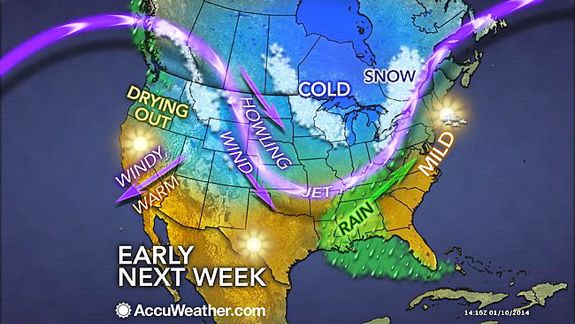
A weather map: the Polar Vortex

Wisconsin Glaciation
The edges of the Laurentide glacier are a pretty good fit to the path of the jet stream when deflected by a blocking high. 

In the old novel The Sixth Winter, this was ascribed by the scientists of the time, processed through John Gribbin, to a cooling atmosphere.


Sunday, May 12, 2013

Where is Global Warming When You Really Need It?

Springtime in Minnesota:


This is definitely a creepy thingie, almost SFnal.  You can actually see the mini-glacier flowing toward the houses.  (This is actually ice pushed off the lake in the background, presumably by wave and wind action, although the trees don't seen to indicate strong winds.)

Saturday, December 8, 2012

Ends and Odds

Yes, it's that time again: Clearing the Tabs!  Wherein TOF posts a number of links which he saved as of possible interest for his Reader and wishes to get up there before his collander-like mind forgets why he thought them interesting.

Sunday, November 4, 2012

Hurricane Warning

Some perspectives.  Part of the purpose of this 11 minute film is to hype the deeds of the WPA, and we note the recurrence of stock phrases such as "shoulder to shoulder" that were popular in the 1930s.  But the fascinating thing is how little they had to work with back then.  Also, the good ol' 1930s Newsreel Voice. 

The 1938 hurricane was dubbed "The Long Island Express."  (Our modern naming conventions were not then in use.)  It flooded Manhattan all the way up to Canal Street. 


Waves 20-50 feet high crashing on the shore registered on seismographs in Alaska.  More than 600 people were killed, many of them children.  Katherine Hepburn barely escaped.  The History Channel did a show on the hurricane a while back, and it is intriguing how closely the Long Island Express matched conditions for this year's Sandy.  Instead of dying out over the colder North Atlantic, it was pinned between two highs and prevented from turning east.  Plus the autumn equinox and a full moon meant it was driving unusually high tides before it. 

The eight-part History Channel show starts here:

Of particular interest is how little meteorologists had to go on in 1938.  No radar, let alone satellite imagery.  Even the idea of using physics rather than experience was brand new and contrary to today, the one young junior meteorologist who called it right was ignored by the senior forecasters. 

Saturday, July 14, 2012

When is Weather Really "Climate"?


Answer: when the weather is warm. 

Over at Statistician to the Stars, we find some commentary on a recent calculation that thirteen consecutive months of above-average temperatures has a 1 in 1.6 billion probability of occurring by chance.  This figure was obtained by considering temperature anomalies (deviations of adjusted actual temperatures from the mean temperature for that month), classifying them as "above normal," "normal," and "below normal," and assigning probabilities of 1/3 to each group.  Then taking ⅓^13 to calculate the probability of a run of 13 "above-normal" temperatures.  This is a fairly simplistic model.  It also suggests that 14 months ago, temperatures were normal or below.  You will notice that 13 months is just over one year, which hardly qualifies as climate and may not even qualify as 13 independent measurements. 


Dr. Briggs writes...

Friday, December 9, 2011

Adventures in Statistics

The following graph was prepared by NOAA and presented on the National Public Radio website.  The gist of the accompanying article was OMG!!  WE'RE ALL GONNA DIE!!! Or something like that.  In particular, weather ("which is not climate") has suddenly become climate again.   
at least until the last line of the article:

Saturday, October 29, 2011

What Hath Global Warming Wrought?

Snow near my brother's house by Philadelphia
It is snowing here in the Lehigh Valley.  Forecasts are for 4-8 inches.  It is not yet Hallow E'en.

Now, the IPCC models were always in agreement that most of the warming would take place in Northern Hemisphere winter nights (which actually doesn't sound so bad), so the trend toward colder over these past ten years or so is whiffing a lot like Popper.  But never fear: weather is not climate!  (Except when it is: cf. Katrina, Irene, Texas drought, etc.)  And it ain't global warming no more; it's climate change!  So any time the climate seems to change, it is due to climate change.  And never mind the dizzy spell from circular reasoning.  I suppose the orbits of the planets can now be explained by location change, too. 

Wednesday, October 26, 2011

TOF Translation Service 

Current global warming appears anomalous in relation to the climate of the last 20000 years
Svante Björck
Department of Earth and Ecosystem Sciences, 
Division of Geology, Quaternary Sciences, Lund University, Sölveg. 12,
223 62 Lund, Sweden

Friday, December 10, 2010

Sometimes, the Mask Slips, a Little

A quote that is disheartening to read:

Then, in 2003, the same data set, which in their [IPCC’s] publications, in their website, was a straight line—suddenly it changed, and showed a very strong line of uplift, 2.3 mm per year, the same as from the tide gauge. And that didn’t look so nice. It looked as though they had recorded something; but they hadn’t recorded anything. It was the original one which they had suddenly twisted up, because they entered a “correction factor,” which they took from the tide gauge. So it was not a measured thing, but a figure introduced from outside. I accused them of this at the Academy of Sciences in Moscow—I said you have introduced factors from outside; it’s not a measurement. It looks like it is measured from the satellite, but you don’t say what really happened. And they answered, that we had to do it, because otherwise we would not have gotten any trend!
-- Dr. Nils-Axel Mörner

Klimaschutz hat mit Umweltschutz kaum mehr etwas zu tun, sagt der Ökonom Ottmar Edenhofer. Der nächste Weltklimagipfel in Cancún sei eigentlich ein Wirtschaftsgipfel, bei dem es um die Verteilung der Ressourcen gehe.
-- Klimapolitik verteilt das Weltvermögen neu
(Climate policy has almost nothing to do anymore with environmental protection, says the German economist and IPCC official Ottmar Edenhofer. The next world climate summit in Cancun is actually an economics summit during which the distribution of the world's resources will be negotiated.)
 ...

Monday, October 25, 2010

Goosey Goosey Gander

Upstairs, Downstairs

Kirk Myers, Seminole County Environmental News Examiner has compiled a fascinating list of quotes, many of which are below:

"The climate of New-York and the contiguous Atlantic seaboard has long been a study of great interest. We have just experienced a remarkable instance of its peculiarity. The Hudson River, by a singular freak of temperature, has thrown off its icy mantle and opened its waters to navigation.”
– New York Times, Jan. 2, 1870

“Is our climate changing? The succession of temperate summers and open winters through several years, culminating last winter in the almost total failure of the ice crop throughout the valley of the Hudson, makes the question pertinent. The older inhabitants tell us that the winters are not as cold now as when they were young, and we have all observed a marked diminution of the average cold even in this last decade.”
– New York Times, June 23, 1890
========================
“The question is again being discussed whether recent and long-continued observations do not point to the advent of a second glacial period, when the countries now basking in the fostering warmth of a tropical sun will ultimately give way to the perennial frost and snow of the polar regions.”
– New York Times, Feb. 24, 1895
========================
“The Arctic Ocean is warming up, icebergs are growing scarcer and in some places the seals are finding the water too hot,” [according to a Commerce Department report].

“Reports from fishermen, seal hunters and explorers. . . all point to a radical change in climate conditions and . . . unheard-of temperatures in the Arctic zone . . . Great masses of ice have been replaced by moraines of earth and stones . . . while at many points well-known glaciers have entirely disappeared.”
--Washington Post, Nov. 2, 1922
========================
Professor Gregory of Yale University stated that “another world ice-epoch is due.” He was the American representative to the Pan-Pacific Science Congress and warned that North America would disappear as far south as the Great Lakes, and huge parts of Asia and Europe would be “wiped out.”
– Chicago Tribune, Aug. 9, 1923

“The discoveries of changes in the sun's heat and southward advance of glaciers in recent years have given rise to the conjectures of the possible advent of a new ice age
– Time Magazine, Sept. 10, 1923
===========================
Headline: “America in Longest Warm Spell Since 1776; Temperature Line Records a 25-year Rise”
– New York Times, March 27, 1933
==================
“America is believed by Weather Bureau scientists to be on the verge of a change of climate, with a return to increasing rains and deeper snows and the colder winters of grandfather's day.”
– Associated Press, Dec. 15, 1934
======================
Warming Arctic Climate Melting Glaciers Faster, Raising Ocean Level, Scientist Says – “A mysterious warming of the climate is slowly manifesting itself in the Arctic, engendering a "serious international problem," Dr. Hans Ahlmann, noted Swedish geophysicist, said today.
– New York Times, May 30, 1937

Greenland's polar climate has moderated so consistently that communities of hunters have evolved into fishing villages. Sea mammals, vanishing from the west coast, have been replaced by codfish and other fish species in the area's southern waters.”
– New York Times, Aug. 29, 1954

“An analysis of weather records from Little America shows a steady warming of climate over the last half century. The rise in average temperature at the Antarctic outpost has been about five degrees Fahrenheit.”
– New York Times, May 31, 1958

“Several thousand scientists of many nations have recently been climbing mountains, digging tunnels in glaciers, journeying to the Antarctic, camping on floating Arctic ice. Their object has been to solve a fascinating riddle: what is happening to the world's ice?
– New York Times, Dec. 7, 1958
========================
“After a week of discussions on the causes of climate change, an assembly of specialists from several continents seems to have reached unanimous agreement on only one point: it is getting colder.
– New York Times, Jan. 30, 1961

“Like an outrigger canoe riding before a huge comber, the earth with its inhabitants is caught on the downslope of an immense climatic wave that is plunging us toward another Ice Age.”
– Los Angeles Times, Dec. 23, 1962
=================
“Col. Bernt Balchen, polar explorer and flier, is circulating a paper among polar specialists proposing that the Arctic pack ice is thinning and that the ocean at the North Pole may become an open sea within a decade or two."
 
– New York Times, Feb. 20, 1969
=======================

Because of increased dust, cloud cover and water vapor, "the planet will cool, the water vapor will fall and freeze, and a new Ice Age will be born.”
– Newsweek magazine, Jan. 26, 1970

“The United States and the Soviet Union are mounting large-scale investigations to determine why the Arctic climate is becoming more frigid, why parts of the Arctic sea ice have recently become ominously thicker and whether the extent of that ice cover contributes to the onset of ice ages.”
– New York Times, July 18, 1970

“In the next 50 years, fine dust that humans discharge into the atmosphere by burning fossil fuel will screen out so much of the sun's rays that the Earth's average temperature could fall by six degrees. Sustained emissions over five to 10 years, could be sufficient to trigger an ice age."
– Washington Post, July 9, 1971

It's already getting colder. Some midsummer day, perhaps not too far in the future, a hard, killing frost will sweep down on the wheat fields of Saskatchewan, the Dakotas and the Russian steppes...”
– Los Angles Times, Oct. 24, 1971

“An international team of specialists has concluded from eight indexes of climate that there is no end in sight to the cooling trend of the last 30 years, at least in the Northern Hemisphere.”
– New York Times, Jan. 5, 1978
======================
“A poll of climate specialists in seven countries has found a consensus that there will be no catastrophic changes in the climate by the end of the century. But the specialists were almost equally divided on whether there would be a warming, a cooling or no change at all.”
– New York Times, Feb. 18, 1978
===============
“A global warming trend could bring heat waves, dust-dry farmland and disease, the experts said... Under this scenario, the resort town of Ocean City, Md., will lose 39 feet of shoreline by 2000 and a total of 85 feet within the next 25 years.”
– San Jose Mercury News, June 11, 1986

Global warming could force Americans to build 86 more power plants -- at a cost of $110 billion -- to keep all their air conditioners running 20 years from now, a new study says...Using computer models, researchers concluded that global warming would raise average annual temperatures nationwide two degrees by 2010, and the drain on power would require the building of 86 new midsize power plants
– Associated Press, May 15, 1989

New York will probably be like Florida 15 years from now.”
-- St. Louis Post-Dispatch, Sept. 17, 1989

"[By] 1995, the greenhouse effect would be desolating the heartlands of North America and Eurasia with horrific drought, causing crop failures and food riots . . . [By 1996] The Platte River of Nebraska would be dry, while a continent-wide black blizzard of prairie topsoil will stop traffic on interstates, strip paint from houses and shut down computers . . . The Mexican police will round up illegal American migrants surging into Mexico seeking work as field hands.”
– "Dead Heat: The Race Against the Greenhouse Effect," Michael Oppenheimer and Robert H. Boyle, 1990.

"It appears that we have a very good case for suggesting that the El Ninos are going to become more frequent, and they're going to become more intense and in a few years, or a decade or so, we'll go into a permanent El Nino. So instead of having cool water periods for a year or two, we'll have El Nino upon El Nino, and that will become the norm. And you'll have an El Nino, that instead of lasting 18 months, lasts 18 years,” according to Dr. Russ Schnell, a scientist doing atmospheric research at Mauna Loa Observatory.
– BBC, Nov. 7, 1997

"Scientists are warning that some of the Himalayan glaciers could vanish within ten years because of global warming. A build-up of greenhouse gases is blamed for the meltdown, which could lead to drought and flooding in the region affecting millions of people."
-- The Birmingham Post in England, July 26, 1999

“This year (2007) is likely to be the warmest year on record globally, beating the current record set in 1998.”
– ScienceDaily, Jan. 5, 2007

Arctic warming has become so dramatic that the North Pole may melt this summer (2008), report scientists studying the effects of climate change in the field. "We're actually projecting this year that the North Pole may be free of ice for the first time [in history]," David Barber, of the University of Manitoba, told National Geographic News aboard the C.C.G.S. Amundsen, a Canadian research icebreaker.
– National Geographic News, June 20, 2008

"So the climate will continue to change, even if we make maximum effort to slow the growth of carbon dioxide. Arctic sea ice will melt away in the summer season within the next few decades. Mountain glaciers, providing fresh water for rivers that supply hundreds of millions of people, will disappear - practically all of the glaciers could be gone within 50 years. . . Clearly, if we burn all fossil fuels, we will destroy the planet we know . . . We would set the planet on a course to the ice-free state, with sea level 75 metres higher. Climatic disasters would occur continually."
-- Dr. James Hansen (NASA GISS), The Observer, Feb. 15, 2009.

Tuesday, May 11, 2010

Odds and Ends

Venus: A Lot of Hot Air

The common supposition that Venus is Really Hot because of the CO2 seems contraindicated.  It is the sheer weight of the atmosphere that heats things up down below.  Seems sunlight doesn't even penetrate the atmosphere deeply enough for the "greenhouse" effect to matter.  (No sunlight filtering in = no IR on the bounceback.)  The attached essay is interesting; and you can ignore the snipes at the AGW folks and mentally return to the days when science meant knowledge rather than political power. 

wattsupwiththat.com/2010/05/06/hyperventilating-on-venus/#more-19270

Prometheus Awards: Read & Watch

 Hello Friends & Fans of Michael Flynn,       The Libertarian Futurist Society has made available the text of the acceptance speech Dad...