Showing posts with label topology. Show all posts

Sunday, November 22, 2020

Putting On My Top Hat

Politics these days seem based more on feelz than on thoughts. Now that the shouting is over -- Biden won, so there are no mobs raging in the street -- and the only sound is the high-pitched whine of a well-known Narcissist. TOF thought to take a moment to review the awful simple-mndedness of standard political thought; to wit, the Left-Right spectrum.

Catastrophe Theory was devised by topologist Rene Thom to model situations where stable behavior suddenly flips to chaotic behavior (and vice versa). These surfaces have been used to model such diverse phenomena as the collapse of nations, the buckling of a beam, the binging of anorexia, the flight/fight of animals, boiling of liquids, et al. According to his Fundamental Theorem, there are seven elementary catastrophe surfaces, classified by the number of independent variables and the number of dependent variables. The behavior of a system governed by a potential function converges to an equilibrium surface, the manifold dM. The bends of folds of this manifold describe the varied behaviors of the system.

Back in the 70s, E. C. Zeeman applied the cusp model to political ideologies. The two parameters were A economic (opportunity versus equality) and B political (the rights of the individuals versus the rights of the group). The state space was a “cloud of points” representing the opinions of the individuals in the society. (These are measurable, at least in theory, by opinion polling.) The cloud was embedded topologically in a one-dimensional space, Y, which turned out to be the traditional left-to-right political spectrum. Zeeman‘s catastrophe surface shows why this simple line really has a complex “anatomy”.  
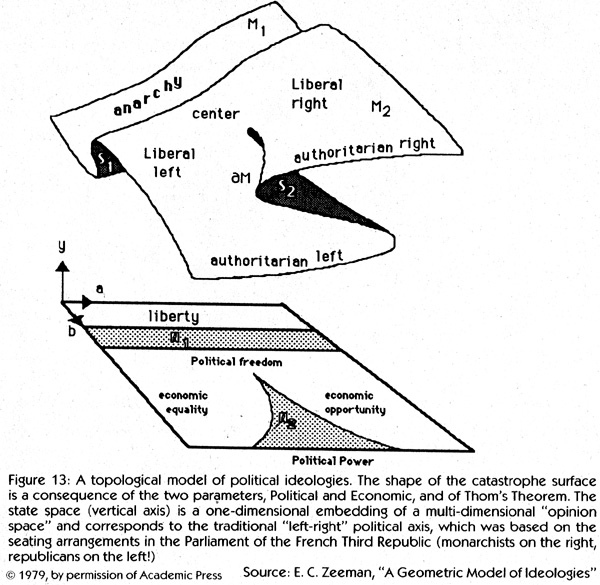

 An authoritarian left regime that moves toward economic opportunity without opening up politically is liable to snap suddenly to an authoritarian right regime. But if it moves first toward political freedom, it can transition gradually to an open economy. As a society moves smoothly around the parameter space (AxB at bottom) its equlibrium state moves about on the manifold above. For each position in parameter space there is a single unique state on the manifold... Until the society enters the bifurcation set (triangular region) where there are two equilibrium states. Inertia keeps it on the original sheet until it exits the bifurcation set on the opposite side. The original equilibrium vanishes and, governed by the potential function, snaps rapidly to the other equilibrium.

Projecting the surface dM onto the AY and BY planes reveals why dictatorships of the left and the right resemble each other so closely, and why right-wing populists often sound like left-wingers. It also shows why some social changes must be revolutionary; and why one-party states frequently develop left and right wings within the Party. 

In 2016, both "tea party" activists and "occupy movement" activists made the same diagnosis of America's ills: viz., the government was controlled by "oligarchs." However, they differed in their solutions. The one wanted to give the government more power (to be wielded, one supposes, by those self-same oligarchs), while the other wanted to elect a junior varsity oligarch.


Monday, October 10, 2016

A Blast from the Past, continued

Ht99ztT6Sac

Putting on My Top Hat

I warned you. Nostalgia is a terrible force. Could we but harness it, our energy problems would be solved. Ah, the good old days...

Topologies

Topology is a branch of mathematics concerned with whether or not two points are close together, and how this closeness is affected by mappings from one space to another. On what basis can we say that two point a and b are "close"?

A topology on X is a family of subsets that constitute the "open" subsets of X. The familiar open sets of the real number line (a,b) constitute such a topology on E^1. The difference between the set of all real numbers and Euclidian 1-space is the open set structure, or topology. This is the difference between a set and a space.

Now it's nice to know that the family of all open sets consists of open sets. What topology does is build this up from beneath. IOW, we start with no preconception of what constitutes an "open" set and a set of rules for what a topology is. Basically, a topology is a family of sets that is closed under union (each union of members of the family is a member of the family) and closed under finite intersection (each finite intersection etc.) And, oh yeah, Ø and X are members, too.  It turns out (fortunately) that open sets are open sets under these rules. Phew.

A set can have more than one topology. The coarsest (smallest) topology is just that consisting of {Ø,X}, that is: the null set and the space itself. In such a topology, there are no small neighborhoods. If you want to say where a point is, it's in X. Sorry, can't pin it down any closer. This is called the indiscrete topology. The finest (largest) topology is P(X), the Power Set, which consists of the set of all subsets of X. This is the discrete topology.

Consider the set X={0,1} consisting of exactly two points with the discrete topology. 
T = P(X) = {Ø, 0, 1, X} This space is called 2. 
(Nice to know where 2 comes from when you start out with only 0 and 1.....)
 
The same set with the topology T = {Ø, 0, X} is called Sierpinski Space or S. Notice that {1} has no small neighborhoods in Sierpinski space, since the only open set containing {1} is X itself.

That's enough of that.

Functions

A function is a continuous map from one topological space to another. Notation is f:Y→Z. For example, the square maps E^1 into E^1 (actually into the non-negative part of E^1) by mapping 0 to 0, 1 to 1, 2 to 4 and so on and in between. This is illustrated below for a few points in Y.

This illo shows how a few open sets in Y are mapped into open sets in Z. For example:
f:(-2.8284271etc, +2.8284271etc) → (0,8)
f:(1,2) → (1,4)
f:(-2,-1) → (1,4)

f:(-1,+1) → (0,1)


Lastly, consider other functions mapping the same interval (0, 1.5 etc.) into Z.
-4 maps it into (-4) a "constant" map
Y^2 maps it into (0, 2.25)
-Y maps it into (-1.5, 0)
Y+2 maps it into (2,3.5)
4Y maps it into (0,6)


Function Spaces

It is natural to ask: what sort of topological space can we make of the set of all continuous functions from Y->Z.
In what sense can we say two functions f and g are "near" each other?
Who cares?

Tune in again next time for the next exciting installment in this mesmerizing topic. 

Alas

No third installment was posted. It began to seem all too esoteric a topic of an internet post.

Mathematica Antiqua

Ys-k6p-D4
This is a reposting of something that was on the Auld Blogge at LiveJournal. I cannot now use LiveJournal since some sort of virus has squatted on the page and insists on popping up new tabs that promise to remove the very obstacle in questions. However, I was able to use navigation keys to capture and paste the material here for posterity

A Blast from the Past

Last week (sic) I received a comment on this blog from my old topology professor, Doug Harris. This has sent my brain on a stroll down memory lane. I wrote a master's thesis under him that resulted in an original theorem or two. I have always taken great pride in the fact that they were of no practical use whatsoever. It appears now that the field of function space topologies has now become a hot new topic, and so the danger has arisen that someone somewhere may actually cite "Flynn's Theorem."

Now I remember a much younger professor, with darker hair. Of course, I also remember a much younger graduate student several pounds lighter. When I was there, he was the topology guy. Later, he moved into computer science, internet, and stuff like that; although he still has an interest in topology and is working on an interesting spectral theory of commutative rings with unit. He writes at spectral.mscs.mu.edu/GeneralTopology/ that

"My later work discovered some specific simple topological spaces which could act as "prime numbers" for constructing and characterizing very general classes of spaces. That is, any space in the class can be constructed from my spaces, which is the easy part, but if my spaces are constructed from other spaces one of the other spaces must be one of mine: that is the hard part, the primeness, and is something very unusual in topology."

One of the theorems in my own master thesis was that any function space topology in a class could be described as a subspace of a product of a particular space of the class, which I called the universal space of that class. So there is a distant analogy here that tickles me. The theorem was later published in a math journal, and so is my first publication, albeit not SF. Okay, so I had some stories published in my high school literary magazine; but they don't count because I was one of the two editors. But I digress. By some weird coincidence I had come across a copy of the paper and had been thinking about the Old Days. I had even pulled down Schubert, Dugundji and some other texts and was doing a little recreational reading. And then along comes the comment from Prof. Harris. How weird is that?

(Not that weird. I pulled those books out of storage when Margie built me an office with lots of bookcases, and from time to time I ave looked in one or another of the books. Tensor Analysis on Manifolds. Rings of Continuous Functions. Fundamentals of Linear Algebra. Woo hoo. So I have looked in the Topology books before without calling up spirits from the vasty deep.)

Some of you may be wondering, What the @#$%^ is topology, and thinking it has something to do with maps. It does; but not those kinds of maps. Perhaps I will post on the subject and elevate the tone of this blog. But for a sum of money I will not. You have been warned.

Sunday, October 3, 2010

Putting on my Top Hat

I ran across an intriguing abstract the other day that ties into Thom's topological catastrophe surfaces.  But alas I cannot get hold of the whole article. 

First Things First
Rene Thom developed catastrophe theory in algebraic topology many years ago.  Like so-called "chaos" theory, it is somewhat mis-named.  In French, apparently, "catastrophe" means only a sudden, discontinuous change, as when a stretched rubber band stops growing longer and snaps; or when a waterfall changes from laminar flow to turbulent flow.
The catastrophe surface is a manifold in response (or "state") space that consists of all the equilibrium points of the response variables over all values of the parameter variables.  The are the "attractors" toward which a system will move in systems governed by a potential function; and thus they function as a type of Aristotelian "final cause."  

Prometheus Awards: Read & Watch

 Hello Friends & Fans of Michael Flynn,       The Libertarian Futurist Society has made available the text of the acceptance speech Dad...