Friday, November 10, 2017

No Wonder We're Fat!

Factoids on Parade!

"Food inflation hit an 18-year high in April [2008], with grocery prices rising 1.5 percent for the month, the government said Wednesday. Prices rose in every aisle--dairy, breads, meats, beverages, fruits and vegetables. It means $53 more a month to feed a family of four with a typical food budget."
-- Pioneer Press of St. Paul, MN
05/15/2008 06:59:05 AM CDT

Thursday, November 9, 2017

News From the Front

More dispatches from the War on Science, this time from the Mathematics Front:

https://link.springer.com/epdf/10.1007/s12129-017-9659-z?author_access_token=stOqFhx08wuEn9MIBRNfBve4RwlQNchNByi7wbcMAY4pF6Km7OthXxcqYwy7bIQTTkzFiPQPrBZEUI-oVBSjQ25rb8GOWARgw6unbmR54uU_8n7rNst8xQ80FQ1Aji0iZRqjhulYOhgG6lyoW0x7Pw%3D%3D

Read it and be afraid. Be very afraid. The barbarians are already inside the gates.

+++

I recollect one time when as a graduate assistant at Marquette, I had an office with two other TAs on the second floor of what was then the Math building and is now not there at all. Three other TAs had the office next to us. The rest of the math department was on the third floor, where they needn't associate with us peasants. The remainder of the 2nd floor was given over to something called the Education Department.

One day, we math grads fell into discussion with one of the Education professors regarding the New Math, in which little kids were being taught abstract set theory. At one point we objected that not even the teachers understood such abstractions. "The teacher does not need to understand the material," the professor of education insisted. "He only needs to understand how to teach the material."

All hail Common Core, where a kid can be marked wrong for showing that 5x3=15 because 5+5+5=15 rather than 3+3+3+3+3=15 as the syllabus says!

Wednesday, November 8, 2017

Fake News

THE THOUGHT-CLICHE of "Fake News" (which TOF will endeavor to spell "Fake News [sic]" at least until he tires of doing so) which was launched by the old-school dish-it-out media has faded somewhat as the old-school media discovered it bounding back on them like eager little puppy dogs.
Most ironic of all ... was the outcry against "fake news," said to be fostered and encouraged by their upstart rivals in the social media, possibly with the assistance of Russian or Macedonian hackers (experts said) plying gullible Trump supporters with disinformation (or accurate but purloined information) tending to the disadvantage of Mrs Clinton. Worst of all, these dark, clandestine forces were causing a drop in readership and in newspaper advertising revenue and so endangering the livelihood of proper journalists, like the criers-out.
"The internet-borne forces that are eating away at print advertising are enabling a host of faux-journalistic players to pollute the democracy with dangerously fake news items," thundered Jim Rutenberg of The New York Times on the day before the election.
--James Bowman, "Faking It and Making It" The New Criterion, Jan 31, 2017)
The first example to pass before TOF's optics was one played on the network news regarding a pizza parlor in Washington DC said to host a satanic child pornography ring run by DNC officials, identified by no less reliable a source than a guy in his pajamas in his mother's basement: i.e., a blogger. This so evidently inspired a bloggee that he went there with a rifle to "self-investigate the claims." At least no one did so wretched a thing back when the mainstream media was propagating similarly bootless calumnies -- quoting real-life officials who self-investigated -- about satanic day-care centers. They used firearms and juries to clap innocent people in jail. Satanic child-care is always a winner in stirring folks up, whether it is a blogger or a district attorney who does the stirring.

Thursday, November 2, 2017

Medieval SF

This was a post originally appearing on the Auld Blogge lo! these many years ago. I had thought it reposted here, but I cannot find it and so I am doing so now. 

ET in the Middle Ages

It has long been held that the medievals would have been terrified of aliens, regarded them as "demons," and otherwise persecuted them in their religious ignorance and fanaticism, while we wise moderns would recognize them as intelligent and equivalent to humans, deserving of the same consideration as humans. The latter is a self-flattering mythos, but likely no more true than the former.

For illumination, we might turn to the well-known SF novel, Eifelheim, but this too may be regarded as self-flattering. Besides, I have it on good authority that the author made it all up; so it can be seen as begging the question.

So let us turn to the story of Ratramus and the Dog-Heads (h/t James Hannam)

In his Encyclopedia, Pliny quotes from Megasthenes’ Indica regarding alien creatures living in India:
Megasthenes writes that on different mountains in India there are tribes of men with dog shaped heads, armed with claws, clothed with skins, who speak not in the accents of human language, but only bark and have fierce grinning jaws.....Those who live near the source of the Ganges, requiring nothing in the shape of food, subsist on the odour of wild apples, and when they go on a long journey, they carry these with them for safety of their life by inhaling their perfume..Should they inhale air, death is inevitable
The Dog-Heads were not the only aliens the medievals believed in. There were also the Monopods, the cyclops, the centaurs, men with eyes in their torsos, full hermpaphrodites, and so on.

A Greek physician named Ctesias wrote:
‘In the mountains dwell men who have the head of a dog; they wear skins of wild beasts as clothing, and they speak no language, but bark like dogs, and in this way understand one another’s speech. They have teeth bigger than a dog’s...they understand the speech of the Indians, but cannot respond to them; instead they bark and signal with their hands and fingers, as do mutes’.

‘All of them, men and women, have a tail above their hips, like a dog’s except bigger and smoother. They have intercourse with their wives on all fours like dogs, and consider any other form of intercourse to be shameful. They are just, and the longest lived of any human race; for they get to be 160, sometimes 200 years of age’.
The existence of alien beings became popular in the medieval period. Sometimes they were used to frighten people (a la The Blob or Earth Versus the Flying Saucers) and sometimes they were used to illustrate virtues (ET: The Extraterrestrial) or vices (the Ferengi in ST:The Next Generation). According to a Welsh poem, King Arthur fought with the creatures:
‘On the mountain of Edinburgh; He fought with dog-heads; By the Hundred they fell’
The story of St Christopher from Ireland describes him thusly::
St. Christopher the Dog-head
‘Now this Christopher was one of the Dogheads, a race that had the heads of dogs and ate human flesh. He meditated much on God, but at that time he could speak only the language of the Dogheads. When he saw how much the Christians suffered he was indignant and left the city. He began to adore God and prayed. "Almighty God," he said, "give me the gift of speech, open my mouth, and make plain thy might that those who persecute thy people may be converted". An angel of God came to him and said: "God has heard your prayer."The angel raised Christopher from the ground, and struck and blew upon his mouth, and the grace of eloquence was given him as he had desired.’
St Christopher was baptized and abjured his erstwhile human-eating. As a result he gained human appearance before getting martyred.  Pay attention to that last: As a result of baptism, he "gained human appearance."

A 9th century churchman called Rimbert - later archbishop of Hamburg-Bremen – was planning to leave on a missionary journey to the northern reaches of Scandinavia. To prepare for his journey he wrote to Ratramnus, a monk of Corbie in Picardy, asking for information regarding the dog-heads, whom he thought he might encounter. According to a dossier Rimbert had put together, the dog-heads lived in villages, practised agriculture and domesticated animals. In response Ratramnus wrote his Epistola de Cynocephalis addressing the question of whether the dog-heads were "worthy of evangelism." The issue hinged on whether the mysterious creatures could be considered rational. (You may recall that in Eifelheim, Dietrich has a similar conversation with his old teacher Willi, a canon of Freiburg. If you don't recall this, that means you have not read the book, and you should rectify this error immediately and without hesitation.)

Ratramnus begins by describing the Dog-Heads' manner of speaking:
the form of their heads and their canine barking shows that they are similar not to humans but to animals. In fact, the heads of humans are on top and round in order for them to see the heavens, while those of dogs are long and drawn out in a snout so that they can look at the ground. And humans speak, while dogs bark.
And yet, "despite their appearance," Rimbert's information clearly depicts them as capable of domesticating animals.

‘I do not see’ wrote Ratramnus, ‘how this could be so if they had an animal and not a rational soul’ since the living things of the earth were subjected to men by heaven, as we know from having read Genesis. But it has never been heard or believed that animals of one kind can by themselves take care of other animals, especially those of a domestic kind, keep them, compel them to submit to their rule, and follow regular routines.

Ratramnus pointed to the way in which the dog-heads ‘keep the rules of society’ and recognised the rule of law. ‘There cannot be any law, which common assent has not decreed. But such cannot be established or kept without the discipline of morality’. Unlike Ctesias’s dog-heads, Rimbert’s report stated that they covered their genitalia. Ratramnus interpreted this as a sign of decency and these and others attributes convinced him they were human; in any case, St Christopher had once been one and converted. Hence, Ratramnus concluded that the dog-heads were degenerated descendants of Adam, although the Church generally classed them with beasts. They may even receive baptism by being rained upon. Here Ratramnus was following in the footsteps of Augustine of Hippo, who had written that if the monstrous races did exist, they were created according to God’s will and, if they are human and descended from Adam, they must be capable of salvation. This would extend the Church's missionary obligation to the farthest flung parts of the earth and make ‘monstrous missionizing’ a necessary fulfillment of Christ’s charge.

Before we chuckle too much at medieval beliefs, keep in mind that their cosmology impeded their ability to think of these aliens as living on other planets, where we sophisticated moderns imagine our own "dog-heads" to dwell. At least the medievals had "travelers' tales" to fall back on. They could reasonably believe that someone had been "out there" and brought back reports. And they never suffered from the defect of thinking that allowed moderns to seriously debate whether Africans or Amerinds had souls or even (after Darwinism had informed the discourse) whether they were of the same species.
Which brings us back to "St Christopher the Dog-Head." Why was it that no one seemed to be any more outraged that a Dog-Head could be baptized and become a saint than that, say, a Krenk in Eifelheim could be so? The key is that: As a result of baptism, he gained human appearance. Church doctrine was that the soul was the substantive form of the human body. And the soul of a human was defined as a "rational soul," one possessing intellect [abstract reasoning] and will [appetite/desire for abstract concepts]. This is the "human form" or appearance, the "image" in which humans were said to have been made.  Thus, while there was a clear distinction between humans and other animals, this was based on rationality.  Any race of creatures which displayed rationality -- as the Dog-Heads did in keeping a code of laws, showing dominion over other animals, etc. -- would be regarded as the equivalent of human beings.  In consequence, Church teaching has not changed in this regard, as Brother Guy, the Vatican astronomer, points out in this article: Would You Baptize An Extraterrestrial?

The Franciscan friar, John de Marignollis traveled to the Far East in the 1330s and, in the spirit of true medieval empiricism, looked for "the monstrous races the ancients had spoken of." He asked the Indians about the existence of the dog-heads. They answered, ‘we thought they lived where you came from’. (p. 106) books.google.com/books

Alas, like today's aliens from other planets, the Dog-Heads always seem to live "somewhere else."  I did not know the story of "St. Christopher the Dog-Head" or Ratramnus' reply to Rimbert when I wrote the original "Eifelheim," but there is a certain uncanny similarity in the stories. 

Augustine and the Dog-Heads

Augustine discusses the dog-heads, as well as other monstrous races, in The City of God, Book. 16, Chap. 8.  And he writes just as you would expect one of those religious nuts to write:

Whether Certain Monstrous Races of Men are Derived from the Stock of Adam or Noah's Sons.

Medieval Aliens
It is also asked whether we are to believe that certain monstrous races of men, spoken of in secular history, have sprung from Noah's sons, or rather, I should say, from that one man from whom they themselves were descended. For it is reported that some have one eye in the middle of the forehead; some, feet turned backwards from the heel; some, a double sex, the right breast like a man, the left like a woman, and that they alternately beget and bring forth: others are said to have no mouth, and to breathe only through the nostrils; others are but a cubit high, and are therefore called by the Greeks Pigmies: they say that in some places the woman conceive in their fifth year, and do not live beyond their eighth. So, too, they tell of a race who have two feet but only one leg, and are of marvelous swiftness, though they do not bend the knee: they are called Skiopodes, because in the hot weather they lie down on their backs and shade themselves with their feet. Others are said to have no head, and their eyes in their shoulders; and other human or quasi-human races are depicted in mosaic in the harbor esplanade of Carthage, on the faith of histories of rarities. What shall I say of the Cynocephali, whose dog-like head and barking proclaim them beasts rather than men?  But we are not bound to believe all we hear of these monstrosities.  But whoever is anywhere born a man, that is, a rational, mortal animal, no matter what unusual appearance he presents in color, movement, sound, nor how peculiar he is in some power, part, or quality of his nature, no Christian can doubt that he springs from that one protoplast. We can distinguish the common human nature from that which is peculiar, and therefore wonderful.

Too bad the Cartesians began by denying there was such a thing as a single human nature.  We could have saved ourselves a lot of trouble wooling over things like skin color. 

Augustine then goes on to give reasons for his statement; viz., that of monstrous births among the known races, including one remarkable fellow that he remembered from his youth: "Some years ago, quite within my own memory, a man was born in the East, double in his upper, but single in his lower half — having two heads, two chests, four hands, but one body and two feet like an ordinary man; and he lived so long that many had an opportunity of seeing him."
The same account which is given of monstrous births in individual cases can be given of monstrous races. For God, the Creator of all, knows where and when each thing ought to be, or to have been created, because He sees the similarities and diversities which can contribute to the beauty of the whole. But He who cannot see the whole is offended by the deformity of the part, because he is blind to that which balances it, and to which it belongs. We know that men are born with more than four fingers on their hands or toes on their feet: this is a smaller matter; but far from us be the folly of supposing that the Creator mistook the number of a man's fingers, though we cannot account for the difference. And so in cases where the divergence from the rule is greater. He whose works no man justly finds fault with, knows what He has done. At Hippo-Diarrhytus there is a man whose hands are crescent-shaped, and have only two fingers each, and his feet similarly formed. If there were a race like him, it would be added to the history of the curious and wonderful. Shall we therefore deny that this man is descended from that one man who was first created? As for the Androgyni, or Hermaphrodites, as they are called, though they are rare, yet from time to time there appears persons of sex so doubtful, that it remains uncertain from which sex they take their name; though it is customary to give them a masculine name, as the more worthy. For no one ever called them Hermaphroditesses. Some years ago, quite within my own memory, a man was born in the East, double in his upper, but single in his lower half — having two heads, two chests, four hands, but one body and two feet like an ordinary man; and he lived so long that many had an opportunity of seeing him. But who could enumerate all the human births that have differed widely from their ascertained parents? As, therefore, no one will deny that these are all descended from that one man, so all the races which are reported to have diverged in bodily appearance from the usual course which nature generally or almost universally preserves, if they are embraced in that definition of man as rational and mortal animals, unquestionably trace their pedigree to that one first father of all. We are supposing these stories about various races who differ from one another and from us to be true; but possibly they are not: for if we were not aware that apes, and monkeys, and sphinxes are not men, but beasts, those historians would possibly describe them as races of men, and flaunt with impunity their false and vainglorious discoveries. But supposing they are men of whom these marvels are recorded, what if God has seen fit to create some races in this way, that we might not suppose that the monstrous births which appear among ourselves are the failures of that wisdom whereby He fashions the human nature, as we speak of the failure of a less perfect workman? Accordingly, it ought not to seem absurd to us, that as in individual races there are monstrous births, so in the whole race there are monstrous races. Wherefore, to conclude this question cautiously and guardedly, either these things which have been told of some races have no existence at all; or if they do exist, they are not human races; or if they are human, they are descended from Adam.

Augustine of Hippo, The City of God, Book 16, Ch. 8
Guy Consolmagno, "Would you baptize an extraterrestrial?" 
Humphrey Clarke, "Ratramnus and the Dog Heads," (Quodlibeta, August 04, 2009)

Wednesday, November 1, 2017

Diversity

Reposted from last year for this time of year. Some additions since original post.


Students terrified that others might hear a contrary opinion
ONE OF the shibboleths of Late Modern thought is something called 'diversity.' It is supposedly to be treasured, but actually it is applied only in certain contexts. No one wants diversity in a Big Mac. The last thing you want when biting the big bun is a big surprise, inasmuch as such a surprise is more than likely to be unpleasant. In other cases, we find a lack of enthusiasm for diversity of speech on campus, where disfavored speakers are shut down or shouted out by people chanting uniform  (i.e., non-diverse) three-word slogans. Diverse speech is likewise likely to be unpleasant or at least unwelcome. The same applies to diversity in the DNA code. Without consistency, there is no species and no formal cause of evolution. Most mutations kill the organism.

AND YET... Without diversity in the genome there is nothing for natural selection to chew on. It is the material cause of evolution. Diversity enters too between kinds of things: the same outlet that offers the Big Mac also offers chicken breast sandwiches, cheeseburgers, nuggets, and a diversity of other kinds. And if diversity within a species is iffy, diversity between species is another matter. Aquinas held that the multiplication of species across time and geography was a way in which creation participated in the infinity of the Creator.

Today being All Saints, we celebrate the single most diverse assemblage on Earth: to wit, the Communion of Saints. It includes peasants [St. Joan of Arc] as well as emperors and empresses [Sts. Heinrich II and Kunigunde]. They are 12 years old [Maria Goretti] and 86 years old [Polycarp of Smyrna]. They include schoolteachers [Jean Baptiste de la Salle] and highwaymen [Moses the Black]. They are been martyrs [Habib the Martyr], musicians [Ephraem of Syria], and mystics [Hildegarde of Bingen]. They have come from every people on the face of the earth.

Naturally, this Church must be celebrated by the champions of diversity....


A sampling across time and space:

Habib the Martyr
Jews: Joseph of Palestine, Pope Zozimus, Romanus the Melodist, Daniel of Padua, Julian of Toledo, Edith Stein of Dachau, etc.
Syrians: Habib the Martyr, John of Damascus, Pope John V 

Lebanese: Nimatullah Kassab Al-Hardin, Rafka al Rayes, Sharbel Makluf
Anatolians: Nicholas, Gregory Nazianzen, Macrina the Younger
Greeks: Irene, Athanasia of Aegina, Alexander Akimetes
Romans: Agnes, Cecilia, Pope Cornelius
North Africans: Augustine of Hippo, Perpetua and Felicity, Cyprian of Carthage
Egyptians: Anthony the Hermit, Mary of Egypt, John the Merciful, Catherine of Alexandria
Arabs: Moses the Arab, Cosmas and Damian, Sheikh Aretas of the Banu Harith and the Martyrs of Najran, Mary Baouardy, the Little Sister to Everyone
Assyrians/Iraqis: Thaddeus and Maris, Maruthas of Maiferkat, Ephraem, the Harp of the Holy Ghost
Persians: Anastasius Majundat, Abdon and Sennen
Ethiopians: Iphegenia of Ethiopia, Kaleb Elesbaan of Axum, Moses the Black
Armenians: Mesrop Mashtots, Isaac the Great, Gomidas Keumerigian
The Little Flower
Georgians: Euthymius the Enlightener, George Mtasmindeli
Italians: Thomas Aquinas, the “Dumb Ox,” Clare of Assisi, John Bosco, Pope John XXIII
Spaniards: Nathalia and Aurelius, Theresa of Avila, Bonifacia Rodríguez de Castro  
Basques: Ignatius Loyola
Portuguese: Anthony of Padua, Isabella 
French: Jane Frances de Chantal, Margaret Mary Alacoque of the Sacred Heart, Theresa of Lisieux, the Little Flower  
Bretons: Alan de Solminihac 
The Dutch: Cornelius of Wijk bij Duurstede and the Martyrs of Gorkum
Belgians: Mary of Oignies 
Irish: Brigit of Kildare, Columba, Colmcille of Iona, etc.  
Scots: David, King of Scots, Margaret of Scotland 
English: Margaret Clitherow, the Pearl of York, Thomas More
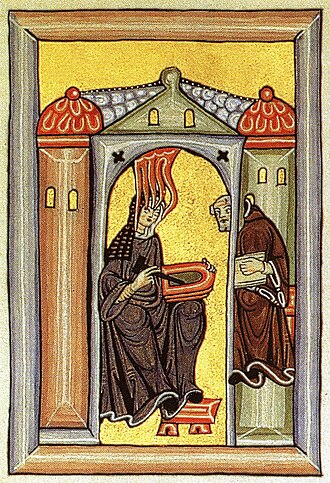
The Sybil of the Rhine
Welsh: Winefride of Holywell, Cadoc of Llancarfan
Germans: Gertrude of Helfta, Herman the Cripple, Hildegarde of Bingen, the Sybil of the Rhine
Austrians/Swiss: Nicholas von Flue, Jakob Gapp
Scandinavians: Willehad of Denmark, Hallvard of Oslo, Bridget of Sweden, Thorlak Thorhallsson of Iceland
Balts: George Matulaitis
Magyars: King Istvan the Great, Elizabeth of Hungary
Czechs: Good King Wenceslaus, Agnes of Bohemia
Poles: Hyacinth Ronzki, Stanislaus Szczepanowski, Mother Mary Theresa Ledochowska, Pope John Paul the Great
Albanians: Mother Theresa of Calcutta
Slovenes: Lojze Grozde
Serbs: Sava
The Lily of the Mohawks
Croats: Mark Korosy
Romanians: Ieremia Stoica
Bulgars: Bishop Eugene Bossilkov
Russians: Olga of Kiev, Sergius of Radonezh, Euphrosyne of Polotsk
Native Americans: Kateri Tekakwitha, the Lily of the Mohawks, Black Elk of the Oglala, Juan Diego Cuauhtlatoatzin of Guadeloupe
Puerto Ricans: Carlos Manuel Rodríguez Santiago 
Mexicans: María Guadalupe García Zavala, “Mother Lupita”, Bartholomew Laurel, Padre Pio, José María Robles Hurtado and the Martyrs of the Christero War   
Central Americans: Peter Betancurt of Guatemala, Bishop Oscar Romero of El Salvador
Peruvians: Rose of Lima, Ana de los Angeles Monteagudo
Ecuadorians: Mercedes of Jesus, Mariana de Paredes, the Lily of Quito
Brazilians: Pauline of the Agonizing Heart of Jesus, Antonio de Santa Ana Galvao
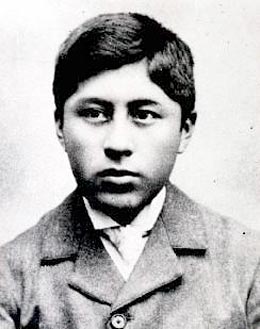
The Lily of Patagonia
Paraguayans: Roque Gonzalez de Santa Cruz
Argentinians: Ceferino Namuncurá, the Lily of Patagonia 
Chileans: Teresa of the Andes, Alberto Hurtado Cruchaga 
Americans [USA]: John Nepomucene Neumann, Elizabeth Seton, Katherine Drexel, Mother Frances Cabrini
Canadians: Marguerite D’Youville, Mary Rose Durocher 
Indians: Alphonsa Mattahupadathus, Kuriakose Chavara, Mother Mariam Thresia Chiramel Mankidiyan
Chinese: Thaddeus Lieu, Agnes Sao Kuy
Japanese: Father Thomas Hioji Rokuzayemon Nishi, Magdalene of Nagasaki
Koreans: Agatha Kim, Paul Chong Hasang
Thais: Philip Siphong, Sister Lucy Khambong
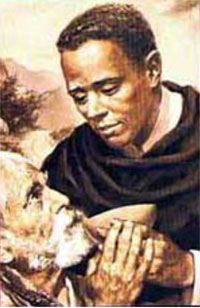
Martin de Porres
Vietnamese: Vinh Sơn Phạm Hiếu Liêm, Micae Hồ Đình Hy, Agnes De, Father John Dat
Filipinos: Lorenzo Ruiz
Australians: Mary of the Cross
African diaspora: Benedict the Moor, Martin de Porres
Africans: Charles Lwanga of Uganda, Mother Josephine Bakhita of the Sudan, Anwarite Nengapeta of the Congo
Polynesians: Victoria Rasoamanarivo of Madagascar


A: Jesus said, “Go, therefore, and make disciples of all nations, teaching them all that I have commanded you.” 
℟: And there before me was a great multitude which no one could count, from every nation, race, people, and tongue, standing before the throne and before the Lamb.

Monday, October 23, 2017

Science in Danger!

A bunch of fringe elements are attacking the very roots of science using dubious "facts" taken from sacred texts.

No, not those fringe elements. The other ones, the ones that are taken seriously within the academy, by which we mean feminists.

One day professors of gender theory and critical studies will critically study discourses for implicit and explicit values and elitist norms and determine quantitatively that the stance and interdiscursivity of the syllabus descriptions do not privilege masculinist values; but that day is not this day.

Evidence presented by the prosecution:

1. Ståhl, Marie and Anita Hussénius. "Chemistry inside an epistemological community box! Discursive exclusions and inclusions in Swedish National tests in Chemistry." Cultural Studies of Science Education (2016) pp. 1-29.

Abstract: This study examined the Swedish national tests in chemistry for implicit and explicit values. The chemistry subject is understudied compared to biology and physics and students view chemistry as their least interesting science subject. The Swedish national science assessments aim to support equitable and fair evaluation of students, to concretize the goals in the chemistry syllabus and to increase student achievement. Discourse and multimodal analyses, based on feminist and critical didactic theories, were used to examine the test’s norms and values. The results revealed that the chemistry discourse presented in the tests showed a traditional view of science from the topics discussed (for example, oil and metal), in the way women, men and youth are portrayed, and how their science interests are highlighted or neglected. An elitist view of science emerges from the test, with distinct gender and age biases. Students could interpret these biases as a message that only “the right type” of person may come into the chemistry epistemological community, that is, into this special sociocultural group that harbours a common view about this knowledge. This perspective may have an impact on students’ achievement and thereby prevent support for an equitable and fair evaluation. Understanding the underlying evaluative meanings that come with science teaching is a question of democracy since it may affect students’ feelings of inclusion or exclusion. The norms and values harboured in the tests will also affect teaching since the teachers are given examples of how the goals in the syllabus can be concretized.

2. Parson, Laura. (2016). "Are STEM Syllabi Gendered? A Feminist Critical Discourse Analysis." The Qualitative Report, 21 (1), 102-116.

Abstract: This study explored the gendered nature of STEM higher education institution through a feminist critical discourse analysis of STEM course syllabi from a Midwest research university. I explored STEM syllabi to understand how linguistic features such as stance and interdiscursivity are used in the syllabus and how language and discourses used in the syllabus replicate the masculine nature of STEM education. Findings suggest that the discourses identified in the syllabi reinforce traditional STEM academic roles, and that power and gender in the STEM syllabi are revealed through exploration of the themes of knowledge, learning, and the teaching and learning environment created by the language used in the syllabus. These findings inform and extend understanding of the STEM syllabus and the STEM higher education institution and lead to recommendations about how to make the STEM syllabus more inclusive for women.

TOF is astonished to learn that in Sweden chemistry tests -- excuse me -- "the chemistry discourse presented in the tests" showed "a traditional view of science" by discussing topics like oil and metal. Who knew these were chemicals? If one wonders at the shortage of women among metallurgical and petrochemical engineers, look no further than feminist professors.

Fortunately, discourse analysis and multimodal analysis "based on feminist and critical didactic theories" were used. Presumably, these were calibrated to the relevant ISO standards prior to the analyses.

Parson in the second reference also used "discourse analysis," which appears to mean counting whether and how often certain words were used in the course syllabus descriptions. Apparently, some people pay attention to these things. Technical-sounding terms like "stance" and "interdiscursivity" are used to give it all a patina of objectivity, due to the curse of scientism infecting all of post-modernity. TOF is not sure what "findings" means when one always finds what one sets out to find a priori. In technical fields one sometimes discovers surprises, and this may form a sort of disconnect for those who regard such things as a form of false consciousness or even oppression.
Example of discourse analysis
http://www.gocomics.com/dilbert-classics/2017/10/22

Notes for the perplexed. The paper defines the term: "interdiscursivity is the use of elements in a text that carry institutional and social meaning from other discourses (Afros & Schryer, 2009). Syllabi reflect the conventions, values and practices of neighboring discourses and communities that are identifiable, in part, through content-specific terminology (Afros & Schryer, 2009). Specifically, the discourses that syllabi refer to are college teaching (e.g., learning objectives) and discipline-specific languages/terminology (Afros & Schryer, 2009). Connecting to larger discourses about STEM education and teaching is often accomplished through interdiscursivity." Now you know all that TOF knows about interdiscursivity, which seems to be a fancy, pseudotechnical term for using common words like "learning objectives."  TOF also does not know why the same reference text was mentioned three times in the same definition, but without page references. 

Sunday, October 22, 2017

Her Earliest Bow Upon the World's Stage

THE WELL-LADEN SHIP by Egbert of Liege was written between 1010 and 1026, as a classroom text in Latin for his young students at the cathedral school at Liege, where he taught the trivium. TOF is sore tempted to say that he was a trivial teacher, save that he had a brilliant notion. Observing that it was difficult to teach his young charges the intricacies of Latin -- though Latin was notably less intricate in the 11th c. than it had been in Cicero's more convoluted day -- Egbert decided that he could better teach the little terrors darlings by creating a reader with proverbs and folk tales with which they were already familiar in the vernacular. He wrote it, as he explained, "not for those who are already perfected to manly strength by careful attentive reading, but for those timid little boys still subject to discipline in school; so that, when their teachers are absent, while that band of youths is babbling to one to one another certain ditties (though none of them to any purpose) in order to sharpen somewhat their meager talent by practicing and frequently chanting those little verses, at such times they might rather use these."

Thus, instead of chanting in the absence of magisterial authority,
"I see Paris. I see France. I see Childeric's underpants."
They could instead recite
"Dum deerit cattus, dicurrens conspicitur mus."

That way, already knowing what the Latin meant, they could more easily grasp its forms. He divided the text into two parts: the Bow and the Poop. The Bow apparently consisted of pithy quotations and proverbs and the Poop of stories and fables. Since these texts were all hand-written, there could not have been very many of them, but an original copy survives and was translated fairly recently.

 Among the proverbs are some with a familiar ring:
  • While the cat’s away, the mouse is seen scurrying about.
Dum deerit cattus, dicurrens conspicitur mus.
  • When a horse is offered for free, you should not open its mouth.
Gratis equo oblato non debes pandere buccas.
  • I’ve never see a wagon go when placed in front of the oxen.
Ante boves versum non vidi currere plaustrum.
  • One ought to strike iron while it’s hot.
Dum calidum fuerit, debetur cudere ferrum.
 The currency of these proverbs -- Don't put the cart before the horse! When the cat's away, they mice will play! Don't look a gift horse in the mouth! -- indicate how deeply rooted in the medieval our culture is.

BUT ONE OF THE MOST INTERESTING TIDBITS in the Well-Laden Ship, indicating how well-laden indeed she is, is the following fable, set in unrhymed dactylic hexameters. Egbert says that it is a rendering of a tale he had heard told among the peasants -- though one doubts he heard them tell it in dactylic hexameters. Remember, Latin poetry traditionally based itself on the length of syllables, not on stress, although in Late Latin, stress was coming into use.

This tale marks the first appearance in literature of one of our enduring heroines: 

First, in Latin:
De puella a lupellis seruata
Quod refero, mecum pagenses dicere norunt,
Et non tam mirum quam ualde est credere uerum:
Quidam suscepit sacro de fonte puellam,
Cui dedit et tunicam rubicundo uellere textam;
Quinquagesima sancta fuit babtismatis huius.
Sole sub exorto quinquennis facta puella
Progreditur, uagabunda sui inmemor atque pericli,
Quam lupus inuadens siluestria lustra petiuit
Et catulis predam tulit atque reliquit edendam.
Qui simul aggressi, cum iam lacerare nequirent,
Ceperunt mulcere caput feritate remota.
"Hanc tunicam, mures, nolite", infantula dixit,
"Scindere, quam dedit excipiens de fonte patrinus!"
Mitigat inmites animos deus, auctor eorum.
In English:

Concerning the Girl Saved from the Wolf Cubs
The story I tell, the country folk know how to tell me,
and it is not so much marvelous to believe as it is very true.
A certain man raised a girl from the sacred font,
and he gave her a tunic woven from red wool.
Shrove Sunday was the holy day of this baptism.
When the sun had rise, the girl now five years old
set out wandering, heedless of herself and of danger.
A wolf attacked her and headed for his woodland haunts;
and he took her as prey to his cubs and left her to be eaten.
They approached her, and gnawed at her cap; but unable to tear it,
they began to caress her head, their fierceness having been allayed.
The little infant said, “Oh mice, don’t rip this tunic
which my godfather gave me, taking me from the font!”
God, their creator, softens savage souls.
That's right, sports fans, it's Little Tunicam Rubicundo, Little Red Cape, making her first appearance in recorded history! And wearing her red Pentecostal baptismal cloak, too, which protects her from the devil-wolves of the dangerous woods. So much for Michel Foucault and the red hood representing menstrual blood and her sexual awakening. (Why are Moderns and Postmoderns so obsessed with their pelvises! An Early Modern French version has Red stripping naked and hopping in bed with the Wolf and ends with a warning not to do that.)
In early medieval Europe, baptisms were performed twice a year: at Easter and Pentecost, but the trend was toward more frequent baptism dates to protect the children as early as possible. 

The story was elaborated as time went on. In an episode from a Norse saga, in which Freyja has been betrothed to a giant named Thrym, Thor disguise himself as Freyja and goes with Loki (disguised as a serving maid) to a banquet thrown by Thrym. The giant grows suspicious and asks many questions about his bride-to-be.
“Why are Freyja’s eyes so sharp?” Thrym calls to [Loki]. “They burn me like fire.”
“Oh” said the cunning serving-maid [Loki], “she has not slept for a week, so anxious has she been to come here, and that is why her eyes are so fiery.”
How Old is Little Red Riding Hood?: Tales Over Time, by Gwen Thurston Joy

Interestingly, some of the earliest versions present a more resourceful Red (or Granny, when she makes an appearance) than the more modern ones. She doesn't have to be rescued by woodcutters or hunters. But all of them, including Granny (who came from a separate story-tradition) were later additions. The original story of Red was simple and unadorned tale of an innocent beset by evils and protected by God's providence.


The Earliest Little Red Riding Hood Tale
November 10, 2013 by Medievalists.net 

A Fairy Tale from before Fairy Tales: Egbert of Liège's "De puella a lupellis seruata" and the Medieval Background of "Little Red Riding Hood" Jan Ziolkowski
Source: Speculum, Vol. 67, No. 3 (Jul., 1992), pp. 549-575

Published by: Medieval Academy of America
Stable URL: http://www.jstor.org/stable/2863656
 

Prometheus Awards: Read & Watch

 Hello Friends & Fans of Michael Flynn,       The Libertarian Futurist Society has made available the text of the acceptance speech Dad...