is a trade-off with bipartisan efforts to pick our pockets.
http://reason.com/blog/2018/09/28/while-you-were-watching-kavanaugh-congre
Saturday, September 29, 2018

Meanwhile
For some reason, the internet here at the rehab does not allow Facebook through its door, so anyone looking for the usual tidbits will have to come here. If you like you can share that info at my Book of Faces. I don't know when I can get back on.
The Manhattan Contrarian has a post up about the Kavanaugh kerfuffle and how it fits in with the strategy of overturning the previous election. (He does not point out how it furthers the Russian agenda of discrediting democratic procedures by interposing essentially autocratic stalls and blocks.)
Apparently, among the Usual Suspects
there is the near total lack of interest in recent, credible, well-corroborated reports of physical abuse of two women by the Vice Chair of the Democratic National Committee, who is also the Democratic candidate for Attorney General of Minnesota.So these sorts of charges generate national news depending on who is accused -- and how old and obscure the charges are.
Wednesday, September 26, 2018
Not on your life.
Epicurus and Euripides have Tea in Shrewsbury College
No comment needed.Regularly, twice a year, some British Government minister gives certain formulaic and ritual undertakings.
Apparently there is so much violence against girls - of thirteen years or even as young as eleven - including a great deal of sexual violence from boyfriends - that the government is going to take action. What sort of action? Somehow reinforcing patterns of parental control? Ensuring that parents know how their young are dressed and where they're going and what they're doing and who they're with and what time they come home? A long and up-hill struggle to reintroduce patterns of courtship and of gradualism in the development of relationships? Seminars for the young on Modesty?
Not on your life. They will take the same action as they promised six months ago. Children aged five (or three?) and upwards are to be taught in school about the wrongness of violence against females.
Sex and drink need ritual. They need inherited and formalised restraints. For, as Euripides taught the Athenians in their theatre, Aphrodite and Dionysus are dangerous gods. If you don't believe me, ask Hippolytus or Pentheus. When you fail to treat the divinities with respect, they take you to the cleaners. What is wrong with our society is not that the schools fail adequately to drive home the imperatives of political correctness; it is that members of the cultural elite have in the last generations prided themselves on destroying the restraints and deriding the rituals; and now the gods have descended upon them, as they did upon that Hideous Strength, and, my goodness, with what a vengeance. And those elites don't like it. And the only remedy they seem to be capable of discerning is the ancient mantra: "Doctor says keep on taking the pills". But what the Modern Girl needs is not more skill in contraception and better access to abortifacients, but careful lessons on how to entertain the Modern Boy to Tea.
And there can never have been a society which knew so little about hedone - real pleasure. I doubt if our culture of binge drinking delivers half the pleasure of wine approached with respect and drunk in accordance with archaic rituals (I know you will remember the Alec Guinness clergyman character in Kind Hearts and Coronets reminding the visiting 'bishop' that "The decanter is with you, my Lord").
And I doubt if our culture of instant polybonk delivers a tenth of the pleasure of wondering whether she really meant to brush your hand with hers as she offered you another sandwich.
Saturday, September 1, 2018
Tarachódocracy
 |
| Beasts and their young in travel cages. |
It suffices for an intransigent minority –a certain type of intransigent
minority –to reach a minutely small level, say three or four percent
of the total population, for the entire population to have to submit to
their preferences.
-- Nassim Nicholas Taleb, "The Most Intolerant Wins: The Dictatorship of the Small Minority"
 |
| Note that the lion is not shown pouncing upon the zebra. Although the zebra warily keeps the elephant between them. |
This change came about at the behest of PETA, which apparently believed the old retro circus art was somehow double-plus ungood and possessed the causal power to entail extinctions. It did not come about because of a groundswell of grassroots demand. This illustrates a curious point:
Change comes about from instransigant minorities within societies, not from the majority or the "consenseus." This is not because the minority convinces the majority, but because there is frequently an asymmetry in choices.
 |
| Ratchets permit motion in only one direction. |
One example of the Ratchet is kosher soft drinks. Almost all beverages are kosher. The reason is that those who keep kosher will drink nothing else, while those who do not don't care one way or the other. Since the cost differential in minimal and those who insist on kosher are scattered throughout the population, bottlers find it much cheaper to just make everything kosher than to keep two inventories. (That is not always true for other rules; or for intransigant minorities who are concentrated in a few areas, or if the cost differential is large.)
 |
| National Helium Reserve |
 |
| Some folks don't trust GMO foods |
Islam prevailed in the heartland of Christianity because of a Ratchet. If a Christian [or other non-muslim] man married a muslim woman, he had to convert. (Christian woman could be kept by muslims without converting.) But any children would have to be raised muslim, and no convert could revert under pain of death. This ensured that all changes in religion were one-way; and even if the original converts had done so cynically to avoid taxes or some other burden, their grandchildren were likely to be sincere.
In the US, the "minority rule" is still largely compartmentalized. On most issues, the several states must decide for themselves. If, as some wish, the country became a unitary state rather that a federation (often expressed by "reforming" the Electoral College) then tarachódocracy would preveil acoss the nation and a stubborn minority could impose their desire on the whole country rather than on say Texas alone.
Nicholas Rashevsky, the "father" of mathematical biophysics, also wrote a book applying mathematics to historical processes, including what later became "tipping point" theory and incorporated the idea of "partisan" groups who could never be won over. But Warren Weaver, in his discussion of complexity in science, wrote that "organized complexity" consisted not only of many individual units but also the interrelationships among them. Readers my recognize thia as matter and form. Such systems were beyond the organizing power of mathematics or statistics or even human intuition and had to be grasped through models. But "all models are wrong," and the outputs of them are likely to be Wrong. Taleb points out that "in complex systems the ensemble behaves in way not predicted by the components." These are called emergent behaviours, or formal causes. That's because the connections among the units matter more than the units themselves. [See Warren Weaver, "Science and Complexity," American Scientist, 36:536 (1948)]
All good ideas originate with some small initial group that will not take No for an answer. The trouble is, all bad ideas start the same way.
All of this bodes ill for the long-term survival of the Republic. Tolerance of free speech means tolerating even those calling for the banning of some speech, and tarachódocracy means their views will come to dominate. Such minorities cannot or will not ever concede.
Reference
Rashevsky, Nicholas. Looking at History through Mathematics, The MIT Press (1968)
Taleb, Nassim Nicholas. "The Most Intolerant Wins: The Dictatorship of the Small Minority,"
Weaver, Warren. "Science .and Complexity," American Scientist, 36:536 (1948)
Thursday, August 16, 2018
Is God Made of Soap?
Ninth Article
Is God made of soap?
We proceed thus to the Ninth Article:
Objection 1: It would seem that God is made of soap. For whatever is highest in a genus must be predicated of God. But the highest in the genus of cleanliness, which the Philosopher says is next to godliness, is soap.
Objection 2: Moreover, Scripture says, "Wash me, and I shall be clean indeed." But it belongs to soap to wash.
Objection 3: Furthermore, Dionysius says in On the Divine Names, "For the being of the Most High, being beyond Being, which is what is, can only be denied, as of foamy lather that surpasses even the most excellent conception." But the principle of foamy lather is soap, and where the effect is found, there must the principle be posited.
On the contrary is the opinion of Saint Augustine, who says, "I did wander long among vain fancies, thinking that thou wert as the soap that cleanseth all things, and that evil was a grimy blot on thy purity."
I answer that, 'Soap' can be said in two ways. In one way, soap is the material principle of cleanliness as such. But we have already shown that there is no material principle in God. Therefore, God is not made of soap. But in another way, 'soap' is said of whatever is highest in the order of efficient causes directed towards cleanliness secundum quid by an order that is less than formal with respect to the finality of an end, simply as such, without respect of quiddity in potentiality to the sensitive appetite. And in this sense all men say that God is made of soap, and that in the highest degree, as is plain from the definition.
Reply Obj. 1: Soap is not the highest in the genus of cleanliness, as the Saponians heretically maintain, but only in the genus of material ablutions, which is related to cleanliness in the way that principles of natural reason are related to the eternal law, as the Psalmist says, "How shall a young man cleanse his way? By keeping to your law."
Reply Obj. 2: Scripture also says, "I will wipe away every tear from their eyes." But soap is an efficient cause of tears, and not of their remotion. Therefore, God is not made of soap.
Reply Obj. 3: In this place Dionysius understands 'foamy lather' in accordance with the way of remotion, so that it implies only the lack of such qualities as are inconsistent with foamy lather, as shortness of duration and irritation to the skin.
This lost part of the Summa was discovered by Thomas Williams (Assistant Professor of Philosophy, Iowa) while a graduate student at Notre Dame.
Tuesday, August 7, 2018
The Singing City
Just sold a short story to Analog, entitled "The Singing City. The opening paragraphs are:
All during the party Theresia has been remarkably subdued. Oh, she has smiled at all the right jokes and chatted with all her guests, but Bill has seen her smile wink out the moment she thinks no one is watching. It is as if her face were a moon, reflecting the gaiety of those around her, but not shining through its own inner fires. Who can blame her, he thinks. It must be hard to bid a husband farewell. He remembers how his own father had been absent for months at a time, and how bravely his mother had borne it.
His eyes, dancing across the crowded family room, pick out his father’s curly, silver-white hair and sun-darkened face where he sits and talks wise words with the other old men. Rehashing the good old days, as such men always did; though Ed Mercado has a great many more days worth the hashing than most.
His father will not be around much longer, Bill realizes with a sudden pang. When you lived hard, you wore out faster.
His father notices his regard and tips his bottle of El Presidente toward him. Bill waves and moves off to the edge of the crowd. Everybody says how wonderful it must be having a hero for a father, but they hadn’t been there. They hadn’t known of the long absences and the strange, skinny man who would reappear from time to time to bend down and, laughing, swoop him into the air. Or the schoolyard fights, obliged to defend his father’s honor against those who felt equally as obliged to belittle it. What did your Dad do in the Crisis? Nothing much. Saved the world once or twice, but that’s all. Later, as he matured, Bill learned that there had been other men and women, thousands of them, and many had done and sacrificed far more than Dad. And yet, every morning when he looks into the mirror to shave, Bill Mercado does not see “Flaco” there.
The Singing City
by Michael F. Flynn
All during the party Theresia has been remarkably subdued. Oh, she has smiled at all the right jokes and chatted with all her guests, but Bill has seen her smile wink out the moment she thinks no one is watching. It is as if her face were a moon, reflecting the gaiety of those around her, but not shining through its own inner fires. Who can blame her, he thinks. It must be hard to bid a husband farewell. He remembers how his own father had been absent for months at a time, and how bravely his mother had borne it.
His eyes, dancing across the crowded family room, pick out his father’s curly, silver-white hair and sun-darkened face where he sits and talks wise words with the other old men. Rehashing the good old days, as such men always did; though Ed Mercado has a great many more days worth the hashing than most.
His father will not be around much longer, Bill realizes with a sudden pang. When you lived hard, you wore out faster.
His father notices his regard and tips his bottle of El Presidente toward him. Bill waves and moves off to the edge of the crowd. Everybody says how wonderful it must be having a hero for a father, but they hadn’t been there. They hadn’t known of the long absences and the strange, skinny man who would reappear from time to time to bend down and, laughing, swoop him into the air. Or the schoolyard fights, obliged to defend his father’s honor against those who felt equally as obliged to belittle it. What did your Dad do in the Crisis? Nothing much. Saved the world once or twice, but that’s all. Later, as he matured, Bill learned that there had been other men and women, thousands of them, and many had done and sacrificed far more than Dad. And yet, every morning when he looks into the mirror to shave, Bill Mercado does not see “Flaco” there.
Sunday, July 29, 2018
Numbers, We Got Numbers.
Or not.
Biology is sorely deficient in math when compared to physics or chemistry, and is therefore a sort of Junior Varsity member of Team Science -- at least from the 18th century, Scientific Revolutionary perspective. You may recall that one of the Pillars of that Revolution was the privileging of Mathematics as the Language of Discourse for Science. See Descartes for details. (It is possible to quibble with those details -- after all, if the only tool you allow yourself is a hammer, all you will ever see is a nail, and by restricting themselves to what was mathematically "visible," the Scientists blinded themselves to that which was not measurable.) And so we have equations for Newton's Theory, Maxwell's Theory, Boyle's Theory, Einstein's Theory, and sundry others. But we have, alas, no equations expressing Darwin's Theory.
Fair is fair. Math does show up here and there in biology, usually in biophysics and biochemistry. It appears also in genetics, which was pioneered by Br. Gregor Mendel, trained as a physicist be it noted, who conducted a real, no-foolin' designed experiment, the first in all biology. One also sees biostatistics. But statistics is not mathematics and a regression equation, though it bears a passing resemblance to a mathematical equation, is not actually of the same species. Think of it as mimicry. This distinction is a topic for another day, except that the softer the science, the worse its statistical praxis. And when the science is social the praxis gets downright mushy, usually learned via cookbooks in "Stats 101" courses.
Which brings us to today's topic: correlation. Ever since David Hume, correlation has held pride of place over causation due to the inability of inductive reasoning ever to establish causes. It establishes only a co-relation between two (or more) variables measured on the same unit. Thus, it requires:

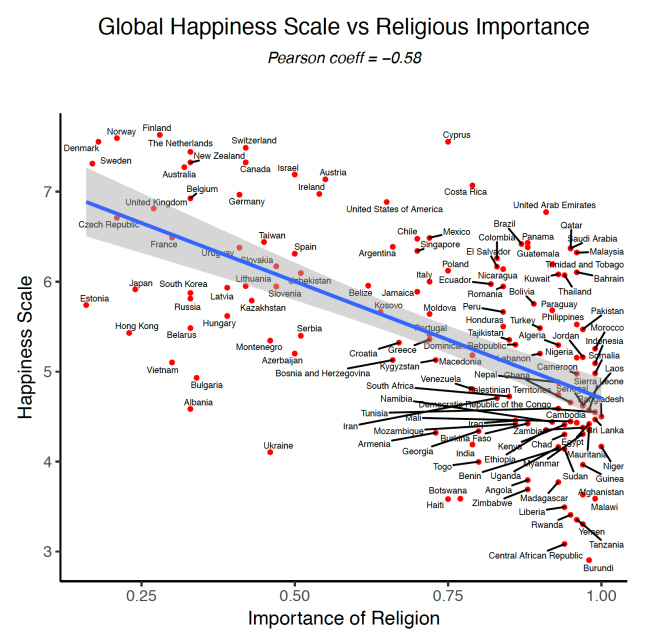 We note first of all that the author of the graph (who was not Coyne) is unfamiliar with Edward Tufte's classic work, The Visual Display of Quantitative Information. Fair enough, since the display is not, strictly speaking of quantitative information at all.
About 1000 people were surveyed in each country in each year. The reported happiness results are the combined results for all the years from 2014-2016. (Although not all countries were surveyed in every year.) Results from multiple years were combined in order to tighten the confidence interval via larger nominal sample sizes. A confidence interval is a mythic figure regarding a parameter of a statistical distribution. Multiple surveys can be combined in this manner only if there has been no substantive change in the population during the time when the various samples were taken, nor any change in the manner of data collection.³ Otherwise, you may be averaging apples and oranges.
The Happiness Scale was measured [sic] using the Cantril life ladder. The English Language version of the key question runs as follows.
That's right, it's all about feelz.
Note that the life ladder begs the question of what the "best possible life" means to different people, especially in different cultures. One easily imagines countries in which the "best possible life" is not very good at all; but one also imagines situations in which access to television has introduced formerly happy people to the life of Western Europeans and the sin of envy, which is defined as unhappiness at the good fortune of others.
The original survey also asked about other factors, such as: GDP, life expectancy, social support ("If you were in trouble, do you have relatives or friends you can count on to help you whenever you need them, or not?"), generosity ("Have you donated money to a charity in the past month?"), corruption perception ("Is corruption widespread throughout the government [or throughout business] or not") etc. Collectively, the UN Report claims, these factors account for nearly all the variation in happiness in the world.
Ordinal in the Court! The Happiness Scale is an ordinal scale, not a ratio scale. A response of "10" on the ladder does not mean that the respondent is twice as happy as someone answering "5". Not like 10 cm. is twice as long as 5 cm., or 10Ω is twice as resistant as 5Ω. This is an illusion created by the imagery of the "ladder" and its "rungs." Without a ratio scale, the whole procedure of averaging and correlating is bogus from the get-go.⁴
It is not clear what the steps on the "ladder scale" mean. A happiness of "8" is eight whats? Not volts, TOF is sure. Happiness is said to "light up a room," so perhaps eight lumens? But TOF doubts it.
Did happiness ratings within a country form a single statistical population? If not, there may be no average for that country. Consider the paste weights of battery grids which were made at different times using different batches of paste, milled fortuitously at different densities. The resulting weights had two distinct averages, not one: those grids pasted prior to 4:00 PM and those pasted after the batch change.
 If you stick your head in the oven and your feet in the freezer, on the average you're comfortable.
An average is a measure of central tendency, and not all processes have a central tendency. In that sense, there is no average, even if you can calculate one. What is the central tendency of the number of testicles possessed by human beings? But we digress.⁵
Most of the same points apply to the religiosity scale. What exactly is "importance of religion"? What is meant by a "religion"? Is shamanism even the same kind of thing as Buddhism? In those countries possessing established churches, citizens are enrolled in the approved churches for tax purposes, whether they attend church or not. Does this count? Does pro forma attendance? Does the devoutness of the attendees? Who measures such subjective attitudes? How do they do so? With what precision? Does "religiosity" mean the same thing in China as it does in Bolivia?⁶ Some folks like to point out that atheistic countries like the quondam Soviet Union are "really" religious because communism is "really" a religion. (See Midgley, Evolution as a Religion for a discussion.)
Notice that an individual may regard "religion" (broadly speaking) as "important" (broadly speaking) even if he himself is not a believer.
It is not clear what the scale measures, except that it appears to be a proportion running from 0.00 to 1.00. If so, it is at least a ratio scale.
These religiosity "data" were not collected in the same survey as the happiness "data." That is, the X and Y "measurements" were not performed on the same units. And yet a correlation was performed!
Imagine trying to determine the relationship between the nitrogen content and tensile strength of steel if the two properties were not measured on the same heats of steel. Even a biologist might hesitate to rely on such results -- even if he did not notice the metallurgist rolling on the floor laughing his guts out. As a thought experiment, imagine Coyne's reaction to a correlation between cancer rates in US census districts versus the usage of lawn services in those same districts, with no attempt to discover whether the households experiencing the cancers were the same households employing the lawn services!
Another issue to be considered is whether one should treat all countries as equal units when they vary widely in size: Singapore is small and compact; Brazil is not.
The reported correlation coefficient is r= ‒0.58. No self-respecting engineer would entertain such a value or r for a New York minute, although TOF has been told that soft "scientists" put much stock in any r greater than zero, provided they have wee p-values. This can be ascribed to their training in "cookbook statistics". But let it be said that you can have a very high "confidence" around a very wrong value. A confidence interval is a statement about the precision of an estimate, not about its accuracy, let alone its appropriateness. An r= ‒0.58 means an r²= 0.34. This means that only about one-third of the variation-among-countries in happiness is "explained" by its association with religiosity of those countries. (Whatever that means.)
It is not clear that the scatterplot is a hot dog or a hamburger with a tail. That is, the weak appearance of a correlation is due to multiple clusters of points. The vast majority of points form an amorphous ball on the right. A second cluster in the northwest consists of Western Europe and a third cluster in the southwest consists of Eastern Europe and East Asia. This is a common pattern on scatterplots.
Apparent correlations between X and Y can indeed come about when:
 The
correlation in the left hand plot apparently shows that errors decrease
with increasing workload on the clerks. The managers were delighted. To
reduce errors we will give the clerks more work! But wait. There were
two clerks: Adam and Betsy. Betsy was more experienced. She got more
work done and made fewer errors than Adam. There was a causal
relationship, but it was not between X and Y! It was between Z
and X and between Z and Y. (In the actual case, there were four clerks.
The case has been simplified for presentation purposes.)
These are all technical issues associated with the use of the statistics; but there are also substantive issues associated with the hypothesis supposedly being tested.
Everyone gives lip service to the fact that correlation is not causation, but then turns around and acts as if it were. The Coynester is no exception to this rule and chortles over the "fact" that religion does not result in happiness for its practitioners. (Notice the leap in logic here. That is not even what the data is supposed to show. These are countries, not people.) But why should anyone suppose that "religiosity" however defined should be expected to entail "happiness" however defined? It may be the opposite case: unhappiness may entail religiosity, at least of certain types. Recall
Notes
5. lurking cause. A nice article on the subject is Brian Joiner. "Lurking Variables: Some Examples." The American Statistician 35(4): 227-233 (Nov 1981)
Biology is sorely deficient in math when compared to physics or chemistry, and is therefore a sort of Junior Varsity member of Team Science -- at least from the 18th century, Scientific Revolutionary perspective. You may recall that one of the Pillars of that Revolution was the privileging of Mathematics as the Language of Discourse for Science. See Descartes for details. (It is possible to quibble with those details -- after all, if the only tool you allow yourself is a hammer, all you will ever see is a nail, and by restricting themselves to what was mathematically "visible," the Scientists blinded themselves to that which was not measurable.) And so we have equations for Newton's Theory, Maxwell's Theory, Boyle's Theory, Einstein's Theory, and sundry others. But we have, alas, no equations expressing Darwin's Theory.
Fair is fair. Math does show up here and there in biology, usually in biophysics and biochemistry. It appears also in genetics, which was pioneered by Br. Gregor Mendel, trained as a physicist be it noted, who conducted a real, no-foolin' designed experiment, the first in all biology. One also sees biostatistics. But statistics is not mathematics and a regression equation, though it bears a passing resemblance to a mathematical equation, is not actually of the same species. Think of it as mimicry. This distinction is a topic for another day, except that the softer the science, the worse its statistical praxis. And when the science is social the praxis gets downright mushy, usually learned via cookbooks in "Stats 101" courses.
Which brings us to today's topic: correlation. Ever since David Hume, correlation has held pride of place over causation due to the inability of inductive reasoning ever to establish causes. It establishes only a co-relation between two (or more) variables measured on the same unit. Thus, it requires:
- measurements
- on the same units

"There can be no science of any hard empirical variety when the very act of identifying one’s object of study is already an act of interpretation, contingent on a collection of purely arbitrary reductions, dubious categorizations, and biased observations. There can be no meaningful application of experimental method. There can be no correlation established between biological and cultural data."An example recently promoted by "The Gift that Keeps on Giving," a.k.a. Jerry Coyne, is that "the happiest countries are the least religious." It is itself a happy¹ illustration of Thucydides' dictum that people will swallow anything if it accords with their prior beliefs.² Also that experts who wander off their reservation are no more insightful than the rest of us fools. Herewith, the evidence in chief as cited by the True Coyne:
-- David Bentley Hart, "Daniel Dennett Hunts the Snark"
Notes:
1. happy. Lucky, fortunate. See also mayhap, happen, happening, happenstance; also hapless.
2. Thucydudes, History of the Peloponnesian War, Book IV, 108
Happy, Happy! Joy, Joy!
The Coynester has committed the scientific gaffe of reifying abstractions: to wit: both happiness and religious. Countries cannot be "happy" (or "religious"), only human beings can be either. Perhaps Coyne meant that "the majority of the people in country X" are happy, but this raises the question of how this can be known. How were they contacted? By sample? Was the sample randomized? Stratified? In some countries, folks do not have telephones; indeed, in some countries they do not have street names or addresses. In some, they do not have streets. How do you randomly sample in Burkina Faso? Is it as straightforward as in Singapore? San Jose, Costa Rica, has streets, but the houses are not numbered. How does one identify a sampling frame from which to select random units? Did the data collector even bother to do so? And, if not, in what manner could the results be generalized from the sample to the target population? Allow TOF to express Profound Doubts on these points. To learn that these data were collected by Gallup is encouraging, although that they were gathered under UN auspices is not.About 1000 people were surveyed in each country in each year. The reported happiness results are the combined results for all the years from 2014-2016. (Although not all countries were surveyed in every year.) Results from multiple years were combined in order to tighten the confidence interval via larger nominal sample sizes. A confidence interval is a mythic figure regarding a parameter of a statistical distribution. Multiple surveys can be combined in this manner only if there has been no substantive change in the population during the time when the various samples were taken, nor any change in the manner of data collection.³ Otherwise, you may be averaging apples and oranges.
Notes.Next, how do you measure "happiness"? With a hap-o-meter? (Preferably one calibrated to a standard certified by NIST). This is perhaps more evidently a problem to a physicist than to a biologist or a social "scientist." The latter in particular is conditioned to accept a questionnaire as an "instrument" and to confuse the answers to a suite of questions with a "measurement." And indeed, so it happened.
3. combining surveys. For example, suppose in the prior year there had been much anticipation that candidate X would be elected and usher in the eschaton because the Opposing Party had been cozened into nominating a Bull Goose Loser. But then in the following year, the Bull Goose Loser unaccountably has won the election, causing much weeping and tooth-gnashing. There might be a sea change in happiness, at least within some strata of the population.
The Happiness Scale was measured [sic] using the Cantril life ladder. The English Language version of the key question runs as follows.
“Please imagine a ladder, with steps numbered from 0 at the bottom to 10 at the top. The top of the ladder represents the best possible life for you and the bottom of the ladder represents the worst possible life for you. On which step of the ladder would you say you personally feel you stand at this time?
That's right, it's all about feelz.
Note that the life ladder begs the question of what the "best possible life" means to different people, especially in different cultures. One easily imagines countries in which the "best possible life" is not very good at all; but one also imagines situations in which access to television has introduced formerly happy people to the life of Western Europeans and the sin of envy, which is defined as unhappiness at the good fortune of others.
The original survey also asked about other factors, such as: GDP, life expectancy, social support ("If you were in trouble, do you have relatives or friends you can count on to help you whenever you need them, or not?"), generosity ("Have you donated money to a charity in the past month?"), corruption perception ("Is corruption widespread throughout the government [or throughout business] or not") etc. Collectively, the UN Report claims, these factors account for nearly all the variation in happiness in the world.
Looking ahead, none of these factors included "religiosity." Hence, there was no "room" in the model for religion to account for happiness positively or negatively. Naturally, this stopped Coyne and his religious enthusiasts in their tracks.Ho, ho. TOF jests. One meaningless social science exercise does not forestall another.
Ordinal in the Court! The Happiness Scale is an ordinal scale, not a ratio scale. A response of "10" on the ladder does not mean that the respondent is twice as happy as someone answering "5". Not like 10 cm. is twice as long as 5 cm., or 10Ω is twice as resistant as 5Ω. This is an illusion created by the imagery of the "ladder" and its "rungs." Without a ratio scale, the whole procedure of averaging and correlating is bogus from the get-go.⁴
It is not clear what the steps on the "ladder scale" mean. A happiness of "8" is eight whats? Not volts, TOF is sure. Happiness is said to "light up a room," so perhaps eight lumens? But TOF doubts it.
Did happiness ratings within a country form a single statistical population? If not, there may be no average for that country. Consider the paste weights of battery grids which were made at different times using different batches of paste, milled fortuitously at different densities. The resulting weights had two distinct averages, not one: those grids pasted prior to 4:00 PM and those pasted after the batch change.

An average is a measure of central tendency, and not all processes have a central tendency. In that sense, there is no average, even if you can calculate one. What is the central tendency of the number of testicles possessed by human beings? But we digress.⁵
NotesHoly Mackerel!
4. ratio scale. See Deming, The Statistical Adjustment of Data for discussion.
5. testicles. The average is just less than one. Half of all humans have zero. The other half usually have two, but there are occasional accidents and elective surgeries.
Most of the same points apply to the religiosity scale. What exactly is "importance of religion"? What is meant by a "religion"? Is shamanism even the same kind of thing as Buddhism? In those countries possessing established churches, citizens are enrolled in the approved churches for tax purposes, whether they attend church or not. Does this count? Does pro forma attendance? Does the devoutness of the attendees? Who measures such subjective attitudes? How do they do so? With what precision? Does "religiosity" mean the same thing in China as it does in Bolivia?⁶ Some folks like to point out that atheistic countries like the quondam Soviet Union are "really" religious because communism is "really" a religion. (See Midgley, Evolution as a Religion for a discussion.)
Notice that an individual may regard "religion" (broadly speaking) as "important" (broadly speaking) even if he himself is not a believer.
It is not clear what the scale measures, except that it appears to be a proportion running from 0.00 to 1.00. If so, it is at least a ratio scale.
These religiosity "data" were not collected in the same survey as the happiness "data." That is, the X and Y "measurements" were not performed on the same units. And yet a correlation was performed!
Notes
6. cross-country comparisons should be made with great care because different countries often use different operational definitions of the variables. Infant mortality is a well-known example. Even within a country, definitions sometimes change. See the discussion sections in the Historical Abstracts of the United States for examples.
Rules of Engagement
A vital issue: Were the happiness and the religiosity "measured" on the same units (people) or only within the same geographical region (country)?Imagine trying to determine the relationship between the nitrogen content and tensile strength of steel if the two properties were not measured on the same heats of steel. Even a biologist might hesitate to rely on such results -- even if he did not notice the metallurgist rolling on the floor laughing his guts out. As a thought experiment, imagine Coyne's reaction to a correlation between cancer rates in US census districts versus the usage of lawn services in those same districts, with no attempt to discover whether the households experiencing the cancers were the same households employing the lawn services!
Another issue to be considered is whether one should treat all countries as equal units when they vary widely in size: Singapore is small and compact; Brazil is not.
The reported correlation coefficient is r= ‒0.58. No self-respecting engineer would entertain such a value or r for a New York minute, although TOF has been told that soft "scientists" put much stock in any r greater than zero, provided they have wee p-values. This can be ascribed to their training in "cookbook statistics". But let it be said that you can have a very high "confidence" around a very wrong value. A confidence interval is a statement about the precision of an estimate, not about its accuracy, let alone its appropriateness. An r= ‒0.58 means an r²= 0.34. This means that only about one-third of the variation-among-countries in happiness is "explained" by its association with religiosity of those countries. (Whatever that means.)
Hot Dogs and Hamburgers
A correlation coefficient, so beloved by soft "scientists" is almost meaningless. Among the assumptions built into the woodwork is the assumption that the data come from a statistical population. That is, that the data represent a constant system of common causes. But out in the wilds, we most often encounter mixtures of populations: units produced at different times, from different material lots, under different operational conditions. Sometimes these differences have no practical effect on the measurement of interest, but sometimes they do. You cannot leave that to assumption. TOF has seen cases where it mattered who the operator was who ran the machine, or made the measurement, or even what time of day. And if these muck up manufactured product, where the output is supposed to be uniform and to specifications, how much more so wild data which is under no such domesticated obligation?It is not clear that the scatterplot is a hot dog or a hamburger with a tail. That is, the weak appearance of a correlation is due to multiple clusters of points. The vast majority of points form an amorphous ball on the right. A second cluster in the northwest consists of Western Europe and a third cluster in the southwest consists of Eastern Europe and East Asia. This is a common pattern on scatterplots.
Apparent correlations between X and Y can indeed come about when:
- X is a cause of Y
- Y is a cause of X
- Z is a lurking cause⁵ of both X and Y
- coincidence

These are all technical issues associated with the use of the statistics; but there are also substantive issues associated with the hypothesis supposedly being tested.
Everyone gives lip service to the fact that correlation is not causation, but then turns around and acts as if it were. The Coynester is no exception to this rule and chortles over the "fact" that religion does not result in happiness for its practitioners. (Notice the leap in logic here. That is not even what the data is supposed to show. These are countries, not people.) But why should anyone suppose that "religiosity" however defined should be expected to entail "happiness" however defined? It may be the opposite case: unhappiness may entail religiosity, at least of certain types. Recall
Notes
5. lurking cause. A nice article on the subject is Brian Joiner. "Lurking Variables: Some Examples." The American Statistician 35(4): 227-233 (Nov 1981)
Subscribe to:
Posts (Atom)
Prometheus Awards: Read & Watch
Hello Friends & Fans of Michael Flynn, The Libertarian Futurist Society has made available the text of the acceptance speech Dad...

-
TOF once wrote an article entitled "The Great Ptolemaic Smackdown and Down 'n Dirty Mud-Wrassle" which described the century-l...
-
 Previously: Part 8, Trial and Error From Plausible to Proven The great dishonesty of Galileo’s Dialogue was to present a contes...
-
 Hello family, friends and fans of Michael F. Flynn. It is with sorrow and regret that I inform you that my father passed away yesterday,...
